
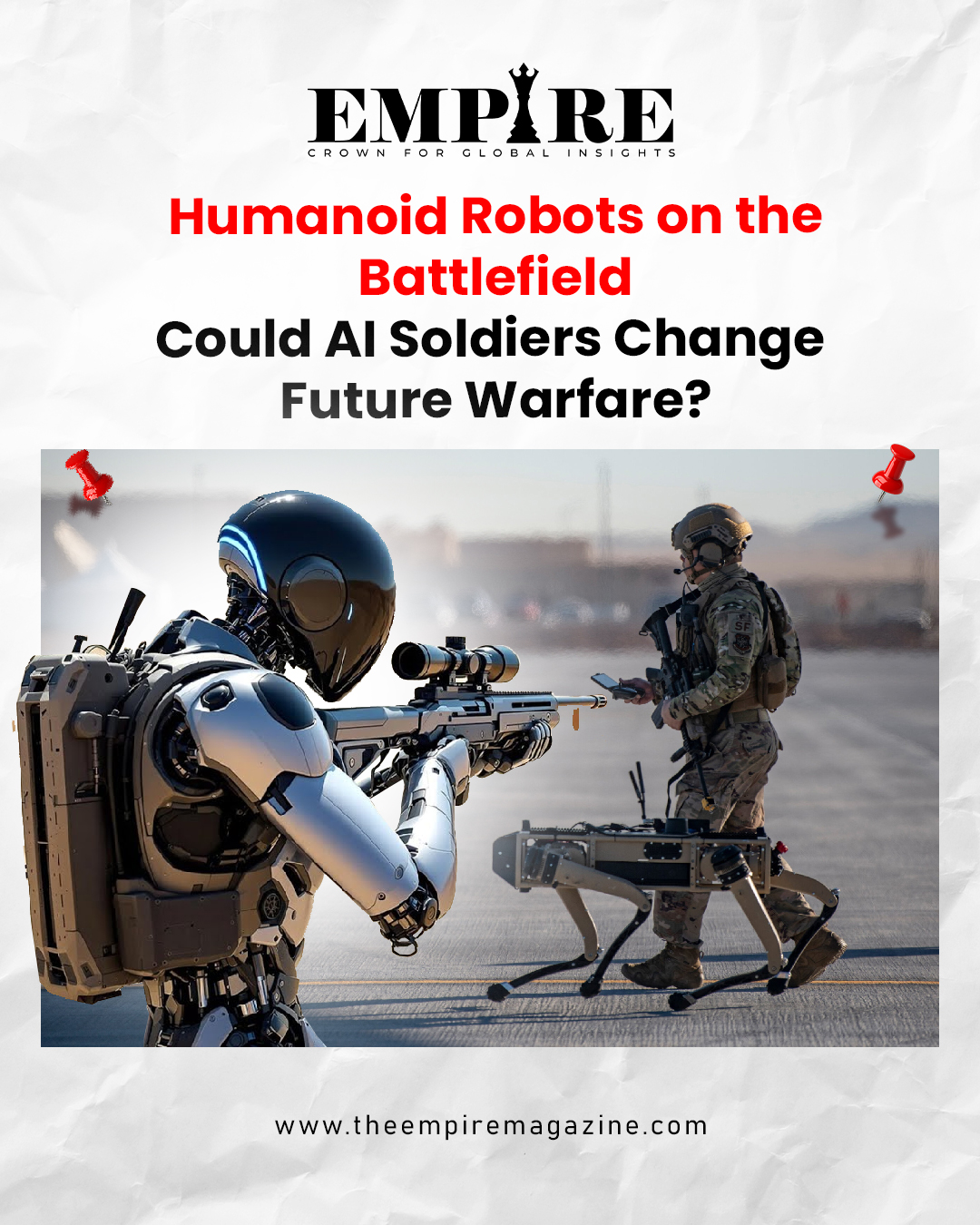
Humanoid Robots on the Battlefield are becoming a serious question as artificial intelligence, robotics, drones, and autonomous systems move deeper into modern defense planning. For many years, humanoid robots were mostly seen in science fiction, research labs, factory demonstrations, and consumer technology events. Today, the idea of human-shaped machines supporting military missions is no longer only imagination.
The battlefield is already changing. Drones are used for surveillance, targeting, supply delivery, and electronic warfare. Unmanned ground vehicles are being tested and deployed for logistics, casualty evacuation, reconnaissance, and dangerous front-line tasks. The next question is whether humanoid robots could join this shift by working in environments built for humans, carrying tools, opening doors, climbing stairs, moving through buildings, or supporting soldiers in high-risk situations.
This does not mean armies are ready to replace human soldiers with humanoid machines. Current humanoid robots still face major limits in mobility, battery life, reliability, cost, safety, and battlefield survivability. However, rapid progress in AI, computer vision, sensors, teleoperation, and robotic movement is pushing defense planners to take the idea more seriously.
Humanoid Robots on the Battlefield and the Rise of Defense Automation
Humanoid Robots on the Battlefield are part of a larger movement toward defense automation. Military forces around the world are trying to reduce risk to human soldiers by using machines for dangerous or repetitive tasks. This includes drones in the air, unmanned vehicles on the ground, robotic systems for bomb disposal, and autonomous software for surveillance and decision support.
Ukraine has become one of the most visible testing grounds for battlefield robotics. The war has shown how quickly drones and unmanned systems can change tactics. Ground robots are being used or tested for moving supplies, evacuating wounded soldiers, carrying equipment, and operating in areas too dangerous for people.
Humanoid robots could eventually fit into this trend, but they are more complex than wheeled or tracked ground robots. A humanoid form has advantages in human-built environments, but legs, arms, balance, and full-body movement make the system harder to engineer.
Why Militaries Are Interested in Humanoid Robots
Militaries are interested in humanoid robots because many battlefield environments are designed around human movement. Buildings, stairs, vehicles, ships, tunnels, doorways, and tools are made for human bodies. A humanoid robot could theoretically operate in these spaces more easily than a wheeled machine.
A humanoid robot could carry supplies, inspect dangerous areas, open doors, move through rubble, assist with casualty evacuation, or support logistics inside bases and urban environments. These tasks do not require the robot to replace a soldier in combat. They could still reduce risk by keeping humans away from mines, drones, snipers, fire, collapsed structures, or contaminated zones.
The strongest near-term use cases are likely support roles. Logistics, reconnaissance, base security, maintenance, and medical support may come before direct combat. This is because support tasks are easier to control and carry fewer ethical risks than armed autonomous engagement.
Human-Shaped Robots for Human Spaces
The main advantage of humanoid robots is form factor. A human-shaped machine can use human-designed spaces and tools. It can walk through standard doors, climb certain stairs, carry objects with arms, and interact with equipment already built for people.
This matters in military settings because redesigning every environment for robots is unrealistic. Bases, vehicles, buildings, ships, and field infrastructure already exist. A humanoid robot could fit into those environments without requiring completely new layouts.
However, this advantage comes with major engineering challenges. Walking on uneven ground, balancing under load, recovering from falls, and operating in mud, dust, smoke, rain, and damaged buildings are difficult even for advanced robots. Battlefields are far harsher than clean demonstration spaces.
The Role of AI in Military Robotics
Artificial intelligence is the reason humanoid battlefield robots are becoming more realistic. AI helps robots understand surroundings, recognize objects, plan movement, process sensor data, and assist human operators.
Computer vision allows robots to identify obstacles, people, vehicles, doors, stairs, and terrain. Machine learning can improve locomotion and balance. AI planning systems can help robots carry out tasks with less direct human control. Teleoperation allows a human operator to guide the robot remotely while the robot handles some movement and stability.
In defense settings, AI must be handled carefully. Military robots need clear command structures, safety limits, cybersecurity protection, and human oversight. A robot that makes mistakes in a factory may damage equipment. A robot that makes mistakes in a conflict zone can create far more serious consequences.
Human Control and Ethical Limits
One of the biggest debates around battlefield robots is human control. Most serious defense discussions focus on keeping humans involved in decisions involving force. This is especially important for armed systems.
Humanoid robots could be used for non-lethal support tasks first because those uses are easier to govern. Carrying supplies, inspecting damaged buildings, transporting equipment, or helping evacuate wounded personnel do not raise the same ethical questions as autonomous weapons.
Still, even non-lethal robots must be regulated. They collect data, move near people, operate in dangerous settings, and may be targeted by enemies. Militaries must decide how much autonomy is acceptable, who is responsible for mistakes, and how robots should behave around civilians.
Why Ukraine Has Accelerated Battlefield Robotics
The war in Ukraine has accelerated interest in battlefield robotics because both sides face heavy drone use, artillery threats, and dangerous front-line conditions. Robots can reduce exposure by performing tasks that would otherwise require soldiers to enter high-risk areas.
Unmanned ground vehicles are already more practical than humanoids in many battlefield roles. Wheeled and tracked robots can carry heavier loads, move across rough terrain, and cost less than advanced humanoid machines. This is why ground robots are likely to scale faster than human-shaped robots.
However, humanoids may still become useful in specific situations. Urban warfare, underground facilities, damaged buildings, and human-designed infrastructure could create demand for robots with arms, legs, and human-like movement.
Commercial Humanoid Robots and Defense Interest
The commercial humanoid robot industry is growing quickly. Companies are building humanoids for factories, warehouses, logistics, healthcare support, and service work. These robots are not always designed for war, but the same technologies can attract defense interest.
Some startups are openly exploring military applications, while others focus only on civilian use. This creates an important policy challenge. A robot built for industrial work may still be adapted for security or defense tasks if governments or military contractors see value.
This is similar to the drone industry. Many drones began as commercial or hobbyist products but later became important tools in conflict zones. Humanoid robots may follow a slower version of the same path because they are more expensive and technically difficult.
Cost and Production Challenges
Cost is one of the biggest barriers to battlefield humanoids. A military needs systems that are reliable, repairable, and affordable enough to deploy in meaningful numbers. If a humanoid robot costs too much and fails easily, it will not be practical in combat conditions.
Battlefield robots must also survive shocks, weather, dust, electronic interference, and rough handling. They need spare parts, trained operators, repair teams, software updates, and secure communications. A robot that works well in a lab may struggle in a real war zone.
For this reason, simpler robots may remain more common for many years. Humanoids will need to prove they can do tasks that cheaper wheeled, tracked, or drone systems cannot do.
Cybersecurity Risks for Humanoid Robots
Humanoid robots are not only mechanical systems. They are computers with sensors, cameras, networks, software, and sometimes cloud connectivity. This creates cybersecurity risks.
If a military robot is hacked, spoofed, jammed, or manipulated, it could become dangerous or useless. Attackers might try to disrupt navigation, steal data, disable communications, or mislead the robot’s perception system.
Cybersecurity will therefore be central to any battlefield use of humanoid robots. Secure software, encrypted communications, protected update systems, and strong operator controls will be essential.
Could Humanoid Robots Replace Soldiers?
Humanoid robots are unlikely to fully replace soldiers soon. Warfare involves judgment, adaptability, leadership, ethics, communication, and human understanding. Robots may support soldiers, reduce risk, and take over certain dangerous tasks, but they are not close to replacing the full role of trained military personnel.
The more realistic future is mixed human-machine teams. Soldiers may work with drones, ground robots, sensors, and AI systems. Humanoid robots could become one tool inside this wider battlefield network.
In that future, the question is not whether robots replace soldiers completely. The question is which tasks are safer, faster, or more effective when assigned to machines.
Near-Term Battlefield Roles
The first practical roles for humanoid robots may include carrying supplies, inspecting buildings, moving equipment, assisting engineers, supporting base operations, or helping with casualty evacuation. These missions can reduce risk without requiring fully autonomous combat.
Humanoids may also support training, simulation, maintenance, and security tasks. They could help test equipment, move through mock urban environments, or operate in spaces where human-shaped movement is useful.
Direct armed combat is more controversial and technically difficult. It raises serious ethical, legal, and safety questions. Any move toward armed humanoid systems would need strict rules and human command oversight.
What This Means for Defense Technology Startups
Humanoid robots on the battlefield could create a new opportunity for defense technology startups. Companies working in AI, robotics, sensors, mobility, teleoperation, and autonomy may find new military interest in their platforms.
Defense startups are already gaining attention as governments seek faster innovation. The rise of drones, AI command systems, autonomous vehicles, and robotic logistics shows that defense is becoming more connected to the technology industry.
However, startups entering defense robotics must manage responsibility carefully. Building tools for warfare is different from building warehouse automation. Safety, ethics, law, and accountability must be part of product development from the beginning.
The Future of Humanoid Robots in Warfare
Humanoid Robots on the Battlefield are not yet a normal part of military operations, but the direction is clear. Robotics is moving from support laboratories into real defense planning. Drones have already changed war from the air. Ground robots are beginning to change logistics and front-line support. Humanoids may become the next step if they can prove useful in human-built environments.
The future will likely include more robotic systems, but not all of them will look human. Wheeled robots, tracked vehicles, drones, and autonomous sensors may remain more practical for many missions. Humanoids will need to prove that their human-like shape gives them a real advantage.
For now, the most realistic battlefield role for humanoid robots is support, not replacement. They may carry equipment, enter dangerous spaces, assist with rescue, and reduce risk to soldiers. As AI and robotics improve, the debate will shift from whether they can be used to how they should be governed.
Readers can also explore more global disaster and infrastructure insights through this related article: Philippines Earthquake: At Least 35 Dead After Major Quake Hits Mindanao.
For more updates from The Empire Magazine, follow us on Facebook and Instagram.
– The Empire Magazine
Crown For Global Insights