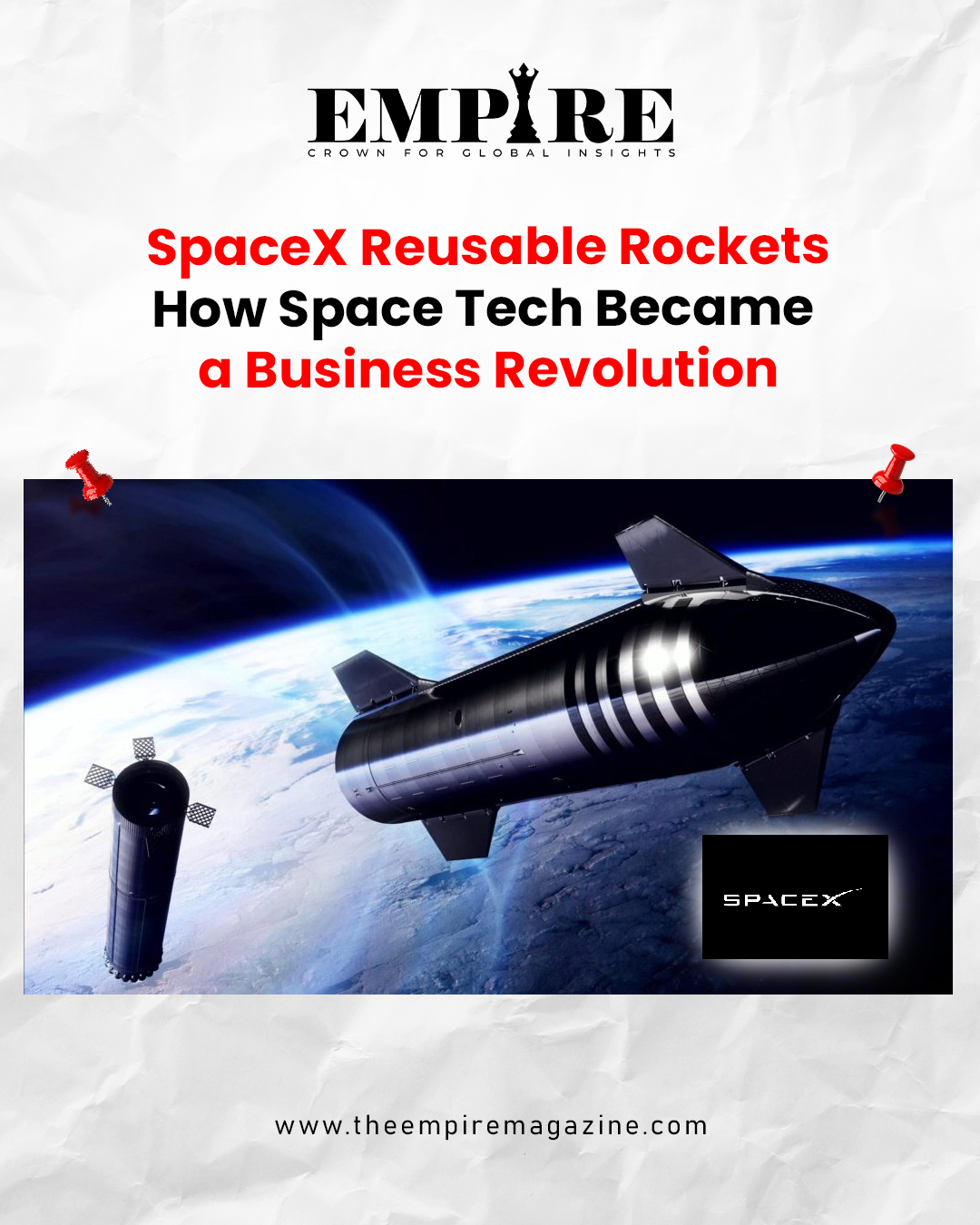
SpaceX Reusable Rockets have changed the economics of spaceflight and turned rocket reusability from a technical dream into a major business advantage. For decades, rockets were mostly used once and then discarded. That made every launch extremely expensive because the most valuable parts of the vehicle were lost after a single mission.
SpaceX changed that model with Falcon 9. The company built a rocket that could launch payloads to orbit, return its first stage, land vertically, and fly again. This shift did not only affect engineering. It changed the business of space by reducing launch costs, increasing launch frequency, supporting satellite networks, and creating a new competitive standard for the global space industry.
The first successful orbital-class Falcon 9 booster landing happened in December 2015. Since then, booster landings and reflights have become routine parts of SpaceX missions. What once looked experimental is now a core part of modern launch operations.
SpaceX Reusable Rockets and the New Space Economy
SpaceX Reusable Rockets are important because they helped create the modern commercial space economy. Before reusable boosters became practical, launch providers needed to build a new rocket stage for nearly every mission. This made launches costly, limited flight frequency, and slowed the growth of commercial space businesses.
SpaceX’s approach was different. The company treated the rocket booster as an asset that could be recovered, inspected, refurbished, and reused. This is similar to the way airlines reuse aircraft instead of throwing them away after one flight.
Reusability allowed SpaceX to fly more often and serve more customers. It helped the company launch satellites, cargo, crew missions, national security payloads, and Starlink satellites at a scale that few competitors could match. This launch cadence became one of SpaceX’s strongest business advantages.
Why Reusability Changed Rocket Economics
The first stage of a rocket is one of the most expensive parts of a launch vehicle. It includes engines, fuel tanks, structures, avionics, landing systems, and other major components. In a traditional expendable model, that stage falls into the ocean or burns up after launch.
By recovering the first stage, SpaceX can reuse expensive hardware. This lowers the need to build a completely new booster for every flight. It also gives the company more launch flexibility because a reused booster can return to service after inspection and preparation.
Lower launch costs matter for many industries. Satellite companies can deploy networks more affordably. Governments can send payloads to space more regularly. Scientific missions can become more accessible. Commercial space businesses can plan with greater confidence because launch is no longer as rare or expensive as before.
From Expensive Missions to Frequent Launches
Reusability changed the launch business from a low-frequency industry into a high-cadence service. SpaceX launches far more often than traditional launch companies did in earlier decades. This frequency helps the company gain operational experience, improve reliability, and build customer trust.
Frequent launches also support Starlink, SpaceX’s satellite internet network. Starlink requires thousands of satellites in low Earth orbit. Without reusable rockets and frequent launches, building and maintaining such a large constellation would be much more difficult and expensive.
This is one reason reusable rockets became a business revolution. They did not only improve one launch. They made entirely new business models possible.
Falcon 9: The Rocket That Proved Reuse Could Work
Falcon 9 became the vehicle that proved orbital-class rocket reusability could work at scale. The rocket is a two-stage launch vehicle designed to carry payloads into Earth orbit and beyond. Its first stage uses nine Merlin engines and is designed to return for landing after separation.
SpaceX first achieved a successful Falcon 9 first-stage landing on land in December 2015. Later, the company also developed drone ship landings at sea. Drone ship recovery is important because many missions require the booster to travel too far downrange to return to the launch site.
Over time, SpaceX improved booster recovery, refurbishment, and reflight. Boosters began flying multiple times, then ten times, then more than twenty times, and eventually beyond thirty flights for some vehicles. This showed that reuse was not only possible but operationally repeatable.
Drone Ships and Landing Technology
SpaceX’s drone ships are floating landing platforms positioned in the ocean. They allow Falcon 9 boosters to land after high-energy missions where returning to land would require too much fuel. The booster uses grid fins, engine burns, guidance systems, and landing legs to descend and touch down vertically.
This technology took years of trial and error. Early landing attempts failed, with boosters crashing or tipping over. But SpaceX continued testing until landings became routine.
Those failures were part of the business revolution. SpaceX accepted risk, learned quickly, and improved the system. This rapid engineering cycle helped the company move faster than many traditional aerospace programs.
Starlink and the Business Power of Reusable Rockets
Starlink is one of the clearest examples of why reusable rockets matter. The satellite internet business depends on launching large numbers of satellites into low Earth orbit. Satellites also need replacement over time, which means the launch requirement is ongoing.
Falcon 9 gives SpaceX the ability to launch Starlink satellites frequently. This vertical integration is powerful. SpaceX builds rockets, launches satellites, operates the Starlink network, and sells internet service to customers. Reusable rockets help support this entire business model.
Starlink has also become an important source of revenue for SpaceX. The service connects households, businesses, ships, aircraft, remote locations, and emergency operations. Without frequent and relatively lower-cost access to orbit, Starlink would be much harder to scale.
Commercial Customers and Market Disruption
SpaceX reusable rockets changed expectations for commercial launch customers. Satellite companies now expect lower prices, more frequent launch opportunities, and more flexible scheduling. This has put pressure on older launch providers around the world.
Before SpaceX, launch markets were dominated by government-backed or traditional aerospace companies. Many had slower launch rates and higher costs. SpaceX’s success forced competitors to rethink rocket design, pricing, production, and reusability.
Today, countries and companies around the world are developing reusable rockets. China, Europe, India, and private space startups are all studying or building reusable launch systems. This shows how strongly SpaceX influenced the industry.
Reusability as a Competitive Standard
Reusability is no longer seen as a futuristic idea. It is becoming a competitive standard. Launch providers that cannot reuse rockets may struggle to match SpaceX’s cadence and cost structure.
This does not mean every mission will use reusable rockets, and it does not mean expendable vehicles will disappear immediately. Some payloads and mission profiles may still require different approaches. However, the business direction is clear: reusable launch systems are now central to the future of space transportation.
SpaceX created this expectation by proving that reusability could work repeatedly in real commercial missions.
NASA, Crew Missions and Trust in Reused Hardware
SpaceX’s reusable rocket success also affected human spaceflight. Through NASA’s Commercial Crew Program, SpaceX developed Crew Dragon to carry astronauts to and from the International Space Station. Falcon 9 launches Crew Dragon, and SpaceX has flown crewed missions for NASA and private customers.
The use of Falcon 9 in human spaceflight shows how far reusable rocket technology has come. A system that was once experimental became trusted enough for high-value and high-risk missions.
NASA’s partnership with SpaceX also showed a new model for government and private industry cooperation. Instead of the government building every system directly, private companies could develop vehicles and provide transportation services.
Starship and the Next Stage of Reusability
Falcon 9 is partially reusable because the first stage can land and fly again, while the second stage is not recovered. SpaceX’s next major goal is full reusability through Starship and Super Heavy.
Starship is designed as a fully reusable transportation system for carrying crew and cargo to Earth orbit, the Moon, Mars, and other destinations. If SpaceX succeeds, full reusability could reduce costs further and increase payload capacity dramatically.
Starship is still in development and testing. The program has faced explosions, delays, regulatory reviews, and technical challenges. However, the ambition is clear: SpaceX wants to make space transportation more like an airline-style system, where vehicles can fly, return, refuel, and fly again.
Why Full Reusability Matters
Full reusability matters because the second stage also represents major cost and capability. If both stages can be reused, launch economics could change even more than Falcon 9 changed them.
A fully reusable heavy-lift system could support larger satellite networks, lunar missions, Mars plans, space stations, cargo transport, and new industries in orbit. It could also lower barriers for companies that want to build businesses beyond Earth.
This is why Starship is important even though it is still under development. It represents the next step in the same business revolution that Falcon 9 began.
The Business Revolution Beyond Rockets
SpaceX reusable rockets changed more than launch pricing. They changed how investors, governments, and entrepreneurs think about space. Lower-cost and frequent launches make it easier to imagine businesses based on satellites, Earth observation, communications, space manufacturing, defense systems, and deep-space exploration.
A startup building a satellite service can plan more confidently when launches are available more often. A government can deploy space infrastructure faster. A research team can send experiments to orbit with more options.
This is how rocket reusability becomes an economic platform. It supports many other businesses that depend on space access.
Risks and Challenges of Reusable Rockets
Reusable rockets still face challenges. Each booster must be inspected and prepared after landing. Engineers must monitor wear, heat damage, engine performance, structural stress, and flight history. Reuse is only valuable if safety and reliability remain strong.
SpaceX must also manage launch-site capacity, regulatory approvals, range availability, weather delays, customer requirements, and technical issues. High launch cadence creates operational complexity.
There are also environmental and community concerns around frequent launches, rocket noise, emissions, debris, and launch-site impact. As launch activity grows, regulators and communities will continue watching these issues closely.
How SpaceX Changed Global Space Competition
SpaceX changed global space competition by proving that private companies could build, launch, land, and reuse orbital-class rockets. This challenged older assumptions about government-led space programs and traditional aerospace timelines.
The company’s success pushed other countries and companies to accelerate their own reusable rocket plans. Reusability is now part of national space strategy for many governments because space access has become important for communications, defense, climate monitoring, navigation, and economic growth.
SpaceX Reusable Rockets turned space technology into a business revolution because they connected engineering breakthroughs with market demand. By making launch more frequent and reusable, SpaceX helped move space from a rare government activity toward a fast-growing commercial industry.
Readers can also explore more European digital sovereignty insights through this related article: Qwant: The French Search Engine Gaining Political Importance in Europe.
For more updates from The Empire Magazine, follow us on Facebook and Instagram.
– The Empire Magazine
Crown For Global Insights