
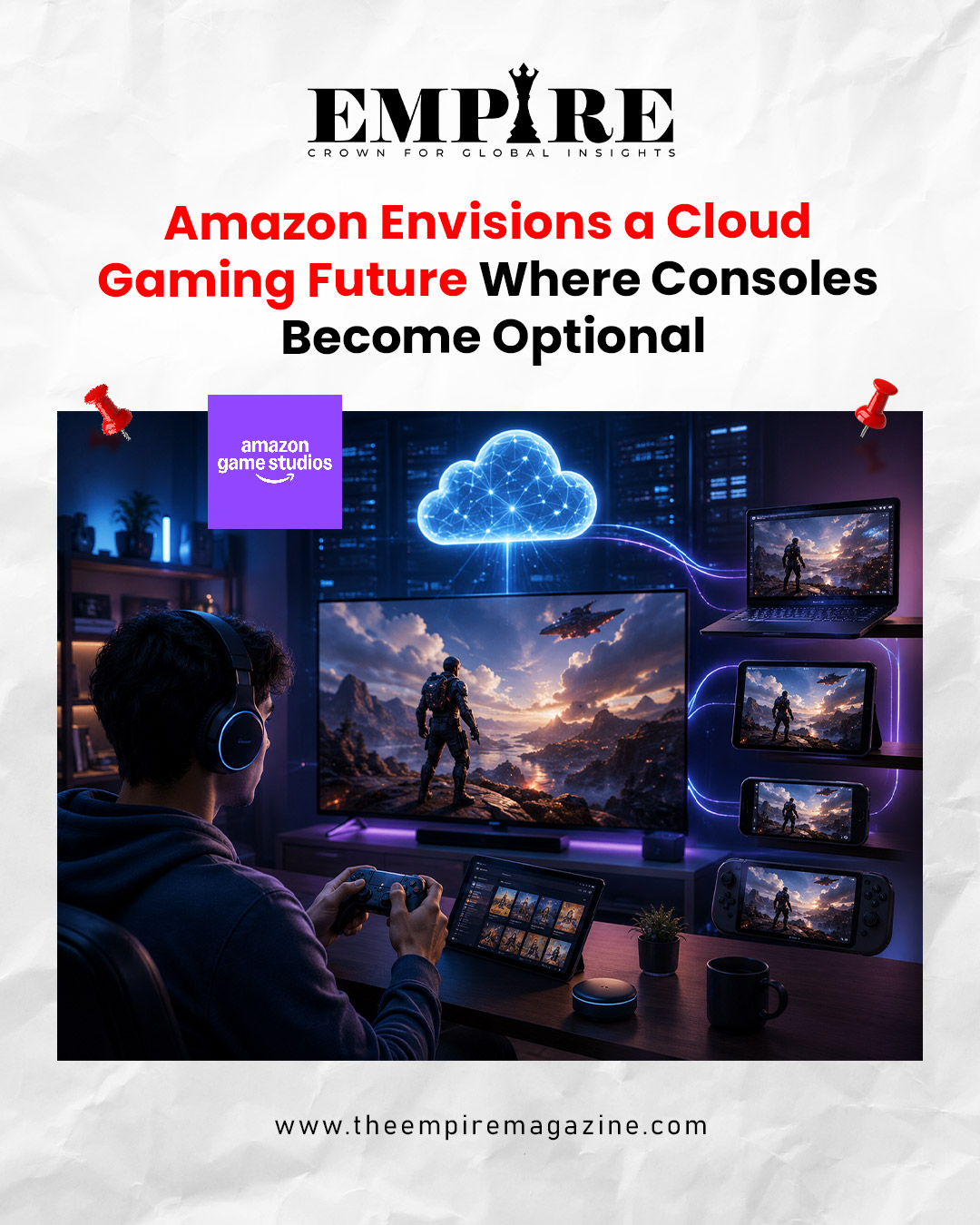
Amazon is accelerating its cloud gaming ambitions, signaling a future where expensive gaming consoles become optional. Explore what this means for gamers, developers, and the gaming industry.
Amazon Envisions a Cloud Gaming Future Where Consoles Become Optional
The gaming industry has always evolved alongside technological breakthroughs. From bulky arcade machines to compact home consoles and now powerful gaming PCs, every generation has changed how people experience entertainment. Today, another transformation is quietly gathering momentum, and this time it may redefine the very concept of owning gaming hardware. At the center of this shift is Amazon Cloud Gaming, a strategy that envisions a future where players no longer need expensive consoles to enjoy premium gaming experiences.
Amazon’s long-term investments in cloud infrastructure, artificial intelligence, and digital entertainment indicate that gaming is becoming another pillar of its connected ecosystem. Rather than persuading consumers to purchase increasingly expensive hardware every few years, Amazon believes computing power can remain inside massive cloud data centers while games are streamed directly to televisions, smartphones, tablets, laptops, and other connected devices.
This vision represents far more than a technological upgrade. It reflects changing consumer behavior, increasing internet speeds, and the growing popularity of subscription-based digital services. Just as music shifted from CDs to streaming and movies moved from DVDs to on-demand platforms, gaming may be approaching a similar turning point.
While consoles from Sony, Microsoft, and Nintendo continue to dominate the market today, Amazon is betting that convenience, accessibility, and cloud infrastructure could eventually become stronger competitive advantages than dedicated gaming hardware. Whether this prediction becomes reality remains uncertain, but the conversation surrounding cloud gaming has become one of the industry’s most significant developments.
Amazon Cloud Gaming Is Redefining Entertainment
The foundation of Amazon’s gaming vision lies in Amazon Luna, the company’s cloud gaming platform launched to demonstrate that games no longer need to run on local hardware. Instead, powerful servers process every action while the player’s device simply displays streamed visuals and sends controller inputs back through the internet. This approach significantly lowers the hardware barrier that has traditionally prevented many consumers from enjoying premium gaming titles. Instead of spending hundreds of dollars on a console before purchasing games separately, users can access large game libraries through subscriptions and compatible internet-connected devices. The strategy mirrors the evolution of video streaming platforms, where physical media gradually disappeared in favor of instant digital access. Amazon believes this convenience resonates with modern consumers who increasingly prioritize flexibility over ownership. As smart televisions, tablets, streaming devices, and smartphones become more powerful and internet connectivity improves worldwide, cloud gaming becomes increasingly practical for casual players while also attracting enthusiasts seeking seamless access across multiple devices. For Amazon, this represents an opportunity to integrate gaming into its broader digital ecosystem that already includes Prime memberships, Alexa, Fire TV, AWS, and numerous digital services.
Amazon Cloud Gaming Builds on AWS Strength
Unlike many competitors entering cloud gaming, Amazon possesses one of the world’s largest technological advantages through Amazon Web Services (AWS). Operating one of the most sophisticated cloud infrastructures globally provides Amazon with significant expertise in handling large-scale computing, storage, networking, and data processing. This infrastructure forms the backbone required for streaming demanding video games with minimal delay. Cloud gaming demands extremely low latency because every player input must travel to a server, be processed instantly, and return to the user’s screen without noticeable lag. AWS already powers thousands of businesses, streaming services, financial institutions, healthcare organizations, and enterprise applications, giving Amazon valuable experience in maintaining reliable global infrastructure. As data centers continue expanding across continents, Amazon can strategically position gaming servers closer to players, reducing latency and improving gameplay quality. Furthermore, the integration of artificial intelligence within AWS could enable smarter server allocation, predictive scaling during gaming peaks, and personalized recommendations based on player preferences. These technological advantages position Amazon uniquely within the competitive cloud gaming landscape, where infrastructure quality often determines the overall user experience more than the gaming platform itself.
Amazon Cloud Gaming Could Change Console Ownership
Perhaps the most disruptive implication of Amazon’s strategy is the possibility that dedicated gaming consoles may eventually become optional rather than essential. Traditionally, every gaming generation has required consumers to purchase new hardware before accessing the latest titles. This cycle has generated billions in revenue for console manufacturers while also creating financial barriers for many players. Cloud gaming introduces a different model where hardware becomes secondary because processing occurs remotely. Consumers simply need a compatible screen, stable broadband connection, and controller. This flexibility enables gamers to switch between devices seamlessly without losing progress or purchasing multiple copies of the same game. Families could share gaming experiences across televisions, laptops, and mobile devices using a single subscription. Students living away from home could continue gaming without transporting bulky consoles. Travelers could access premium games from hotel televisions or tablets. Such convenience aligns with broader digital trends where ownership increasingly gives way to accessibility. While console manufacturers continue introducing more powerful hardware, Amazon is encouraging consumers to rethink whether physical devices remain necessary at all. If internet infrastructure continues improving worldwide, the traditional console purchasing cycle could gradually lose its dominance.
Amazon Cloud Gaming Faces Real Challenges
Despite its ambitious vision, Amazon Cloud Gaming still faces significant hurdles before becoming the industry’s primary model. Internet reliability remains one of the biggest concerns, particularly in regions where broadband speeds fluctuate or data caps limit prolonged streaming sessions. Unlike downloaded games that continue functioning offline, cloud gaming depends entirely on stable, high-speed internet connections. Even minor latency spikes can negatively affect competitive games requiring split-second precision. Additionally, gamers often value ownership, offline accessibility, hardware customization, and physical collections preferences that cloud platforms may struggle to replace entirely. Competition also continues intensifying as Microsoft expands Xbox Cloud Gaming, NVIDIA strengthens GeForce NOW, and other technology companies invest heavily in cloud infrastructure. Developers must also optimize games specifically for cloud delivery, ensuring consistent performance across diverse internet conditions. Licensing agreements, subscription economics, regional server availability, and content exclusivity further complicate the business model. Amazon must therefore convince not only consumers but also publishers and developers that cloud-first distribution can generate sustainable long-term revenue while maintaining exceptional gaming quality.
Amazon Cloud Gaming Benefits Developers
Beyond consumer convenience, Amazon’s cloud gaming ambitions could reshape how games are created, distributed, and monetized. Developers may no longer need to optimize titles separately for numerous hardware configurations because processing occurs within standardized cloud environments. This could simplify development workflows while allowing studios to push graphical boundaries without worrying about hardware limitations inside consumers’ homes. Cloud platforms also generate valuable analytics that help publishers understand player behavior, engagement patterns, and performance metrics in real time. Such insights can improve game balancing, content updates, and personalized experiences. Smaller independent studios may benefit from easier global distribution since players can instantly access games without lengthy downloads or storage limitations. Subscription ecosystems could expose emerging developers to broader audiences who might otherwise hesitate to purchase unfamiliar titles individually. Amazon’s extensive commerce ecosystem may further support integrated game discovery, digital purchases, livestreaming, creator partnerships, and community engagement. As gaming increasingly overlaps with entertainment, e-commerce, and social interaction, Amazon’s interconnected ecosystem provides opportunities extending well beyond simply streaming games.
Amazon Cloud Gaming May Shape Gaming’s Next Era
The future of gaming will likely not be defined by a single winner but by multiple technologies coexisting to serve different audiences. Dedicated consoles will continue attracting enthusiasts who value maximum performance, exclusive titles, and local gaming experiences. However, cloud gaming offers compelling advantages for millions of players seeking affordability, flexibility, and convenience. Amazon understands that technological revolutions rarely happen overnight. Instead, they evolve gradually as infrastructure improves, consumer habits change, and digital ecosystems mature. By leveraging AWS, Amazon Luna, artificial intelligence, and its expansive entertainment ecosystem, the company is positioning itself for a future where gaming becomes as instantly accessible as streaming a movie or listening to music online. Whether consoles disappear entirely remains uncertain, but their exclusivity as the gateway to premium gaming is increasingly being challenged. As internet technology advances and cloud infrastructure expands globally, the definition of gaming hardware itself may continue to evolve. Amazon’s strategy is therefore not merely about launching another gaming platform; it is about redefining how games are accessed, experienced, and shared in an increasingly connected digital world. For players, developers, and the broader entertainment industry, Amazon Cloud Gaming represents more than a technological innovation—it symbolizes the beginning of gaming’s next major transformation, where accessibility may become every bit as valuable as processing power.
Amazon Cloud Gaming and AI Could Create Smarter Gaming Experiences
Another important dimension of Amazon Cloud Gaming is the role that artificial intelligence could play in enhancing the overall gaming experience. Amazon has invested heavily in AI across its business ecosystem, from personalized shopping recommendations to intelligent voice assistants, and similar capabilities could eventually become integral to cloud gaming. AI-powered matchmaking, adaptive game difficulty, personalized content recommendations, automated moderation, and predictive server management could significantly improve how players engage with games. Instead of offering the same experience to every user, cloud platforms may be able to tailor gameplay based on individual preferences, skill levels, and playing habits. Developers could also leverage AI to analyze player behavior in real time, helping them identify bugs, balance gameplay mechanics, and introduce updates more efficiently. As generative AI continues evolving, it may even assist in creating dynamic game worlds, intelligent non-playable characters (NPCs), and procedurally generated missions that adapt to every player’s decisions. By combining cloud infrastructure with AI capabilities, Amazon is positioning itself to deliver gaming experiences that are not only more accessible but also more personalized and immersive than traditional console-based gaming.
Amazon Cloud Gaming Could Expand Gaming Across Emerging Markets
One of the most promising opportunities for Amazon Cloud Gaming lies in expanding premium gaming to emerging markets where the cost of dedicated gaming consoles remains prohibitively high. In countries across Asia, Africa, and Latin America, many consumers own capable smartphones and affordable smart televisions but may not be willing or able to invest several hundred dollars in gaming hardware. Cloud gaming changes this equation by shifting the expensive computing requirements away from consumers and into centralized data centers. As broadband connectivity, fiber networks, and 5G infrastructure continue improving globally, millions of new gamers could gain access to high-quality gaming experiences without significant upfront investments. This democratization of gaming has the potential to introduce entirely new audiences to premium titles while enabling developers to reach markets that were previously difficult to penetrate. For Amazon, whose global business already spans e-commerce, cloud computing, logistics, and digital services, expanding cloud gaming into these regions aligns with its broader strategy of building interconnected digital ecosystems that encourage long-term customer engagement.
Will Amazon Cloud Gaming Replace Consoles Completely?
Despite Amazon’s ambitious vision, industry experts generally agree that traditional gaming consoles are unlikely to disappear in the immediate future. Dedicated hardware still offers advantages in terms of offline accessibility, ultra-low latency, local processing power, and ownership of physical game libraries. Competitive esports players, content creators, and gaming enthusiasts often demand the highest possible performance that locally powered systems currently provide. However, the future may not be about choosing between consoles and cloud gaming but rather allowing both models to coexist. Consumers could purchase consoles for exclusive titles while relying on cloud platforms for casual gaming, cross-device accessibility, or instant game trials without lengthy downloads. This hybrid model already reflects how people consume entertainment today—streaming services exist alongside cinemas, physical books continue alongside e-books, and digital music complements live performances. Amazon appears to recognize this reality, focusing less on eliminating consoles and more on making gaming available wherever consumers already spend their time. If cloud infrastructure continues advancing and internet reliability improves worldwide, the distinction between local and cloud gaming may gradually become invisible to users.
Conversation surrounding Amazon Cloud Gaming
The conversation surrounding Amazon Cloud Gaming extends far beyond the launch of another digital platform. It reflects a broader transformation in how entertainment is created, distributed, and consumed in an increasingly connected world. By leveraging the immense capabilities of Amazon Web Services, integrating artificial intelligence, and building a subscription-driven gaming ecosystem through Amazon Luna, the company is laying the foundation for a future where premium gaming is no longer tied to expensive hardware.
While technical challenges such as internet latency, infrastructure limitations, and fierce industry competition remain significant, the long-term trajectory of cloud gaming continues to gain momentum. Consumers increasingly value flexibility, affordability, and seamless access across multiple devices trends that strongly favor cloud-based experiences. At the same time, developers stand to benefit from simplified distribution, scalable infrastructure, and access to broader global audiences.
Whether gaming consoles eventually become optional or simply evolve into one part of a larger gaming ecosystem, Amazon’s vision is already influencing the direction of the industry. As cloud technology matures and connectivity becomes faster and more reliable, gaming may ultimately follow the same path as music, movies, and television, where access matters more than ownership.
For the global gaming community, Amazon Cloud Gaming is not merely a technological experiment. It represents a bold step toward making interactive entertainment more inclusive, more intelligent, and more accessible than ever before. The next generation of gaming may not arrive in the form of a new console sitting beneath the television, but through the cloud available instantly, anywhere, and on virtually any screen.
For more business and retail insights, read more on The Empire Magazine
Previous article: https://theempiremagazine.com/ai-safety-emergency-kill/
Magazine Feautures | Podcasts: Empire Global Talks
Follow The Empire Magazine on Facebook | Instagram | LinkedIn | YouTube
The Empire Magazine | Crown for Global Insights