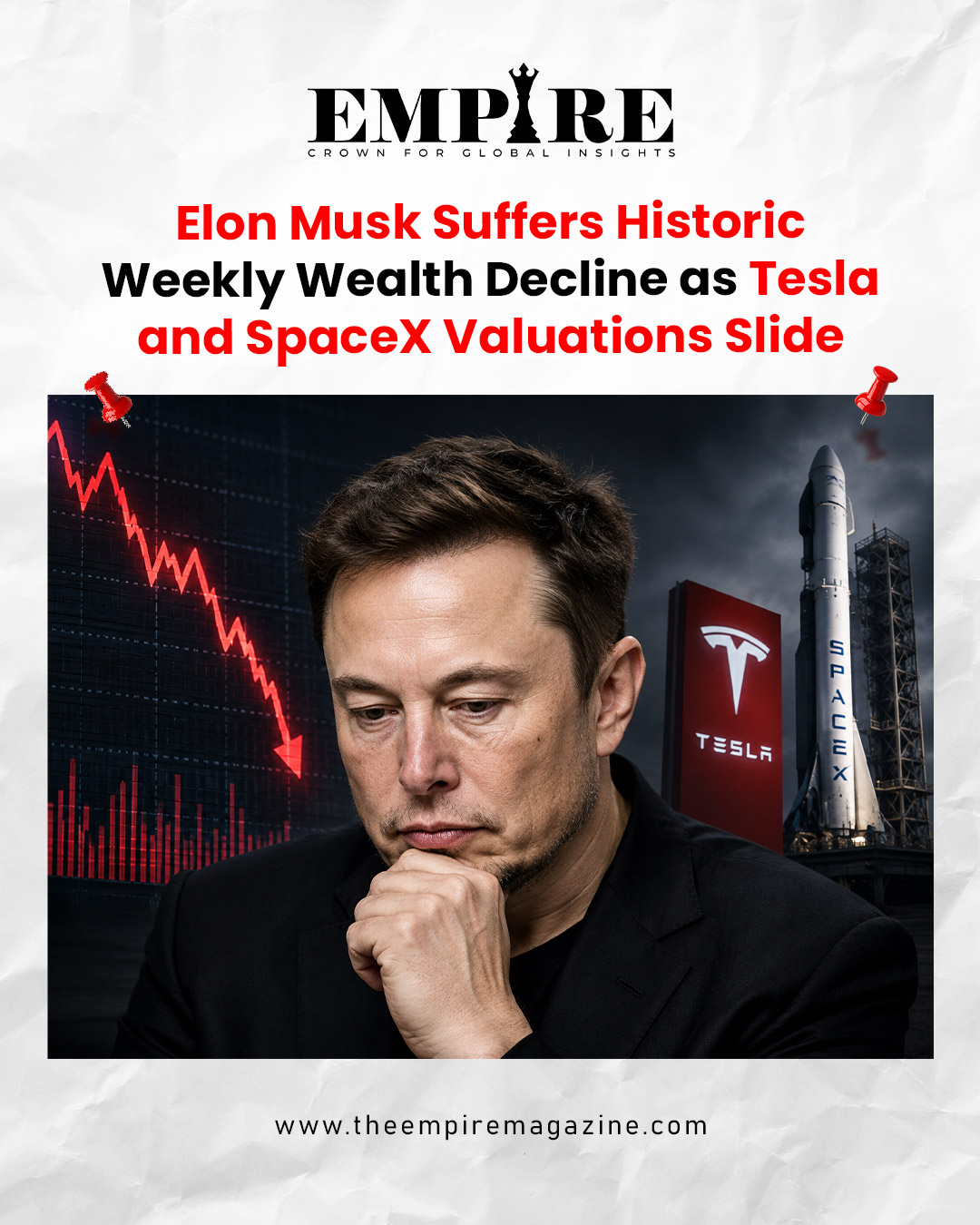
Elon Musk suffers a historic weekly wealth decline as Tesla and SpaceX valuations slide. Explore the reasons, market reaction and future outlook. Elon Musk witnessed one of the biggest weekly declines in personal wealth after sharp corrections in Tesla and SpaceX valuations. While market volatility erased billions from his fortune, the development also reflects how closely billionaire wealth remains tied to investor confidence, technology valuations, and long-term business expectations.
Elon Musk Suffers Historic Weekly Wealth Decline as Tesla and SpaceX Valuations Slide
For years, Elon Musk has symbolised the extraordinary highs of modern entrepreneurship. Whether transforming electric mobility through Tesla, redefining space exploration with SpaceX, or driving advances in artificial intelligence, his wealth has often mirrored investors’ optimism about the future rather than merely the present. Yet the same market forces that rapidly elevated his fortune have once again demonstrated their unforgiving nature. In one of the sharpest weekly reversals ever recorded for an individual, Elon Musk’s net worth fell dramatically as investors reassessed the valuations of Tesla and SpaceX amid concerns over profitability, capital expenditure, and slowing market sentiment. Reports indicate that Tesla’s weaker financial performance and a steep correction in SpaceX’s post-IPO valuation collectively erased hundreds of billions from Musk’s peak fortune, reinforcing the reality that even the world’s wealthiest entrepreneur remains deeply exposed to fluctuations in equity markets. Although Musk continues to rank among the richest people globally, the episode highlights the immense volatility surrounding technology-led wealth creation and raises fresh questions about whether investors are becoming more cautious about companies valued primarily on future potential rather than immediate earnings.
Elon Musk Wealth Decline Reflects Market Reality
The Elon Musk wealth decline is more than just another headline about billionaire rankings it reflects the changing dynamics of global financial markets. For over a decade, Musk’s fortune has largely been tied to the soaring valuations of Tesla and SpaceX rather than traditional income streams. Whenever investors displayed confidence in electric vehicles, reusable rockets, artificial intelligence, autonomous driving and clean energy, Musk’s net worth climbed rapidly. However, when those same investors began questioning premium valuations amid economic uncertainty, higher borrowing costs and increasing competition, the correction became equally swift. Analysts note that the recent decline is not necessarily a verdict on Musk’s entrepreneurial capabilities but rather an indication that financial markets are becoming increasingly selective in pricing high-growth companies. Investors today are demanding stronger profitability, sustainable cash flows and realistic expansion strategies instead of rewarding ambitious future projections alone. This shift has affected several global technology giants, but because Musk owns substantial stakes in both Tesla and SpaceX, the impact on his personal fortune has been significantly magnified. The episode demonstrates how concentrated ownership in high-value companies can create enormous wealth during bullish markets while exposing individuals to equally dramatic declines during corrections. Although Musk continues to remain one of the world’s wealthiest entrepreneurs, the latest downturn serves as a reminder that market confidence remains one of the most valuable and volatile assets in the technology sector.
Tesla Valuation Drives Elon Musk Wealth Decline
A major contributor to the Elon Musk wealth decline has been the sharp fall in Tesla’s market valuation. Once regarded as the undisputed leader of the global electric vehicle revolution, Tesla now faces a far more competitive environment than it did just a few years ago. Established automobile manufacturers have accelerated their EV strategies, while Chinese companies continue to capture market share with competitively priced models and rapid technological innovation. Simultaneously, demand growth in several key markets has moderated as consumers contend with higher interest rates and evolving government incentives. Investors have also been evaluating Tesla on its ability to consistently deliver profitability rather than relying solely on expectations surrounding autonomous driving, robotics and artificial intelligence. Although Tesla remains a dominant player with industry-leading margins, a powerful global brand and an expanding energy business, market participants have become increasingly cautious about assigning exceptionally high valuation multiples. Every percentage decline in Tesla’s share price directly influences Musk’s net worth because of his substantial ownership stake, illustrating how closely his personal wealth is linked to investor sentiment. Nevertheless, many analysts continue to view Tesla as a long-term technology company rather than merely an automobile manufacturer, suggesting that future innovation in AI-powered mobility, battery technology and energy storage could eventually restore investor confidence and strengthen its market position once again.
SpaceX Valuation Deepens Elon Musk Wealth Decline
Beyond Tesla, the Elon Musk wealth decline has also been amplified by changes in SpaceX’s valuation, underlining how even privately held companies are not immune to shifting investor sentiment. Over the past decade, SpaceX has transformed the global aerospace industry through reusable rocket technology, successful commercial launches, satellite internet services under Starlink and an ambitious vision of interplanetary exploration. These achievements helped propel the company’s valuation to unprecedented levels, making it one of the world’s most valuable private enterprises. However, recent market reassessments have prompted investors to adopt a more measured approach toward high-growth companies, particularly those requiring significant capital investments and long-term execution. While SpaceX continues to secure launch contracts, expand Starlink’s global footprint and strengthen partnerships with government agencies and commercial customers, investors are increasingly balancing future potential with present-day financial realities. Since Musk holds a substantial ownership stake in SpaceX, even modest valuation adjustments translate into billions of dollars being erased from his personal fortune on paper. Importantly, the decline does not suggest that SpaceX’s technological leadership has weakened; rather, it reflects a broader market environment where valuations are being recalibrated across the innovation economy. Industry experts continue to view SpaceX as a strategic leader in commercial spaceflight, but the latest correction reinforces the principle that exceptional innovation alone cannot completely insulate companies from wider economic pressures and evolving investor expectations.
Why Elon Musk Wealth Decline Signals a Shift in Investor Thinking
The recent Elon Musk wealth decline also highlights a broader transformation in the way investors evaluate technology businesses. During years of abundant liquidity and historically low interest rates, capital flowed aggressively into companies promising disruptive innovation and exponential future growth. Investors were often willing to overlook short-term profitability in anticipation of long-term market dominance. Today, however, the investment landscape has changed considerably. Rising financing costs, persistent global economic uncertainty and increased geopolitical risks have encouraged institutional investors to place greater emphasis on sustainable earnings, operational efficiency and disciplined capital allocation. As a result, companies commanding premium valuations are facing greater scrutiny than ever before. This shift extends far beyond Tesla and SpaceX, affecting businesses across artificial intelligence, renewable energy, electric mobility and advanced manufacturing. Elon Musk’s wealth decline therefore represents more than the fluctuation of one individual’s fortune it serves as a reflection of changing market psychology. Investors are no longer rewarding ambitious visions alone; they increasingly seek tangible financial performance alongside technological leadership. Even so, many analysts believe such valuation corrections are a natural part of market cycles rather than a permanent reassessment of innovation-driven businesses. History has repeatedly shown that transformative companies often experience periods of significant volatility before entering their next phase of growth, making market discipline as essential as visionary leadership in determining long-term success.
Can Elon Musk Reverse the Wealth Decline?
The Elon Musk wealth decline may appear dramatic in the short term, but history suggests that Musk’s business journey has been defined by resilience, reinvention and an ability to navigate periods of uncertainty. From overcoming Tesla’s production bottlenecks to steering SpaceX through the early years of repeated launch failures, Musk has consistently demonstrated an appetite for tackling challenges that many considered insurmountable. Today, both Tesla and SpaceX continue to possess significant long-term growth drivers that could reshape investor confidence over the coming years. Tesla remains focused on expanding its energy storage business, advancing autonomous driving technology, developing humanoid robotics through Optimus and scaling next-generation manufacturing capabilities. Meanwhile, SpaceX continues to dominate commercial launch services, strengthen the Starlink satellite network and pursue its ambitious Starship programme, which has the potential to redefine space transportation and deep-space exploration. If these strategic initiatives achieve their intended milestones, analysts believe both companies could regain valuation momentum despite current market headwinds. At the same time, investors will closely monitor execution, profitability and regulatory developments before assigning premium valuations once again. Musk’s fortune has historically mirrored the performance of his companies, rising sharply during periods of optimism and falling during phases of market correction. Consequently, while the recent decline is among the largest recorded, it remains largely a reflection of changing market valuations rather than a deterioration of the underlying technological capabilities of his businesses.
Elon Musk Wealth Decline Offers Lessons Beyond Billionaire Rankings
The Elon Musk wealth decline ultimately extends beyond headlines about billions gained or lost in a single week. It serves as a compelling reminder of how modern wealth is increasingly intertwined with financial markets, investor confidence and the perceived future potential of disruptive businesses. In today’s innovation-driven economy, entrepreneurs are often valued not only for what their companies earn today but also for what investors believe they can achieve tomorrow. That expectation can create extraordinary wealth during favourable market conditions, but it can also lead to equally significant corrections when sentiment shifts. For aspiring entrepreneurs, investors and business leaders, the latest episode reinforces the importance of balancing bold vision with operational discipline, sustainable growth and long-term value creation. Elon Musk remains one of the most influential innovators of the modern era, and his companies continue to shape industries ranging from electric mobility and renewable energy to artificial intelligence and commercial space exploration. Whether this historic decline proves to be a temporary setback or the beginning of a broader valuation reset will depend on future business execution, technological breakthroughs and global market conditions. What remains undeniable, however, is that Musk’s journey continues to illustrate both the immense opportunities and the inherent risks of building companies that seek to redefine the future. As markets evolve, the world will continue watching not only the fluctuations in his wealth but also the innovations that have made him one of the most consequential entrepreneurs of the twenty-first century.
Elon Musk Wealth Decline Highlights the Price of Innovation
The Elon Musk wealth decline is not merely the story of billions of dollars disappearing from a balance sheet it is a reflection of how closely modern entrepreneurship is linked to the confidence of global financial markets. As the world’s richest individuals derive much of their wealth from equity ownership rather than liquid assets, fluctuations in company valuations can rapidly reshape personal fortunes without fundamentally altering the businesses themselves. Tesla and SpaceX continue to lead their respective industries through technological innovation, yet they now operate in a market that increasingly values financial discipline, sustainable profitability and consistent execution alongside ambitious vision.
For Elon Musk, whose career has been built on challenging conventional thinking
For Elon Musk, whose career has been built on challenging conventional thinking, market corrections are hardly unfamiliar. From navigating Tesla through production crises to transforming SpaceX into the world’s most successful private space company, his journey has repeatedly demonstrated resilience in the face of scepticism. While the latest decline marks one of the largest weekly losses ever recorded for an individual, it is ultimately a paper loss driven by valuation movements rather than the collapse of the businesses he has spent decades building. Investors, meanwhile, will continue to assess whether Tesla can strengthen its position in the increasingly competitive electric vehicle market and whether SpaceX can sustain its remarkable momentum in commercial space exploration and satellite communications.
More importantly, this episode reflects a broader evolution in global investing. Capital markets are becoming more discerning, rewarding companies that successfully combine innovation with measurable financial performance. In such an environment, visionary leadership alone is no longer sufficient; execution, profitability and adaptability have become equally critical. Whether Elon Musk’s fortune rebounds in the coming months or continues to fluctuate with market sentiment, his companies remain at the forefront of industries shaping the future of transportation, energy, artificial intelligence and space technology.
As history has shown, fortunes may rise and fall, but transformative innovation often outlasts short-term market volatility. The coming years will determine whether this historic wealth decline is remembered as a temporary correction or another pivotal chapter in Elon Musk’s extraordinary entrepreneurial journey. For investors, business leaders and aspiring entrepreneurs alike, it serves as a powerful reminder that in the world of disruptive innovation, the path to creating immense value is rarely a straight line.
For more business and retail insights, read more on The Empire Magazine
Previous article: https://theempiremagazine.com/foxconn-investment/
Magazine Feautures | Podcasts: Empire Global Talks
Follow The Empire Magazine on Facebook | Instagram | LinkedIn | YouTube
The Empire Magazine | Crown for Global Insights