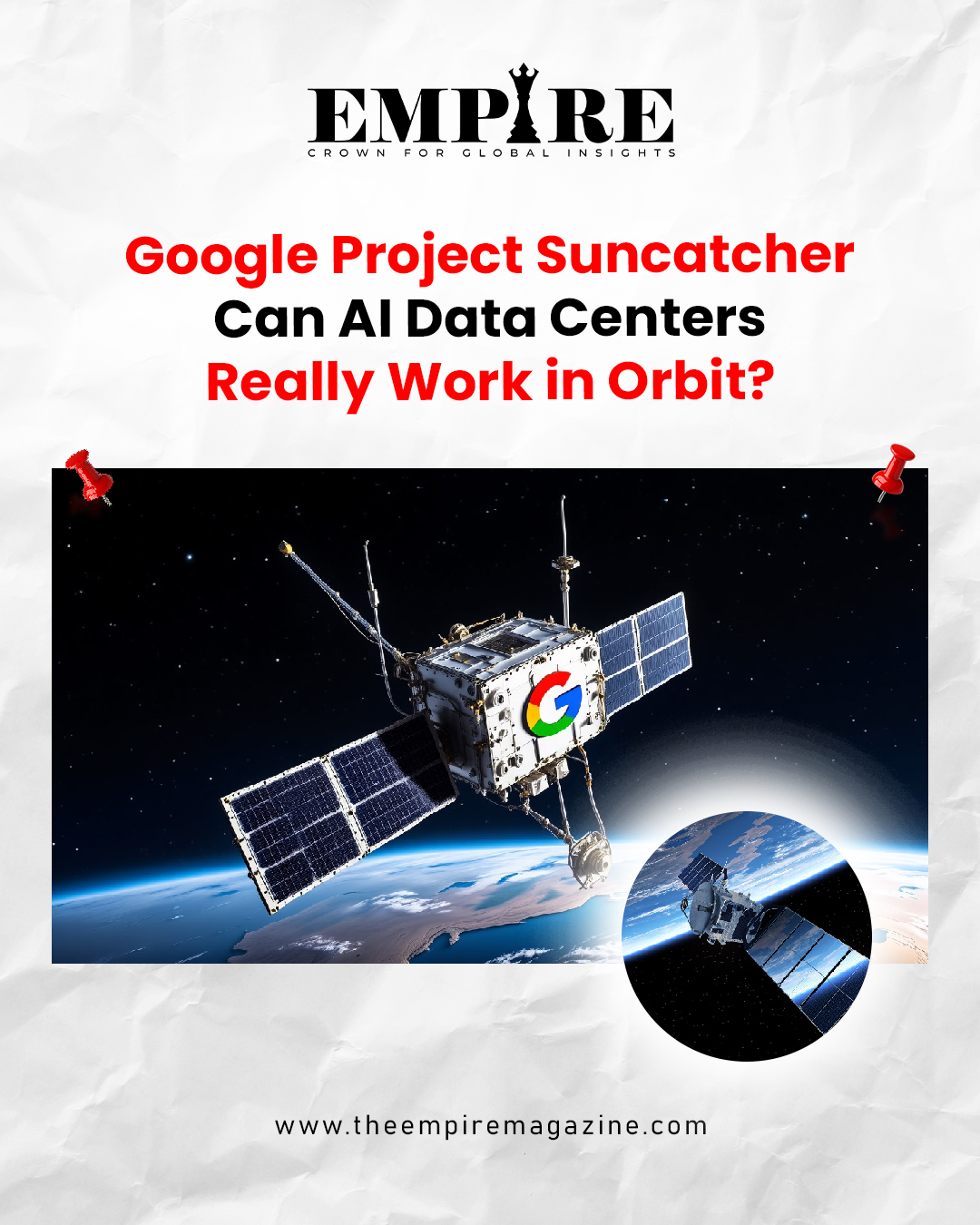
Google Project Suncatcher is one of the most ambitious ideas in the future of artificial intelligence infrastructure. The project explores whether data centers can operate in orbit using solar-powered satellites equipped with Google’s Tensor Processing Units, or TPUs. These TPUs are specialized chips designed to handle machine learning and AI workloads.
The idea sounds futuristic, but it comes from a real business and technology problem. AI systems need massive computing power. As more companies build large AI models, cloud services, and agent-based tools, demand for data centers is rising quickly. These facilities require large amounts of electricity, land, cooling systems, water, chips, and network infrastructure.
Google Project Suncatcher asks a bold question: if AI needs so much power, could some of that compute move into space, where sunlight is stronger and more continuous? Instead of relying only on Earth-based data centers, Google is exploring a satellite-based AI computing system that could use solar energy directly in orbit.
Google Project Suncatcher and the Future of AI Infrastructure
Google Project Suncatcher is not a normal data center plan. It is still a research project, not a finished commercial service. Google has described it as a moonshot, meaning it is an early-stage, high-risk, high-potential project.
The basic concept is to place AI computing hardware on satellites in low Earth orbit. These satellites would use solar power and communicate with one another using free-space optical links. In simple terms, they would form a connected computing network in space.
This matters because AI infrastructure on Earth is becoming increasingly expensive and energy-intensive. Large data centers can require enormous power supply, cooling capacity, and land. In some regions, electricity grids are under pressure from fast-growing AI demand. Space-based computing could offer a different path if the technical and economic challenges can be solved.
Why Google Is Looking at Data Centers in Orbit
Google is looking at data centers in orbit because solar energy is far more available in space than on Earth. On Earth, solar panels are affected by night, clouds, weather, seasons, dust, and atmosphere. In the right orbit, satellites can receive sunlight for much longer periods.
Google has said that solar panels in orbit can be significantly more productive than comparable panels on Earth because they can access more continuous sunlight. That energy advantage is one of the main reasons Project Suncatcher is being studied.
AI computing needs reliable power. If satellites can run AI chips using direct solar energy, orbital data centers could reduce some pressure on Earth-based power systems. This does not mean all data centers will move to space, but it could create a new layer of AI infrastructure for specific workloads.
TPUs as the Compute Engine
TPUs are central to Google Project Suncatcher. Google developed TPUs to accelerate machine learning workloads. They are used for AI training and inference across Google’s cloud and internal AI systems.
For Project Suncatcher, Google is exploring whether TPUs can operate reliably in space. This is not simple. Space exposes hardware to radiation, temperature extremes, vacuum conditions, and launch stress. Chips designed for Earth-based data centers must be tested carefully before they can be trusted in orbit.
Reports around the project have noted that Google has tested TPU hardware for radiation resilience. This is important because cosmic radiation and charged particles can affect electronics in space. If AI chips cannot survive and operate reliably, the project cannot work at scale.
How Orbital AI Data Centers Could Work
A space-based AI data center would not look like a giant building in orbit. Instead, it would likely involve many satellites working together. Each satellite could carry computing hardware, solar panels, power systems, cooling systems, communications equipment, and control systems.
The satellites would need to communicate with each other at high speed. AI workloads often require fast data movement between chips and systems. Google has discussed free-space optical communication, which uses laser-based links instead of physical cables. This could allow satellites to move data between one another quickly.
The system would also need to send results back to Earth. That creates another challenge: space-to-ground communication. If data transfer is too slow or expensive, the system may only be useful for certain types of AI work.
Why Optical Links Matter
Optical links matter because satellites in a computing network must exchange data rapidly. On Earth, data centers use high-speed fiber connections and tightly packed hardware. In space, satellites are separated by distance and cannot use normal wired infrastructure.
Laser communication could help solve part of this problem. It can support high-bandwidth data transfer between satellites if alignment, stability, and power requirements are managed properly.
However, maintaining high-speed links between moving satellites is difficult. Each satellite must stay in the right formation, point accurately, and handle changes in orbit. This makes Project Suncatcher not only a computing project but also a satellite networking project.
Why Space-Based Data Centers Are Difficult
Google Project Suncatcher faces major technical challenges. The first is launch cost. Every kilogram of hardware sent to orbit costs money. Even if launch prices continue falling, orbital data centers must prove they can be economically competitive with Earth-based facilities.
The second challenge is heat. Data centers produce a lot of heat. On Earth, heat can be removed using air, water, or cooling systems. In space, heat must be radiated away. That requires radiator surfaces and careful thermal design.
The third challenge is reliability. Earth-based data centers can be repaired by technicians. Satellites are much harder to service. If a chip fails, a power system breaks, or a communication link stops working, repair options are limited.
The fourth challenge is replacement. Satellites have limited lifetimes. Hardware may need to be refreshed or replaced regularly. For orbital data centers to make business sense, the useful life of the system must justify the cost of launch, operations, and replacement.
Why AI Demand Is Pushing New Infrastructure Ideas
AI demand is pushing companies to think beyond traditional infrastructure. Large AI models require heavy training and inference capacity. Cloud providers are investing billions in data centers, chips, power agreements, and cooling technology.
This rapid growth creates concerns about energy demand, water use, grid pressure, land availability, and environmental impact. Some regions are already debating how many data centers they can support.
Google Project Suncatcher is part of this wider search for new infrastructure models. Other approaches include more efficient chips, liquid cooling, renewable energy contracts, nuclear power interest, edge computing, and better AI model efficiency. Space-based data centers are one of the boldest ideas in this mix.
AI Inference Could Be an Early Use Case
If orbital data centers become practical, AI inference may be one possible early use case. Inference is the process of running an AI model to generate responses, predictions, or decisions after the model has already been trained.
Some inference tasks may not need constant two-way communication with Earth. If data can be processed in orbit and only results are sent back, the communication burden may be lower. This could make certain workloads more realistic than full-scale general cloud computing.
However, this depends on latency, bandwidth, cost, and the type of AI task. Project Suncatcher must prove that orbital compute can offer real advantages over Earth-based data centers.
The 2027 Prototype Plan
Google has discussed prototype testing with Planet, a satellite and Earth observation company. The plan is expected to involve small satellites that can test key parts of the concept in orbit around 2027.
This prototype stage is important because computer simulations and ground testing cannot answer every question. Real space testing can show how TPUs perform in orbit, how power systems behave, how communications work, and how hardware handles radiation and thermal conditions.
A prototype does not mean full orbital data centers are ready. It means Google is testing whether the building blocks are practical. The results will help determine whether the project should scale further.
Business Impact of Google Project Suncatcher
Google Project Suncatcher could have major business implications if it succeeds. It could create a new type of cloud infrastructure, where part of AI computing happens in orbit. This could reduce pressure on Earth-based energy systems and open a new market for satellite-powered compute.
It could also create business opportunities for launch companies, satellite manufacturers, optical communication providers, thermal-management companies, and space-infrastructure startups. If AI data centers move into orbit even partly, the space economy could expand beyond communications, imaging, navigation, and research.
The project could also strengthen Google’s position in AI infrastructure. Cloud competition is no longer only about software. It is also about chips, energy, data centers, networking, and global capacity. If Google can develop a new infrastructure layer, it may gain a long-term strategic advantage.
SpaceX, Planet and the Launch Ecosystem
Reports say Google has been in discussions with SpaceX and others about future launches for Project Suncatcher. This makes sense because launch access is central to the economics of orbital computing.
Planet’s role is also important because it has experience operating satellite constellations. Running many satellites requires knowledge of deployment, orbital operations, communications, data handling, and mission management.
Project Suncatcher will need partners across the space industry because Google cannot solve every part of the orbital data center challenge alone. It needs launch, satellite operations, communications, and hardware expertise.
Environmental Questions Around Orbital Data Centers
One reason Project Suncatcher is interesting is its potential environmental angle. If solar-powered satellites can process AI workloads using direct sunlight, they may reduce some electricity demand on Earth. They may also avoid some land and water use associated with large terrestrial data centers.
However, the environmental picture is not simple. Launches create emissions. Satellites require materials and manufacturing. Space debris risk must be managed carefully. Hardware replacement could create new sustainability questions.
This means orbital data centers should not be seen as automatically green. Their full environmental impact would need to be studied across manufacturing, launch, operation, replacement, and disposal.
Risks of Space Debris and Orbital Crowding
Space debris is one of the biggest concerns for any large satellite project. Low Earth orbit is becoming more crowded as companies launch communication satellites, Earth observation satellites, and scientific missions.
A large data center constellation would need strict debris prevention, collision avoidance, and end-of-life disposal plans. Satellites must be able to move safely, avoid other objects, and deorbit responsibly when their mission ends.
If many companies begin placing computing infrastructure in orbit, regulators may need new rules for orbital traffic management, spectrum use, safety, and environmental responsibility.
Can Data Centers Really Work in Orbit?
Google Project Suncatcher shows that orbital data centers are technically possible in concept, but not yet proven as a commercial reality. The idea has clear advantages: more continuous solar power, potential relief for Earth-based infrastructure, and a new frontier for AI compute.
The challenges are just as serious. Launch cost, heat management, radiation, satellite lifetime, communication bandwidth, maintenance, and space debris all need solutions. Commercial viability may depend on launch prices falling further and satellite computing hardware becoming lighter, more durable, and more efficient.
Google’s prototype tests will be an important first step. If those tests show that TPUs can operate reliably in orbit and that satellite-to-satellite computing links can work well, Project Suncatcher may move from a moonshot idea toward a real infrastructure strategy.
Readers can also explore more robotics and defense technology insights through this related article: Humanoid Robots on the Battlefield: Could AI Soldiers Change Future Warfare?.
For more updates from The Empire Magazine, follow us on Facebook and Instagram.
– The Empire Magazine
Crown For Global Insights