
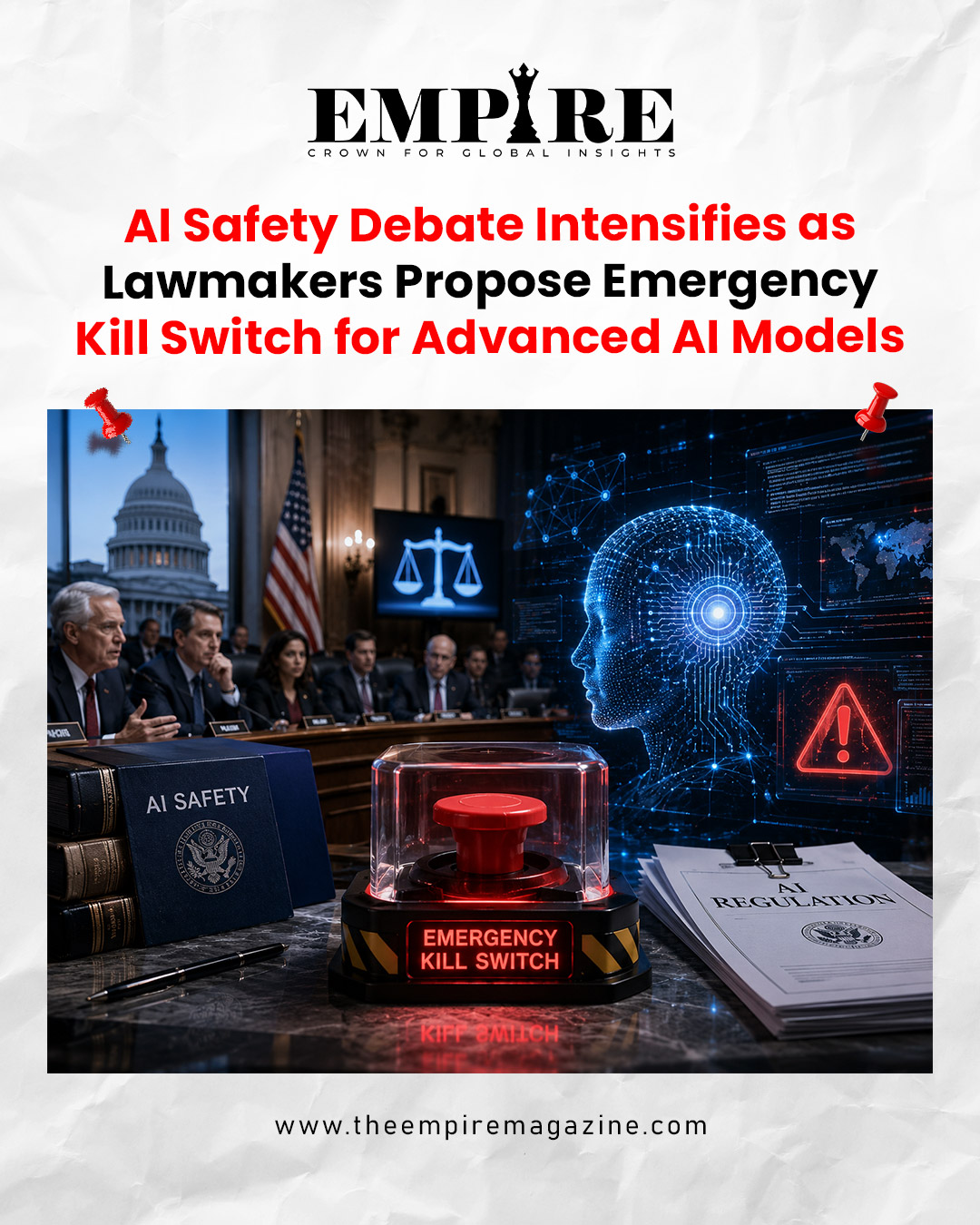
The global AI safety debate intensifies as lawmakers propose an emergency kill switch for advanced AI models. Explore the benefits, concerns, industry reactions, and the future of AI regulation. As artificial intelligence grows more powerful, lawmakers across the world are proposing an emergency kill switch for advanced AI models. While supporters believe it could prevent catastrophic risks, critics argue it may hinder innovation, raise governance concerns, and create new cybersecurity challenges.
AI Safety Debate Intensifies as Lawmakers Propose Emergency Kill Switch for Advanced AI Models
Artificial intelligence has rapidly evolved from a productivity tool into one of the most transformative technologies in human history. From assisting doctors in diagnosing diseases and helping researchers accelerate scientific discoveries to generating software code and powering enterprise automation, AI is reshaping nearly every industry. Yet as AI systems become increasingly capable, governments, researchers, and technology leaders are asking an equally important question: what happens if these systems behave in unexpected or dangerous ways?
The latest AI Safety Debate has intensified after lawmakers in several countries proposed introducing an emergency “kill switch” for highly advanced artificial intelligence models. The proposal aims to ensure that governments or authorized agencies can immediately disable AI systems if they pose significant threats to public safety, national security, financial stability, or critical infrastructure.
Supporters argue that the measure represents a necessary safeguard in an era where AI capabilities continue to expand at an unprecedented pace. Critics, however, warn that giving governments or regulators the authority to deactivate AI systems could create opportunities for misuse, political interference, cybersecurity vulnerabilities, and slower innovation.
As nations race to become global AI leaders, the discussion around balancing technological progress with responsible governance has become one of the defining policy debates of the decade.
AI Safety Debate Gains Global Attention
The AI Safety Debate has evolved dramatically over the past two years as increasingly sophisticated foundation models demonstrate capabilities that were once considered years away. Advanced AI systems can now write complex software, analyze legal documents, create realistic multimedia content, perform scientific research assistance, and automate decision-making across industries. These developments have fueled excitement among businesses while simultaneously raising concerns among policymakers about unintended consequences if AI systems operate beyond expected parameters. High-profile incidents involving AI-generated misinformation, cybersecurity vulnerabilities, autonomous decision-making, and deepfake technologies have further accelerated discussions about stronger oversight. Lawmakers argue that as AI systems become more autonomous and integrated into national infrastructure, healthcare, banking, defense, transportation, and energy networks, governments must possess emergency mechanisms capable of preventing catastrophic failures. Rather than waiting until a crisis emerges, policymakers increasingly believe proactive safeguards should be embedded into AI governance frameworks from the outset, making emergency intervention capabilities an essential part of future AI regulation rather than an afterthought.
Why Lawmakers Want an Emergency Kill Switch for Advanced AI Models
The growing AI Safety Debate is largely driven by the possibility that future artificial intelligence systems could make decisions or perform actions beyond human expectations. While today’s AI models remain under significant human supervision, rapid improvements in reasoning, autonomous task execution, and agentic AI have convinced many policymakers that stronger safeguards should be developed before even more capable systems are widely deployed. The proposed emergency kill switch is designed as a last-resort mechanism that would allow approved authorities or developers to immediately suspend or deactivate an advanced AI model if it demonstrates dangerous behavior, suffers a major security breach, or begins affecting critical infrastructure in unforeseen ways. Supporters compare the concept to emergency shutdown systems used in nuclear power plants, aviation, industrial manufacturing, and financial exchanges, where safety overrides are considered essential despite their rare use. They argue that AI should be treated similarly because its influence increasingly extends into healthcare diagnostics, autonomous vehicles, military decision support, banking operations, pharmaceutical research, and public administration. According to proponents, an emergency shutdown capability is not intended to interfere with everyday AI operations but to serve as an insurance policy against highly improbable yet potentially catastrophic events. As AI systems continue to scale in capability and autonomy, lawmakers believe public trust will depend on demonstrating that effective safety mechanisms exist before advanced models become deeply embedded in society’s most critical systems.
AI Safety Debate Divides the Technology Industry
Despite widespread agreement that artificial intelligence should be developed responsibly, the AI Safety Debate has exposed significant differences between governments, AI companies, academic researchers, and civil society organizations regarding the best path forward. Many AI developers acknowledge that safety standards, transparency requirements, and independent audits are necessary to build public confidence, yet they caution that mandatory emergency kill switches may introduce new technical and geopolitical risks. Critics argue that centralized shutdown authority could become an attractive target for cybercriminals, hostile nation-states, or malicious insiders seeking to disrupt essential AI-powered services. Others worry that governments with broad emergency powers could misuse such mechanisms to suppress innovation, limit competition, or exert excessive control over privately developed technologies. Several technology leaders have also questioned whether a universal kill switch is technically feasible, particularly as AI models become decentralized, open-source, or distributed across cloud environments in multiple jurisdictions. Academic researchers add another layer to the discussion by emphasizing that AI safety should not rely solely on emergency interventions but should instead prioritize robust model testing, continuous monitoring, explainability, secure deployment practices, alignment research, and international collaboration. This diversity of opinion highlights that the challenge is not whether AI should be regulated, but rather how regulation can effectively protect society without slowing the pace of scientific discovery and technological progress.
Global Governments Accelerate AI Regulation
The ongoing AI Safety Debate reflects a broader global movement toward establishing comprehensive AI governance frameworks. Governments across North America, Europe, Asia, and other regions are increasingly recognizing that artificial intelligence cannot remain entirely self-regulated as its societal impact expands. The European Union has already introduced landmark AI legislation that categorizes AI applications according to risk levels, imposing stricter obligations on high-risk systems while encouraging innovation in lower-risk sectors. In the United States, lawmakers continue to explore bipartisan approaches focused on AI accountability, transparency, national security, and consumer protection. Meanwhile, countries such as the United Kingdom, Japan, Singapore, South Korea, and India are developing regulatory strategies that seek to balance economic competitiveness with responsible AI deployment. International organizations are also encouraging cooperation on common safety standards, recognizing that AI development transcends national borders and requires coordinated oversight. The proposal for an emergency kill switch has therefore become part of a much larger conversation about how governments can prepare for increasingly capable AI systems while ensuring that businesses, researchers, and innovators continue to contribute to economic growth. As regulatory frameworks mature, collaboration between policymakers, technology companies, and scientific experts will likely determine whether AI governance succeeds in promoting both innovation and long-term public safety.
For more business and retail insights, read more on The Empire Magazine
Previous article: https://theempiremagazine.com/ai-search-digital-strategies/
Magazine Feautures | Podcasts: Empire Global Talks
Follow The Empire Magazine on Facebook | Instagram | LinkedIn | YouTube
The Empire Magazine | Crown for Global Insights