
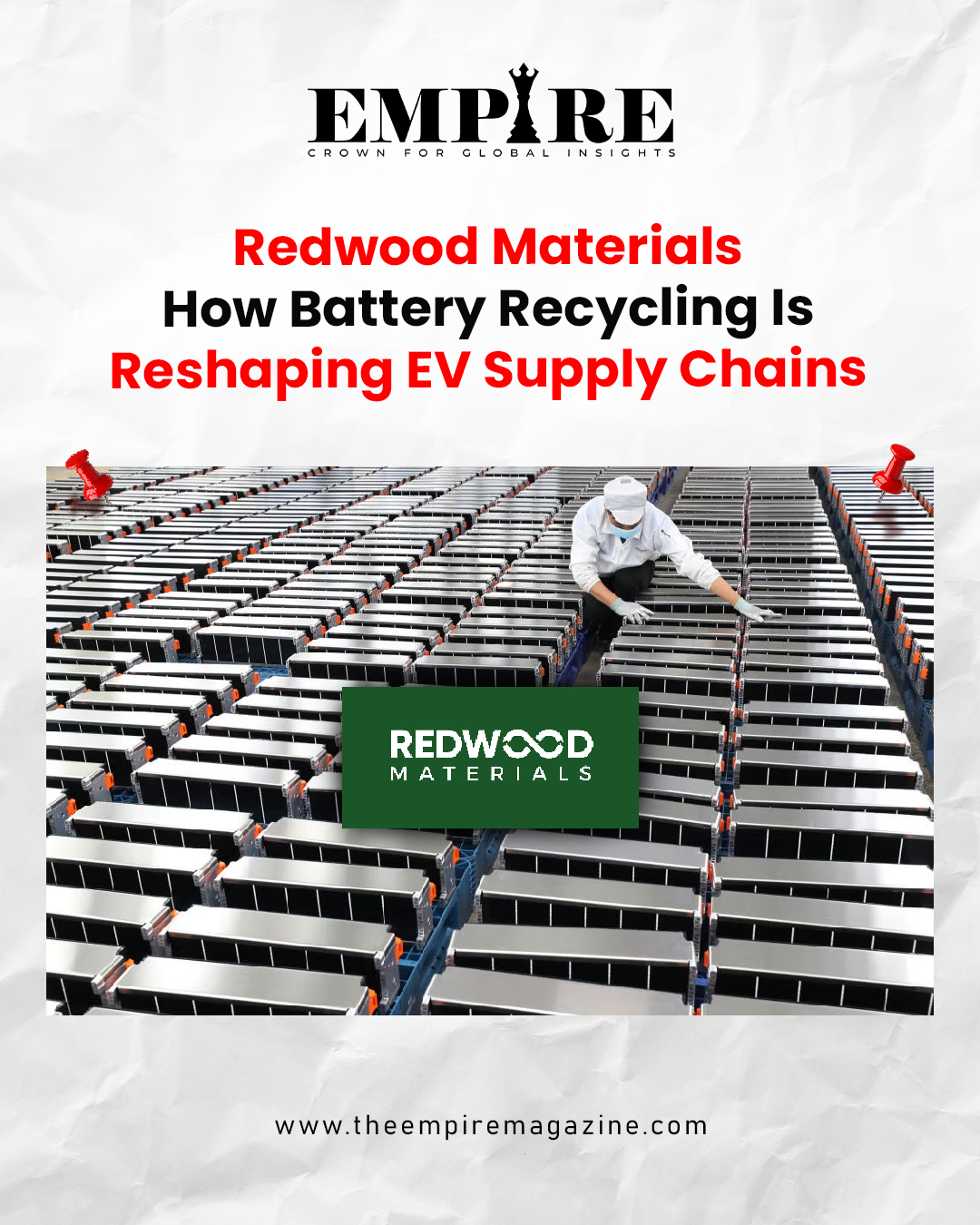
Redwood Materials is becoming one of the most important companies in the future of electric vehicle supply chains. Founded in 2017 by J.B. Straubel, a Tesla co-founder and former chief technology officer, Redwood Materials is focused on recycling lithium-ion batteries and turning recovered materials into new battery components.
The company is based in Nevada and is working to build a circular battery supply chain in the United States. Its mission is simple but difficult: recover valuable materials such as lithium, nickel, cobalt, copper, and other battery metals from used batteries and factory scrap, then return those materials to battery production.
This matters because the electric vehicle industry depends on critical minerals. EV batteries require materials that are often mined, refined, and processed through complex global supply chains. Many of these supply chains are concentrated outside the United States, creating risks for automakers, battery makers, energy storage companies, and governments. Redwood Materials is trying to reduce that risk by keeping more battery materials inside a domestic recycling and manufacturing loop.
Redwood Materials and the Need for Battery Recycling
Redwood Materials is important because EV growth is creating massive demand for battery materials. Electric cars, energy storage systems, consumer electronics, e-bikes, scooters, and data centers all depend on lithium-ion batteries. As these products grow, demand for lithium, nickel, cobalt, copper, and other materials continues to rise.
Mining alone cannot solve the problem quickly or sustainably. New mines take years to develop, face environmental concerns, and are often located far from battery manufacturing centers. Recycling offers another path. Used batteries still contain valuable materials that can be recovered and reused.
Battery recycling also helps reduce waste. Lithium-ion batteries should not simply be discarded because they contain valuable metals and can create environmental and safety risks if handled badly. By collecting and processing old batteries, Redwood helps turn waste into a new source of supply.
How Redwood Materials Supports EV Supply Chains
Redwood Materials supports EV supply chains by recovering critical materials and producing battery components. The company is not only recycling batteries into raw materials. It is also working to manufacture anode copper foil and cathode active materials, two key components used in lithium-ion batteries.
This is important because battery supply chains are not only about mining. A battery cell requires refined materials, engineered components, manufacturing capacity, and strong logistics. If the United States wants to build more EVs domestically, it needs local sources of battery materials and components.
Redwood’s strategy is built around closing the loop. Materials from old batteries and production scrap can be recovered, refined, and returned to new battery production. Over time, as more EV batteries reach end of life, recycled content could become a larger part of new battery supply.
Critical Minerals Inside Batteries
EV batteries contain several valuable materials. Lithium is essential for lithium-ion battery chemistry. Nickel can help increase energy density. Cobalt is used in some battery chemistries for stability and performance. Copper is widely used for current collectors and electrical connections.
These materials are expensive and strategically important. If they are lost when batteries are discarded, the supply chain becomes more dependent on new mining. If they are recovered and reused, the battery economy becomes more circular.
Redwood has said its process recovers a high share of key materials from batteries. This recovery is important because even small improvements can matter at industrial scale. As millions of EVs eventually reach end of life, the amount of recoverable material could become significant.
Why EV Supply Chains Need Domestic Recycling
EV supply chains are vulnerable because many critical minerals and battery components move across several countries before reaching an automaker. A battery material may be mined in one region, refined in another, processed into components elsewhere, and then shipped again for cell manufacturing.
This creates cost, emissions, and geopolitical risk. Trade restrictions, shipping delays, tariffs, export controls, and regional conflict can all affect battery supply. Domestic recycling can reduce some of this exposure.
For U.S. automakers and battery manufacturers, domestic supply is becoming more important. Policies supporting clean energy and electric vehicles have increased interest in local battery production. Recycling can help create a more secure supply of critical minerals while reducing dependence on long international supply chains.
Reducing Dependence on New Mining
Battery recycling does not remove the need for mining immediately. EV production is growing faster than old EV batteries are reaching end of life. That means new mined materials are still needed in the near term.
However, recycling can reduce pressure over time. As the EV market matures, more used batteries will become available. Factory scrap from battery production is already an important recycling source. Eventually, retired EV packs could become a major domestic resource.
This is one reason Redwood’s model is important. The company is building recycling capacity before the largest wave of end-of-life EV batteries arrives. That early infrastructure could help the industry prepare for future volumes.
Redwood’s Partnerships With Automakers and Battery Companies
Redwood Materials has built partnerships with major companies across the mobility and battery ecosystem. Its partners have included Panasonic, Toyota, Ford, Volkswagen Group of America, Audi, Ultium Cells, Amazon, Lyft, and other companies connected to batteries, mobility, and electronics.
These partnerships matter because recycling depends on collection. Redwood needs access to battery scrap, used packs, consumer electronics, and other lithium-ion products. Automakers and battery manufacturers need trusted partners that can handle batteries safely and recover materials efficiently.
Partnerships also support a closed-loop model. For example, materials recovered from one company’s battery supply chain can potentially be returned to new battery components. This helps companies reduce waste and strengthen sustainability claims.
Ultium Cells and Battery Manufacturing Scrap
Redwood’s partnership with Ultium Cells is important because battery factories produce scrap during manufacturing. This scrap may include valuable materials that can be recycled before ever reaching a vehicle.
Manufacturing scrap is a major near-term source of recyclable material because the EV industry is still young. Many vehicles have not yet reached end of life, but battery plants are already producing large volumes of production material.
By recycling factory scrap, Redwood can supply recovered materials back into the battery ecosystem sooner. This helps create recycling volume while the larger EV retirement wave develops.
Redwood’s Nevada and South Carolina Expansion
Redwood’s Nevada campus is central to its operations. The company has expanded its facilities there to support recycling, refining, and battery materials production. In 2025, Redwood said its Nevada campus produced 60,000 metric tons of critical minerals, making it a major domestic source of nickel, cobalt, lithium, and copper.
The company has also been expanding in South Carolina, a region that has become important for battery and electric vehicle manufacturing. Redwood’s South Carolina operations are part of a broader plan to support the growing battery supply chain in the U.S. Southeast.
This geographic expansion matters because battery supply chains work best when materials, cell plants, and automakers are closer together. Shorter supply chains can reduce transportation costs, improve reliability, and lower emissions.
The Role of U.S. Government Support
Redwood Materials has also received strong support from U.S. clean-energy industrial policy. The U.S. Department of Energy announced a conditional commitment for a $2 billion loan to support Redwood’s Nevada project for producing critical EV battery materials.
Government support matters because building battery materials infrastructure is capital-intensive. Facilities for recycling, refining, cathode material, and anode copper foil require major investment. Public financing can help reduce risk and support domestic supply-chain development.
This support also reflects a national priority. The United States wants to reduce dependence on foreign battery supply chains and build more capacity at home. Redwood fits into that goal because it combines recycling, refining, and materials production.
Why Policy Matters for Battery Recycling
Battery recycling is not only a business opportunity. It is also a strategic industry. Governments care about battery materials because they are essential for electric vehicles, grid storage, consumer electronics, and energy security.
Policy can help recycling companies scale faster by supporting facilities, setting recycling standards, encouraging domestic content, and creating incentives for circular supply chains.
As battery demand grows, countries that build strong recycling ecosystems may gain an advantage. They can recover materials from their own markets and reduce exposure to volatile mineral supply chains.
Redwood Energy and Second-Life Batteries
Redwood has also expanded into energy storage through Redwood Energy. This business uses second-life batteries for stationary storage applications. Some used EV batteries may no longer be suitable for vehicles, but they can still hold enough capacity for energy storage.
This is important because data centers, renewable energy projects, and grid systems need more storage. Batteries can store electricity and release it when needed, helping balance power supply and demand.
Second-life battery storage can extend the usefulness of batteries before they are fully recycled. This creates a longer value chain: batteries can first power vehicles, then support stationary energy storage, and finally be recycled for critical materials.
Why Battery Recycling Matters for Automakers
Automakers are under pressure to make EV production more sustainable and cost-effective. Battery packs are one of the most expensive parts of an electric vehicle. If recycled materials can reduce supply risk and support lower-cost production over time, automakers have a strong reason to participate.
Recycling also helps automakers manage end-of-life responsibility. As more EVs are sold, companies must think about what happens when batteries age, fail, or are replaced. A reliable recycling partner helps manage safety, compliance, and sustainability.
For automakers, battery recycling is no longer an afterthought. It is becoming part of long-term EV strategy.
Cost, Sustainability and Brand Trust
Consumers and regulators are paying more attention to where EV materials come from. Mining can involve environmental damage, human-rights concerns, water use, and carbon emissions. Recycling can help improve the sustainability profile of EVs.
A stronger recycling system can also build brand trust. Automakers that show clear plans for battery recovery and reuse may be seen as more responsible. This matters as EV buyers become more informed about the full life cycle of electric vehicles.
Challenges Facing Redwood Materials
Redwood Materials has strong momentum, but the company faces challenges. Battery recycling is complex. Different battery chemistries, pack designs, safety risks, transportation rules, and processing requirements all make the business difficult.
Scaling is another challenge. The company must handle growing volumes while maintaining safety, efficiency, and quality. Producing battery-grade materials is harder than simply recovering metals. Materials must meet strict standards for use in new batteries.
Another challenge is timing. The largest supply of retired EV batteries is still ahead. Until then, Redwood must rely heavily on manufacturing scrap, consumer electronics, and early end-of-life batteries to feed its operations.
The Future of EV Supply Chains
Redwood Materials shows how battery recycling can become a major part of the EV supply chain. As electric vehicles become mainstream, used batteries will become a valuable resource rather than waste.
The future battery industry may look more circular. Materials will move from mines into batteries, from batteries into vehicles, from vehicles into storage systems, and eventually back into new battery materials through recycling.
Redwood Materials is building infrastructure for that future. Its work in recycling, critical minerals, battery materials, partnerships, and second-life energy storage shows how the EV supply chain is changing from a linear model into a more circular system.
Readers can also explore more AI and security insights through this related article: ChatGPT Lockdown Mode: How OpenAI Is Strengthening AI Security.
For more updates from The Empire Magazine, follow us on Facebook and Instagram.
The Empire Magazine Crown For Global Insights