
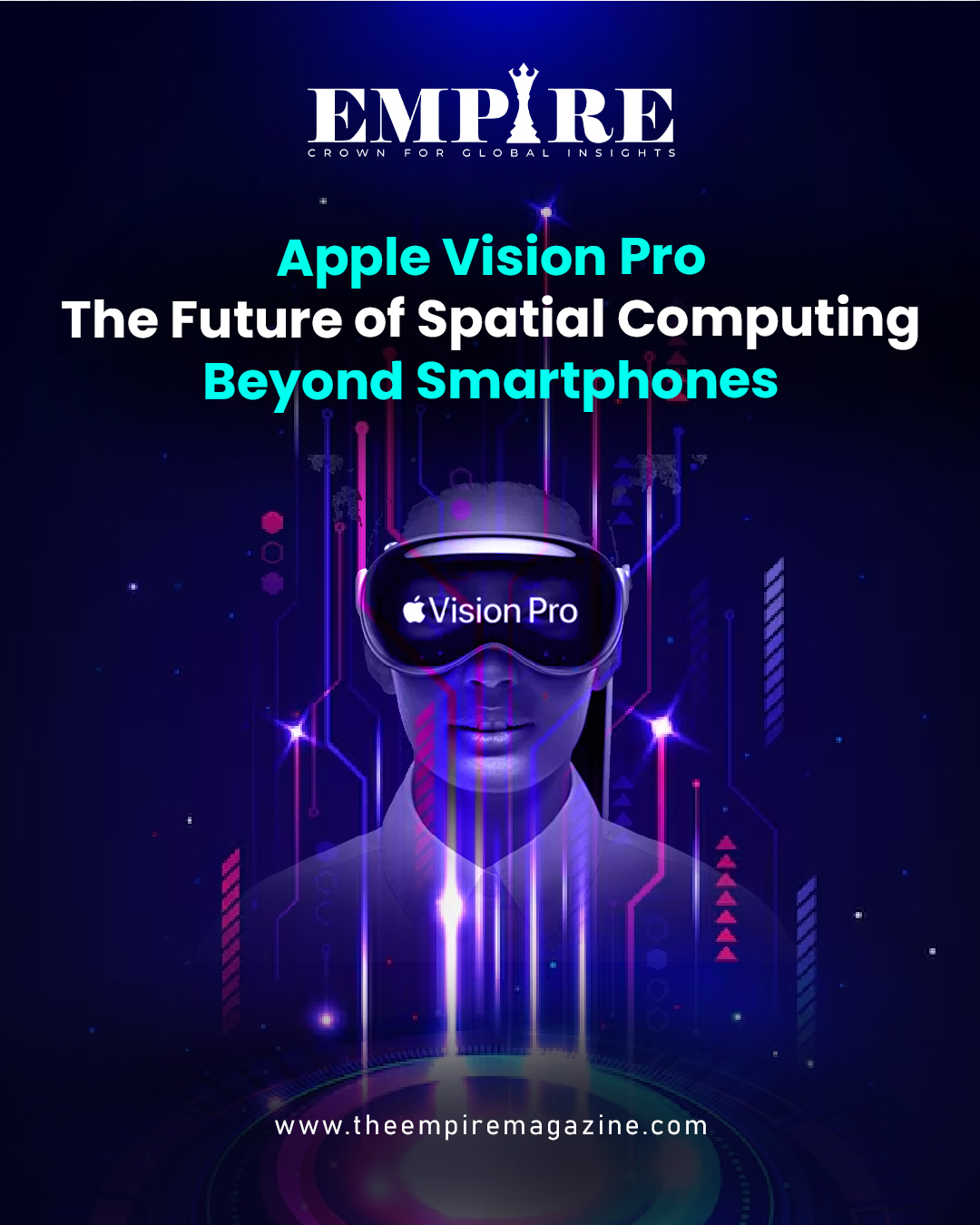
Apple Vision Pro is one of Apple’s most ambitious products because it introduces a new way to use digital content beyond the smartphone screen. Apple describes Vision Pro as a spatial computer, meaning it can place apps, media, workspaces, and interactive experiences into the physical space around the user. Instead of touching a phone or laptop screen, users control the device with their eyes, hands, and voice.
The product was first introduced by Apple in 2023 and launched in the United States in 2024. Apple positioned it as a new computing platform, not simply a virtual reality headset. Vision Pro blends digital content with the real world, allowing users to stay aware of their surroundings while using apps, watching entertainment, working, communicating, and viewing spatial photos and videos.
Apple Vision Pro matters because smartphones have shaped the last two decades of consumer technology. The iPhone changed how people communicate, shop, work, watch media, and use the internet. Vision Pro represents Apple’s attempt to create the next interface after smartphones, where digital experiences are no longer limited to a flat display.
Apple Vision Pro and the Meaning of Spatial Computing
Apple Vision Pro is built around spatial computing, a term used to describe digital experiences that exist in three-dimensional space. Instead of opening apps only on a phone or computer screen, users can place windows around them, resize them, and interact with them inside their environment.
This makes Vision Pro different from traditional devices. A laptop gives users one screen. A smartphone gives users a small portable display. Vision Pro creates what Apple calls an infinite canvas for apps. Users can place Safari, Messages, Photos, FaceTime, productivity apps, entertainment screens, and other content around their room.
The device also supports immersive environments, which can reduce distractions by surrounding the user with digital scenery. This gives Vision Pro two important modes: users can stay connected to the real world or move deeper into immersive content.
Why Apple Vision Pro Goes Beyond Smartphones
Smartphones are powerful, but they are still limited by screen size. Even large phones cannot provide the same workspace as multiple floating windows or a cinema-sized display. Apple Vision Pro is designed to remove that limitation by allowing digital content to appear at different sizes and positions in the user’s physical space.
For work, this can mean opening several apps at once without needing multiple monitors. For entertainment, it can mean watching movies on a large virtual screen. For photos and videos, it can mean viewing memories in a more immersive format. For communication, it can mean using FaceTime with spatial audio and life-size video tiles.
This does not mean Vision Pro replaces the iPhone today. The device is expensive, advanced, and still early in its product journey. However, it shows where computing may move in the future: from handheld screens to wearable spatial interfaces.
A New Interface Controlled by Eyes, Hands, and Voice
One of the most important parts of Apple Vision Pro is its input system. Users do not need a traditional controller. The device tracks eye movement, hand gestures, and voice commands. A user can look at an app, tap fingers together to select, and use voice dictation or Siri for certain actions.
This control system is central to Apple’s design philosophy. The company wants Vision Pro to feel natural rather than technical. Eye tracking allows users to navigate the interface quickly, while hand gestures reduce the need for external accessories.
The device also supports Bluetooth keyboards, trackpads, and game controllers for specific tasks. This gives Vision Pro flexibility for productivity, gaming, and professional use.
Display, Audio, and Hardware Experience
Apple Vision Pro uses advanced display technology to create a high-resolution visual experience. Apple says the device has displays that deliver more pixels than a 4K TV to each eye. This matters because visual clarity is essential for reading text, watching films, using apps, and viewing 3D content.
The device also includes Spatial Audio, which helps sound feel like it is coming from the direction of the content. If a FaceTime participant appears on the left side of the user’s space, the audio can feel like it is coming from that direction. This makes communication and entertainment feel more natural.
Apple Vision Pro includes cameras, sensors, eye-tracking systems, hand-tracking systems, LiDAR, and a dual-chip design. The R1 chip is designed to process input from cameras and sensors quickly, helping reduce delay between the real world and the digital experience. Apple’s current product page lists newer Vision Pro models with the M5 chip, showing that Apple has continued updating the device’s performance.
Optic ID and Privacy
Apple Vision Pro includes Optic ID, a biometric security system based on iris recognition. It allows users to unlock the device, authorize purchases, and protect personal data inside apps.
Privacy is especially important for a face-worn computer because the device uses cameras and sensors to understand the user’s surroundings, eye movement, and gestures. Apple states that Optic ID data is encrypted and protected by the Secure Enclave. This fits Apple’s broader privacy-focused product strategy.
For spatial computing to become mainstream, users must trust that their personal data, environment, and biometric information are protected. Vision Pro’s privacy systems are therefore a core part of its long-term positioning.
Entertainment and Immersive Media
Apple Vision Pro has strong potential in entertainment. Users can watch movies and shows on a large virtual screen, view 3D movies, play compatible games, and experience Apple Immersive Video. This makes the device attractive for people who want a private cinema-style experience.
The product also supports spatial photos and spatial videos. These allow users to capture or view memories with depth, making family moments, travel scenes, and personal videos feel more lifelike than standard flat media.
Entertainment may be one of the easiest ways for people to understand Vision Pro. While business and productivity use cases are important, watching a film on a huge virtual screen is a simple and powerful demonstration of spatial computing.
Business Uses for Apple Vision Pro
Apple has also promoted Vision Pro for business and enterprise use. The device can support training, design review, product visualization, remote collaboration, and specialized workflows. Apple has highlighted use cases in industries such as healthcare, manufacturing, engineering, retail, and aviation.
For example, a company can use spatial computing to show a 3D product model, train employees in a simulated environment, or help teams collaborate around complex visual data. These professional use cases may be important because enterprise customers can justify higher device costs when the technology improves training, design, or operational efficiency.
Vision Pro’s business role also shows that spatial computing is not only about entertainment. It can become a tool for visual work, technical training, and complex decision-making.
Healthcare, Design, and Training Opportunities
In healthcare, spatial computing can help doctors and medical teams review 3D models, understand anatomy, or support training experiences. In design and engineering, teams can view products, buildings, or machinery in three dimensions before physical production.
Training is another strong area. Employees can learn procedures in a controlled digital environment before applying them in the real world. This can be valuable in industries where mistakes are costly, dangerous, or difficult to repeat.
These use cases show why Apple Vision Pro is important beyond consumer technology. It may become part of how companies train workers, present products, and solve visual problems.
Challenges Facing Apple Vision Pro
Apple Vision Pro is advanced, but it also faces real challenges. The starting price has been high compared with most consumer electronics. The device is also larger and heavier than normal glasses, which can affect comfort during long sessions.
Another challenge is app development. A new computing platform needs strong software support. Apple has a large developer ecosystem, but spatial computing requires developers to think differently about interface design, 3D space, and user interaction.
Consumer adoption may take time. The iPhone became mainstream because it was portable, useful every day, and eventually available at many price points. Vision Pro is still in an early stage, and its long-term success may depend on lighter hardware, lower prices, stronger apps, and clearer everyday use cases.
The Future of Spatial Computing
Apple Vision Pro shows how computing could move beyond smartphones, tablets, and laptops. It introduces a future where users can work on floating screens, watch immersive media, communicate in spatial environments, and interact with digital content as part of the real world.
The product may not replace smartphones immediately, but it gives Apple a foundation for the next stage of personal computing. Over time, spatial computing could become more comfortable, more affordable, and more common.
Apple Vision Pro is important because it turns spatial computing into a serious platform backed by Apple’s hardware, software, services, and developer ecosystem. Whether the category grows quickly or slowly, Vision Pro has already started a major conversation about what comes after the smartphone era.
Readers can also explore more healthcare technology insights through this related article: Viz.ai: How AI Helps Detect Stroke Faster.
For more updates from The Empire Magazine, follow us on Facebook and Instagram.
– The Empire Magazine
Crown For Global Insights