
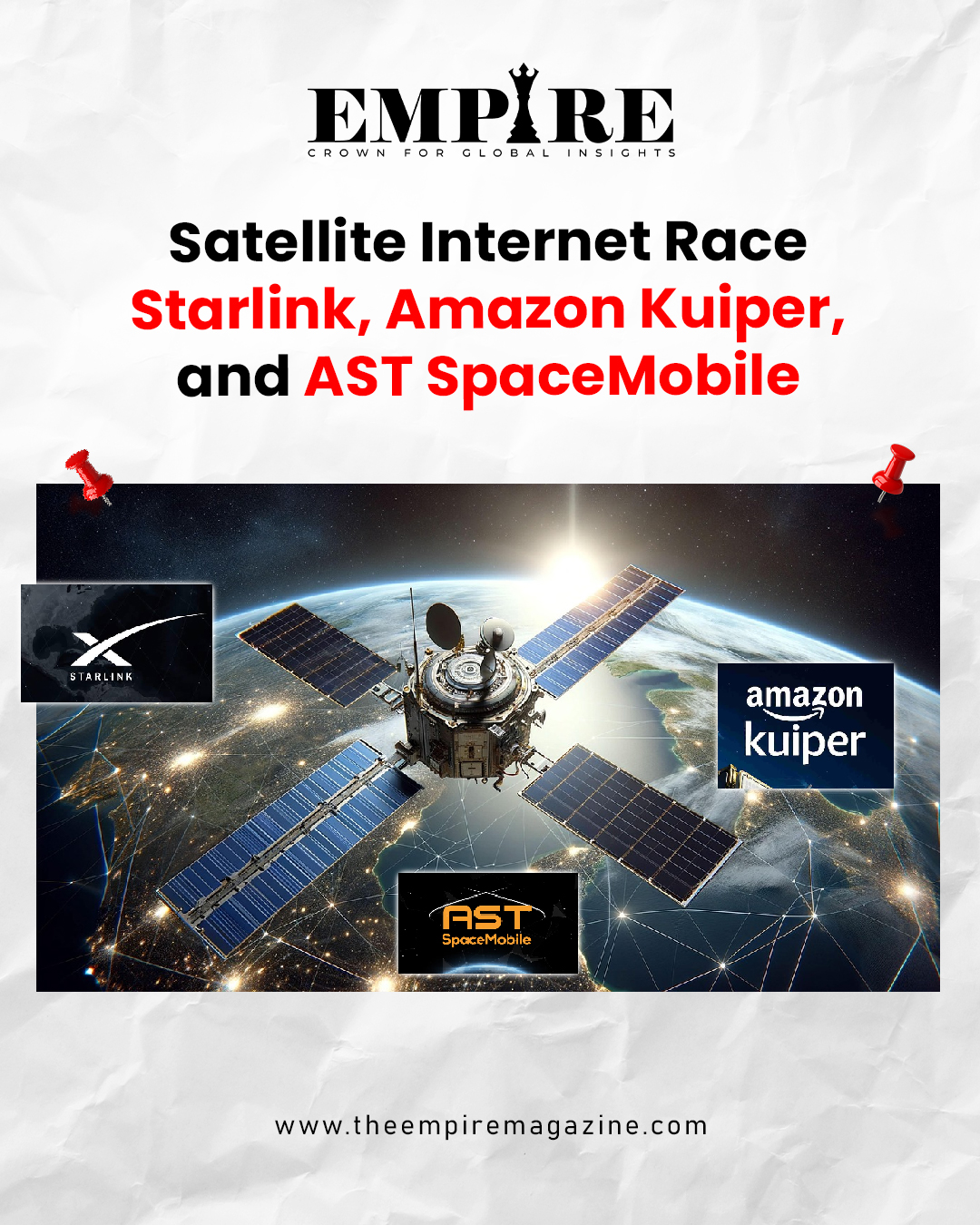
Satellite Internet Race is becoming one of the most important technology battles in global connectivity. Companies such as Starlink, Amazon Kuiper, now branded as Amazon Leo, and AST SpaceMobile are competing to connect homes, businesses, ships, aircraft, emergency services, and mobile phone users through satellite networks.
For decades, satellite internet was often seen as expensive, slow, and mainly useful in remote regions. That image has changed quickly with the rise of low Earth orbit satellite networks. Unlike older geostationary satellites, low Earth orbit satellites operate much closer to Earth, which can reduce latency and improve broadband performance.
The race is not only about internet speed. It is also about market control, global coverage, telecom partnerships, government contracts, rural connectivity, defense use, and digital inclusion. Starlink currently leads the market, Amazon is building a major rival network, and AST SpaceMobile is taking a different route by trying to connect ordinary smartphones directly to satellites.
Satellite Internet Race and the Rise of Low Earth Orbit Networks
The modern satellite internet market is largely driven by low Earth orbit, or LEO, satellite systems. These satellites orbit much closer to Earth than traditional geostationary satellites. Because of this lower altitude, LEO networks can deliver faster response times, which is important for video calls, online work, gaming, business applications, and cloud-based services.
LEO networks require many satellites because each satellite covers a smaller area while moving quickly around the planet. This is why companies are launching large constellations containing hundreds or thousands of satellites. The goal is to create continuous global coverage by having satellites pass overhead in coordinated patterns.
This model has created a new kind of infrastructure race. The companies that can launch satellites quickly, manage network capacity, reduce user costs, and win regulatory approvals may gain a strong advantage in the next stage of global internet access.
Starlink: The Current Leader in Satellite Broadband
Starlink, operated by SpaceX, is the clear leader in the satellite internet race. It has already built the largest operational LEO broadband constellation and serves millions of customers across many countries and territories. Starlink’s biggest advantage is speed of deployment. SpaceX controls both the satellite network and the launch system, allowing it to send new satellites into orbit at a rapid pace.
Starlink has become especially important in rural and remote areas where fiber and mobile networks are limited. It has also been used in emergency situations, conflict zones, maritime connectivity, aviation, and enterprise services. This gives Starlink a wide customer base beyond normal home broadband users.
The company’s terminals are designed to be relatively easy to install, making the service useful for homes, businesses, vehicles, boats, and field operations. Starlink has also been expanding into direct-to-cell technology, which aims to connect mobile phones in areas without traditional cellular coverage.
Why Starlink Has a Strong Advantage
Starlink benefits from SpaceX’s reusable rocket program. Because SpaceX can launch satellites frequently with Falcon 9 rockets, it can expand and refresh the network faster than many competitors. This launch advantage is one of the reasons Starlink has moved ahead of the market.
The company also has strong brand recognition. In many countries, Starlink has become the most recognized name in satellite broadband. For rural users, remote workers, and businesses in hard-to-reach areas, Starlink is often the first satellite internet option that comes to mind.
However, Starlink also faces challenges. Satellite congestion, regulatory approval, astronomy concerns, orbital debris, pricing pressure, and competition from telecom operators may all affect its future growth. As more companies enter the market, Starlink will need to keep improving speed, reliability, and affordability.
Amazon Kuiper and the Amazon Leo Strategy
Amazon Kuiper, now publicly branded as Amazon Leo, is Amazon’s answer to Starlink. The project is designed to create a large LEO satellite constellation that can deliver high-speed internet to homes, businesses, governments, and underserved regions.
Amazon has major advantages in cloud computing, logistics, devices, e-commerce, and enterprise relationships. Through Amazon Web Services, the company already serves many businesses and government customers. This could help Amazon connect satellite internet with cloud services, edge computing, and enterprise digital infrastructure.
Amazon’s satellite internet strategy has taken time to develop, but the company has secured a large number of launches and has started deploying operational satellites. Public mission updates show that Amazon Leo has crossed the 300-satellite mark, making it a serious future competitor even though it still trails Starlink by a wide margin.
Why Amazon Can Still Compete
Amazon may not be the first mover, but it has the capital, technology ecosystem, and customer relationships to compete in the long term. The company can bundle satellite connectivity with cloud services, smart devices, logistics networks, and enterprise solutions.
Amazon also has experience building large-scale customer platforms. If Amazon Leo can offer reliable service at competitive pricing, it may become a major alternative for rural broadband, business connectivity, and government projects.
The challenge for Amazon is speed. Starlink already has a large installed base and a massive satellite network. Amazon needs to deploy satellites quickly, secure regulatory access in multiple countries, and prove that its service can match customer expectations.
AST SpaceMobile: Direct-to-Smartphone Connectivity
AST SpaceMobile is different from Starlink and Amazon Leo because its main focus is direct-to-device mobile connectivity. Instead of selling home satellite terminals as the core model, AST SpaceMobile is building satellites that can connect directly to ordinary mobile phones.
This approach is important because billions of people already own smartphones. If satellite networks can connect directly to standard phones, users may not need special satellite equipment. This could help eliminate mobile dead zones in rural areas, oceans, mountains, disaster zones, and regions with weak terrestrial coverage.
AST SpaceMobile has built partnerships with major telecom operators. Its business model depends heavily on working with mobile network companies rather than replacing them. Partners can use AST’s satellite system to extend coverage beyond normal towers.
Telecom Partnerships Matter
AST SpaceMobile’s partnerships are central to its strategy. Agreements and collaborations with companies such as Vodafone, Verizon, AT&T, Orange, and other telecom operators show that mobile carriers are interested in satellite-based coverage expansion.
For telecom companies, direct-to-smartphone satellite service can improve network reach without building towers in every remote location. This is especially useful in areas where terrestrial infrastructure is too expensive, difficult, or slow to build.
AST’s technology could become valuable for emergency alerts, basic messaging, voice services, and eventually broadband-style mobile data. However, the company still needs to scale its satellite constellation, prove commercial performance, and manage the technical demands of connecting satellites with standard phones.
Why the Satellite Internet Race Matters for Global Connectivity
The satellite internet race matters because many parts of the world still lack reliable internet access. Rural communities, remote islands, mountain regions, ships, aircraft, and developing markets often struggle with traditional connectivity.
Satellite networks can reach places where fiber cables and cell towers are difficult to install. This makes the technology important for education, healthcare, agriculture, disaster response, logistics, tourism, and national security.
For businesses, satellite connectivity can support mining sites, energy projects, construction zones, maritime operations, aviation routes, and international field offices. For governments, it can improve emergency communication, military connectivity, and public service delivery in remote areas.
Competition Beyond Consumer Internet
Starlink, Amazon Leo, and AST SpaceMobile are not competing only for home broadband customers. The bigger opportunity includes enterprise, government, defense, mobile operators, airlines, shipping companies, and connected vehicles.
Starlink has already built momentum in several of these areas. Amazon can bring strong enterprise cloud relationships. AST SpaceMobile can work through mobile network operators to reach phone users. Each company has a different route to market, which makes the race more complex.
The future may not have only one winner. Starlink may dominate broadband terminals, Amazon may become strong in enterprise and cloud-linked connectivity, and AST SpaceMobile may grow through telecom partnerships. Different use cases may support different companies.
Challenges Facing the Industry
The satellite internet industry still faces serious challenges. Launching and maintaining thousands of satellites is expensive. Satellites have limited lifespans and must be replaced. Companies must also manage spectrum rights, country-by-country approvals, space traffic, and environmental concerns.
Astronomers have raised concerns that large satellite constellations can affect night-sky observations. Space debris is another issue, especially as more satellites are launched into low Earth orbit. Regulators will likely pay closer attention as constellations grow.
Pricing is also important. Satellite internet must become affordable enough for mass adoption, especially in developing regions. If the service remains too expensive, it may serve businesses and wealthier users more than the communities that need connectivity most.
What Comes Next for Starlink, Amazon Kuiper, and AST SpaceMobile
The next stage of the satellite internet race will depend on scale, reliability, and partnerships. Starlink will focus on expanding capacity, improving direct-to-cell services, and defending its market lead. Amazon Leo will need to accelerate deployment and convert its technology into commercial service. AST SpaceMobile must prove that direct-to-smartphone satellite connectivity can work at scale with telecom partners.
This race is important because it could reshape how the world connects. Instead of depending only on cables and towers, future networks may combine fiber, 5G, Wi-Fi, and satellites into one broader connectivity system.
For users, the biggest benefit could be fewer dead zones and more choice. For businesses and governments, satellite internet can become a strategic infrastructure layer. The companies that succeed will not only sell internet service; they may help define the future of global communication.
Readers can also explore more technology and innovation insights through this related article: Microsoft Majorana 2: The Quantum Chip Built With AI.
For more updates from The Empire Magazine, follow us on Facebook and Instagram.
– The Empire Magazine
Crown For Global Insights