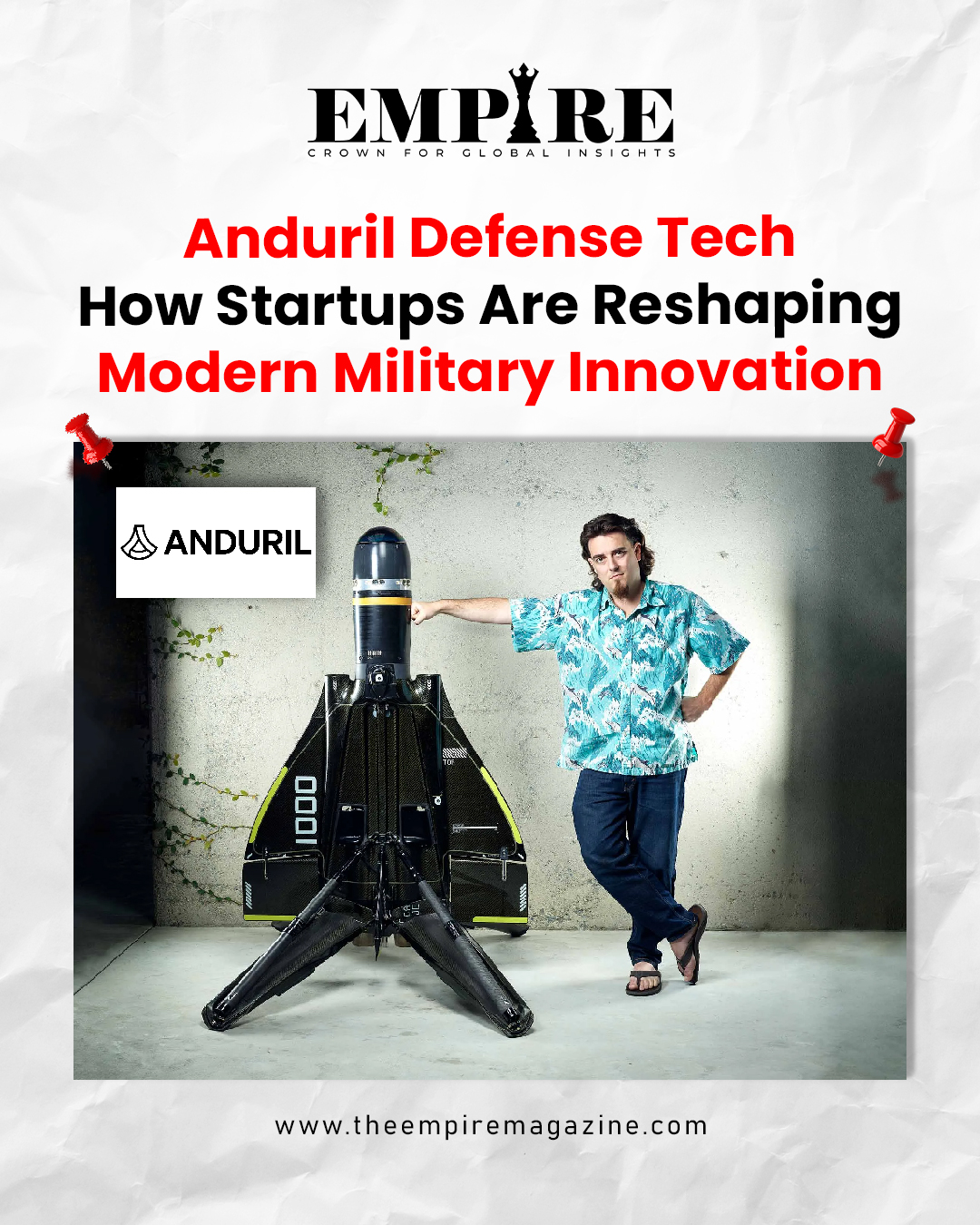
Anduril Defense Tech has become one of the clearest examples of how startups are changing the defense industry. Founded in 2017 by Palmer Luckey, Trae Stephens, Matt Grimm, Joe Chen, and Brian Schimpf, Anduril Industries has grown into a major defense technology company focused on autonomous systems, software platforms, sensors, drones, and advanced military products.
For decades, the defense industry was dominated by large legacy contractors with long government relationships and slow procurement cycles. Anduril entered the market with a different approach. Instead of waiting years to build technology through traditional defense programs, the company uses private capital, fast engineering cycles, and software-led product development to create systems for the U.S. and allied militaries.
This is why Anduril has become a symbol of a new startup category: defense tech. The company shows that national security innovation is no longer limited to traditional defense giants. Startups can now build serious military technology when they combine engineering talent, venture funding, autonomy, manufacturing, and strong government demand.
Anduril Defense Tech and the Rise of a New Startup Category
Anduril Defense Tech became important because it challenged the old model of defense contracting. Traditional military programs often involve long timelines, complex requirements, and heavy government funding from the earliest stages. Anduril’s model is closer to a technology startup. It builds products first, proves that they work, and then sells them to government customers.
This model matters because modern defense needs speed. Military threats are changing quickly, and governments need faster ways to adopt new technology. Drones, autonomous aircraft, counter-drone systems, surveillance towers, battlefield software, and sensors are now essential parts of security strategy.
Anduril built its identity around this shift. Its products are not only hardware systems. Many of them are connected through software, especially Lattice, the company’s command-and-control and mission autonomy platform. This software-first approach helped Anduril stand out in a market that has traditionally been hardware-heavy.
Why Defense Tech Became Attractive to Investors
Defense tech became a startup category because global security needs changed. The war in Ukraine, rising tensions in the Indo-Pacific, drone warfare, border security challenges, and the need for faster military modernization have all increased demand for new defense systems.
Venture capital firms once avoided defense because government sales could be slow and unpredictable. Anduril helped change that perception by showing that a startup could win major contracts and build products for real national security needs.
In May 2026, Reuters reported that Anduril raised $5 billion in a funding round that doubled its valuation to $61 billion. The round was led by Thrive Capital and Andreessen Horowitz, showing continued investor confidence in defense technology startups.
This level of funding is important because defense products require significant capital. Startups must design, test, manufacture, and support systems that meet military standards. Anduril’s fundraising gives it more ability to scale production, expand research, and compete with larger contractors.
A Software-First Defense Company
Anduril’s Lattice platform is central to its strategy. The company describes Lattice as a system for command and control, mission autonomy, mesh networking, and software development. It helps connect different sensors, vehicles, and operators into one operational picture.
This matters because modern defense is increasingly about information speed. Military teams need to detect threats, understand situations, and act quickly. A sensor is more useful when it is connected to a software system that can organize data and support decision-making.
Lattice is designed to work across different environments, including air, land, sea, and border security. This gives Anduril a platform approach rather than a single-product strategy. The company can build many systems that connect into the same software foundation.
Anduril’s Major Products and Technologies
Anduril has built a growing portfolio of defense systems. Its products include autonomous air vehicles, surveillance systems, counter-drone tools, undersea vehicles, and command-and-control software.
One of its well-known products is Fury, an autonomous air vehicle that uses Lattice software and is designed for near-fighter-speed performance, modular payloads, and affordable production.
Another important product is Roadrunner, a reusable vertical takeoff and landing autonomous air vehicle. Roadrunner is designed for fast response and modular mission use. The company also developed Barracuda, a family of air-breathing autonomous air vehicles designed for scalable production and military use.
These products show how Anduril is building around autonomy, modularity, and speed. Rather than depending only on one system, the company is creating a broader defense technology ecosystem.
Autonomous Systems and Military Change
Autonomous systems are becoming important because militaries need more flexible and cost-effective tools. Traditional military platforms can be expensive, complex, and slow to produce. Autonomous systems can help fill gaps where speed, scale, and risk reduction are important.
This does not mean humans are removed from decision-making. Military systems still require command responsibility, oversight, and rules of engagement. Anduril generally positions its technology as supporting human operators, not replacing them.
Autonomy can help with surveillance, threat detection, drone interception, reconnaissance, and mission support. These are areas where machines can process information quickly while human teams focus on decisions and strategy.
The U.S. Air Force CCA Program
A major milestone for Anduril came in April 2024 when the U.S. Air Force selected Anduril and General Atomics to move forward in the Collaborative Combat Aircraft program. The program is focused on developing production-representative autonomous aircraft that can support future air combat missions.
This was a major moment because Anduril was chosen alongside an established defense company, showing that a startup-style firm could compete in one of the most advanced areas of military aviation.
Collaborative Combat Aircraft are expected to work with crewed fighter aircraft and support missions such as sensing, electronic warfare, strike support, or other operational roles. The program reflects the U.S. Air Force’s interest in mixing crewed and uncrewed systems to expand capability.
For Anduril, the CCA selection strengthened its position as a serious defense company, not only a startup experiment.
Arsenal-1 and the Future of Defense Manufacturing
One of the biggest challenges for defense tech startups is manufacturing. A company may build impressive prototypes, but military customers need reliable production at scale. Anduril has been addressing this challenge through Arsenal-1, its advanced manufacturing facility planned in Ohio.
Breaking Defense reported in March 2026 that Anduril’s Arsenal-1 facility is expected to produce Fury, Roadrunner, Barracuda, and a classified platform by the end of 2026.
This facility is important because Anduril wants to prove that defense startups can manufacture advanced systems in large quantities. Modern conflicts have shown that production capacity matters as much as innovation. Countries need systems that can be built quickly, replaced when lost, and deployed in large numbers.
Why Manufacturing Scale Matters
Defense technology is not only about design. It is also about supply chains, factories, testing, materials, quality control, and delivery. A product that cannot be manufactured at scale may not solve real military needs.
Anduril’s manufacturing strategy is part of its larger argument that defense companies must become faster and more software-driven. By combining digital engineering, automation, and large-scale production, the company wants to build systems faster than traditional defense timelines allow.
This is also why investors are paying attention. If Anduril can combine software, autonomy, and manufacturing scale, it may create a new model for defense production.
Competition With Legacy Defense Contractors
Anduril does not operate in an empty market. It competes with major defense contractors such as Lockheed Martin, Northrop Grumman, Boeing, RTX, and General Dynamics. These companies have deep experience, large workforces, long government relationships, and major production capacity.
However, Anduril’s advantage is speed and focus. It is built around software, autonomy, and startup-style execution. This allows the company to move quickly in emerging categories such as counter-drone systems, autonomous aircraft, and AI-supported command platforms.
Legacy defense companies are also adapting. They are investing in autonomy, software, and faster development. This means the future defense market may include both large traditional contractors and newer defense tech firms working side by side or competing for the same programs.
Challenges Facing Anduril
Anduril’s growth is impressive, but the company faces serious challenges. Defense procurement remains complex, and military systems must meet strict performance, security, reliability, and safety standards. Products must work in difficult environments and be supported over long periods.
Autonomous defense systems also raise ethical and political questions. Governments must ensure that human oversight, accountability, and legal frameworks remain clear. Public debate around military autonomy is likely to continue as these systems become more advanced.
Another challenge is global regulation. Defense products involve export controls, allied partnerships, and national security restrictions. A company like Anduril must navigate not only technology development but also government policy and international rules.
How Anduril Changed the Defense Industry
Anduril changed the defense industry by making defense tech a visible startup category. It showed that venture-backed companies can build serious national security products and compete for major programs.
The company’s growth also reflects a wider shift in military technology. Defense is now deeply connected to software, drones, robotics, sensors, space systems, and autonomous platforms. These are areas where startups can move quickly and create new solutions.
Anduril’s story is important because it shows how the defense industry is becoming more like the technology industry. Speed, software, data, autonomy, and manufacturing innovation are now central to military power.
Readers can also explore more technology and innovation insights through this related article: JW Anderson: How Brand Storytelling Builds Modern Luxury Value.
For more updates from The Empire Magazine, follow us on Facebook and Instagram.
– The Empire Magazine
Crown For Global Insights