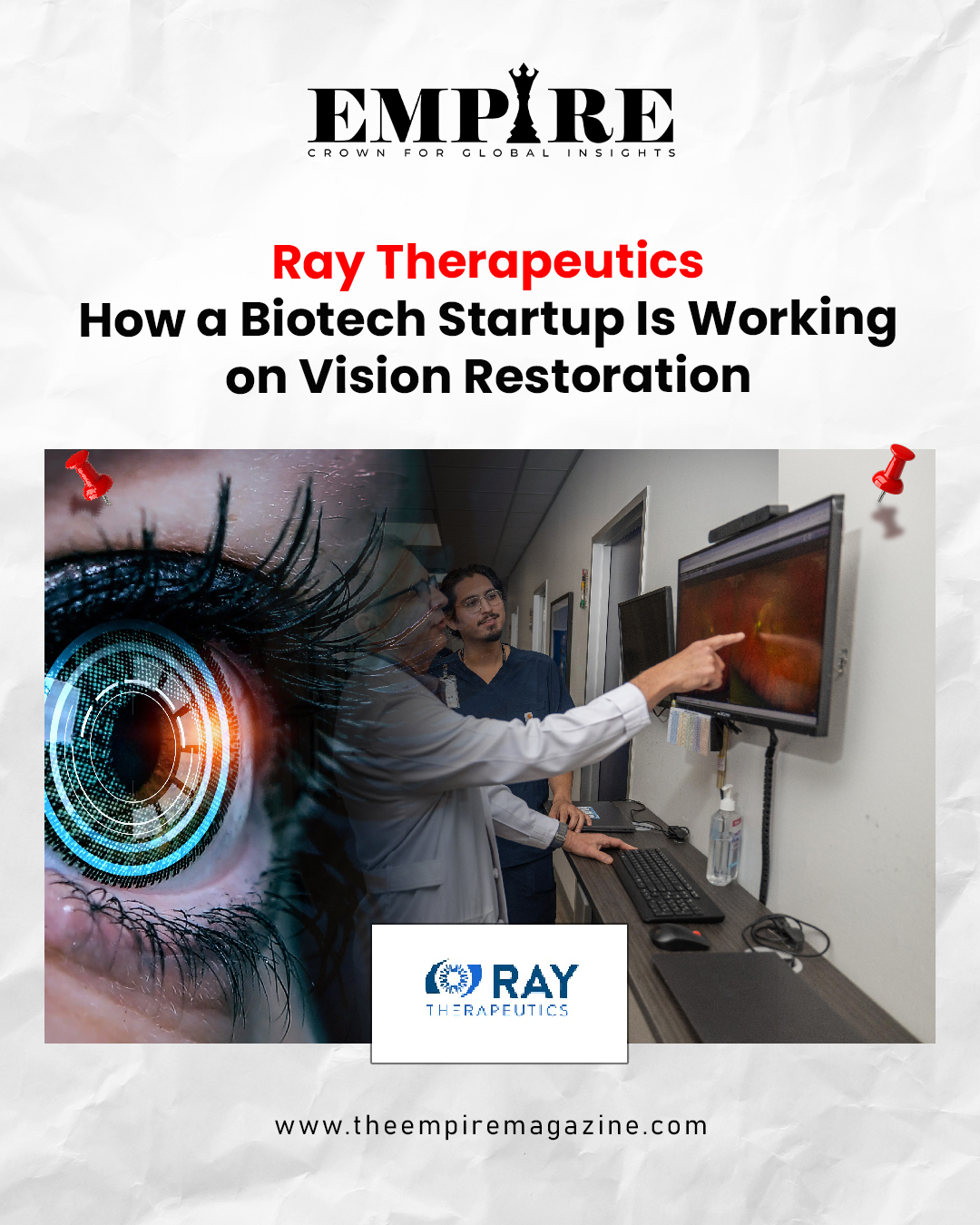
Ray Therapeutics is a clinical-stage biotechnology company working on new treatments for serious retinal diseases that can lead to severe vision loss or blindness. The company is focused on optogenetic gene therapies, a scientific approach designed to help restore functional vision in people with advanced retinal degeneration.
Ray Therapeutics has gained attention because its lead program, RTx-015, is being developed for retinitis pigmentosa, a rare inherited retinal disease that gradually damages the retina and can lead to blindness. The company is also studying its approach for other serious eye diseases, including choroideremia, Stargardt disease, and geographic atrophy.
The startup represents an important part of the growing ophthalmology biotech sector, where companies are trying to address diseases that currently have limited or no effective treatment options. For patients with inherited retinal conditions, the need is urgent because many of these diseases progress over time and can deeply affect independence, mobility, work, and quality of life.
Ray Therapeutics and the Need for Vision Restoration
Vision restoration is one of the most challenging areas in biotechnology. Many retinal diseases damage photoreceptors, the light-sensitive cells in the eye that help convert light into visual signals. When these cells are lost, vision can become severely limited.
Retinitis pigmentosa is one of the key diseases targeted by Ray Therapeutics. It is not a single condition caused by one mutation. Instead, it includes a group of inherited retinal diseases connected to many different genetic mutations. This makes treatment development difficult because a therapy designed for one mutation may not help patients with another mutation.
Ray Therapeutics is working on an optogenetic approach that may be useful across different genetic causes of disease. This is important because mutation-specific treatments can be powerful, but they may only serve smaller groups of patients. A broader approach could potentially reach more people affected by advanced retinal degeneration.
What Makes RTx-015 Important
RTx-015 is the company’s lead investigational therapy. It is being studied as an optogenetic gene therapy for patients with retinitis pigmentosa and choroideremia. According to Ray Therapeutics, RTx-015 is delivered through a single intravitreal injection into one eye.
The therapy is currently being evaluated in the ENVISION Phase 1 clinical trial. This study is designed to assess safety and preliminary efficacy. The trial is open-label, non-randomized, and multicenter, and it includes patients with retinitis pigmentosa or choroideremia.
For a biotech startup, reaching clinical-stage development is an important milestone. It means the therapy has moved from laboratory and preclinical research into human testing. However, RTx-015 is still investigational, and its safety and effectiveness must be proven through clinical studies before it can be considered for wider medical use.
Understanding Optogenetic Gene Therapy
Optogenetics is a scientific method that uses light-sensitive proteins to help cells respond to light. In the context of retinal disease, the idea is to make remaining retinal cells more responsive to light after natural photoreceptors have been damaged or lost.
This approach is different from traditional gene replacement therapies that aim to correct or replace a specific defective gene. Because retinitis pigmentosa can be caused by many mutations, a mutation-independent strategy may be valuable for patients with advanced disease.
Ray Therapeutics’ work is focused on restoring functional vision rather than simply slowing disease progression. This makes the company’s platform especially interesting in the vision-restoration field. Still, optogenetic therapies are complex, and real clinical benefit must be carefully measured in patients over time.
Regulatory Progress for Ray Therapeutics
Ray Therapeutics has received important regulatory designations for RTx-015. In April 2026, the U.S. Food and Drug Administration granted Regenerative Medicine Advanced Therapy designation to RTx-015 for the treatment of retinitis pigmentosa. RMAT designation is given to certain regenerative medicine therapies intended to treat serious conditions where early clinical evidence suggests potential to address unmet medical needs.
The company also announced that RTx-015 received Priority Medicines designation from the European Medicines Agency for retinitis pigmentosa. PRIME is designed to support the development of medicines that may offer a major therapeutic advantage or benefit patients without existing treatment options.
These designations do not mean the therapy is approved. Instead, they may help support closer regulatory interaction and more efficient development if the data continues to be promising. For patients and investors, such designations can be important signals that a therapy is being recognized as a potential answer to a serious unmet need.
Why Retinitis Pigmentosa Is a Major Target
Retinitis pigmentosa is a progressive retinal disease that usually affects vision over many years. Patients may first notice difficulty seeing at night or reduced peripheral vision. As the disease advances, central vision may also be affected.
There are limited treatment options for many forms of retinitis pigmentosa. Because the condition can result from many different mutations, developing broad therapies has been difficult. This is why companies like Ray Therapeutics are exploring approaches that do not depend on correcting only one specific genetic defect.
A successful vision-restoration therapy could change the treatment landscape for people who already have significant vision loss. That is one reason RTx-015 is being closely watched in the ophthalmology biotech space.
Funding Behind the Vision-Restoration Pipeline
Biotech development requires significant investment because research, manufacturing, clinical trials, and regulatory work are expensive and time-consuming. Ray Therapeutics has raised major funding to support its programs.
In 2023, the company announced a $100 million Series A financing round to advance its optogenetic gene therapy programs for blinding retinal diseases. Investors included Novo Holdings, Deerfield Management, Norwest Venture Partners, Platanus, MRL Ventures Fund, and 4BIO Capital.
In April 2026, Ray Therapeutics announced an upsized and oversubscribed $125 million Series B financing round. The company said the funding would support late-stage clinical development and commercial readiness for RTx-015 in retinitis pigmentosa, as well as clinical studies for RTx-021 in Stargardt disease and geographic atrophy.
This level of funding shows strong investor interest in the company’s platform and pipeline. It also gives Ray Therapeutics more resources to continue clinical development, expand research, and prepare for future regulatory and commercial steps if the data supports progress.
Pipeline Beyond RTx-015
Although RTx-015 is the lead program, Ray Therapeutics is also building a broader pipeline. RTx-021 is being developed for Stargardt disease and geographic atrophy. These are also serious retinal conditions where patients may face major vision impairment.
Stargardt disease is an inherited retinal disease that often affects central vision. Geographic atrophy is an advanced form of age-related macular degeneration, a major cause of vision loss in older adults. These areas represent large medical needs and have attracted significant biotech and pharmaceutical interest.
By expanding beyond retinitis pigmentosa, Ray Therapeutics is positioning itself as a company focused on multiple forms of retinal degeneration, not just one disease. This broader strategy may help the company apply its optogenetic platform across several conditions where vision restoration remains a major goal.
The Challenge of Turning Science Into Treatment
Ray Therapeutics is working in a field with high potential but also high difficulty. Retinal gene therapies require careful delivery, strong safety monitoring, durable effects, and meaningful improvements in patient function. Clinical trials must show whether patients can experience real benefits in daily life, not only changes in laboratory measurements.
Another challenge is manufacturing. Gene therapies are complex biological products, and producing them at quality and scale can be difficult. Companies must also work closely with regulators, clinicians, patient communities, and treatment centers.
For Ray Therapeutics, the coming stages of clinical development will be critical. The company must continue generating data on safety, dosing, visual function, and long-term follow-up. Success will depend on whether its therapy can show meaningful benefit for patients with advanced retinal disease.
Why Ray Therapeutics Matters in Biotech
Ray Therapeutics matters because it is addressing diseases where many patients have few treatment choices. The company’s work also reflects a broader shift in biotechnology toward advanced therapies that aim to restore function, not only manage symptoms.
Vision loss can affect nearly every part of life. It can limit mobility, reading, work, social interaction, and independence. A therapy that restores even partial functional vision could have a meaningful impact for patients with severe retinal degeneration.
The company’s progress also highlights the importance of specialized biotech startups. Large pharmaceutical companies often invest in broad therapeutic areas, but startups can focus deeply on difficult scientific problems. Ray Therapeutics is an example of how a focused biotech company can attract funding, regulatory attention, and clinical interest by targeting a serious unmet medical need.
Readers can also explore more business and innovation insights through this related article: Macy’s Luxury Retail Strategy: Why Premium Shoppers Still Matter.
For more updates from The Empire Magazine, follow us on Facebook and Instagram.
– The Empire Magazine
Crown For Global Insights