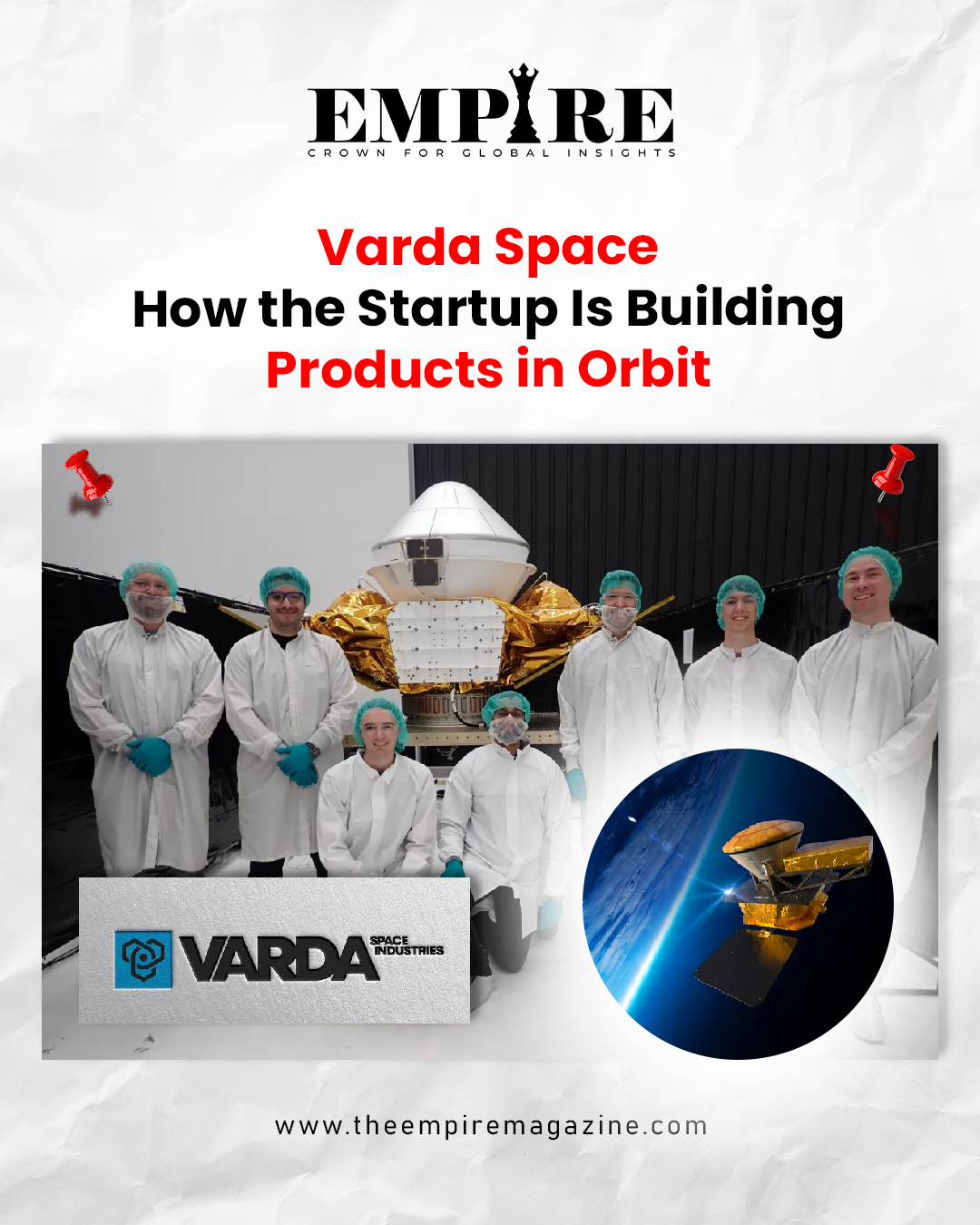
Varda Space is one of the most ambitious startups in the new space economy because it is not only trying to send objects into orbit. It is trying to manufacture products in space and bring them back to Earth. The company, officially known as Varda Space Industries, is focused on microgravity-enabled life sciences, especially pharmaceutical processing in orbit.
Founded in 2021 and based in El Segundo, California, Varda Space is building spacecraft that can produce materials in low Earth orbit and return those materials safely through reentry capsules. This makes the company different from many space startups that focus on launch, satellites, imaging, or communications. Varda’s central idea is that space can become a manufacturing environment for high-value Earth markets.
The company’s work is important because microgravity can change how materials behave. In orbit, fluids, crystals, and biological materials can form differently than they do under Earth’s gravity. For pharmaceuticals, this may create opportunities to improve drug formulations, study new crystal forms, and develop products that are difficult or impossible to make on Earth.
Varda Space and the Rise of In-Orbit Manufacturing
Varda Space is part of a growing movement around in-orbit manufacturing. The idea is that space should not only be used for exploration or communication satellites. It can also become a place where valuable materials are made under unique physical conditions.
For decades, scientists have studied materials and biological processes in microgravity aboard space stations and research missions. The challenge was that space experiments were expensive, limited, and often dependent on government programs. Varda is trying to commercialize that idea by building a repeatable system for private companies, especially in life sciences.
The company’s W-Series spacecraft is designed as a free-flying orbital production system. It does not need to be attached to the International Space Station. It can operate independently in orbit, process materials, and return a capsule to Earth. This independence is important because it could make space manufacturing more frequent, scalable, and commercially useful.
Why Microgravity Matters for Pharmaceuticals
Microgravity matters because materials can behave differently when gravity is greatly reduced. On Earth, gravity affects how particles settle, how fluids mix, and how crystals grow. In space, those processes can happen in different ways, sometimes creating more uniform structures or new forms.
For pharmaceuticals, crystal structure can be extremely important. The form of a drug crystal can affect stability, solubility, manufacturing performance, and how a medicine is delivered. If microgravity helps produce crystal forms that are difficult to create on Earth, it could open new possibilities for drug development.
Varda’s first major demonstration focused on ritonavir, an antiretroviral drug used in HIV treatment. The W-1 mission grew crystals of Form III of ritonavir in orbit and returned them to Earth. This showed that Varda could process pharmaceutical material in space and bring it back through a commercial reentry system.
From Space Experiment to Commercial Platform
The key difference in Varda’s model is that it wants to turn space research into a repeatable commercial platform. A one-time experiment is useful, but a business needs reliable launch, production, reentry, recovery, and customer service.
Varda is building the full logistics chain. Its system includes the orbital production spacecraft, the reentry capsule, and recovery operations on Earth. This is important because in-orbit manufacturing only works commercially if products can return safely and predictably.
The company is also working with partners such as Rocket Lab, which has provided spacecraft support for Varda missions. Rocket Lab’s Pioneer spacecraft helped support Varda’s first mission and enabled the orbital phase before the capsule returned to Earth.
The W-1 Mission and Reentry Milestone
Varda Space reached an important milestone when its W-1 capsule returned to Earth in February 2024. The capsule landed at the Utah Test and Training Range after spending months in orbit. According to Varda, W-1 was the first commercial spacecraft to land on a military test range, the first commercial spacecraft to land on U.S. soil, and the first spacecraft approved to reenter under the FAA’s Part 450 license.
This was a major achievement because reentry is one of the hardest parts of space logistics. A capsule returning from orbit travels at extremely high speed and must survive intense heat, pressure, and aerodynamic forces before landing safely. For Varda, the reentry system is not just a technical detail. It is central to the business model.
Without safe reentry, products made in orbit cannot reach Earth. By proving that its capsule could return, Varda showed that it could complete the full manufacturing loop: launch, operate in space, produce material, reenter, and recover.
Why Reentry Capability Is a Business Advantage
Reentry capability gives Varda a business advantage because many space companies can send hardware into orbit, but fewer can bring products back safely. Manufacturing in space requires both directions: access to orbit and return from orbit.
Varda’s reentry capsules also create another business opportunity. The company has positioned its capsules as useful for government and defense customers that need hypersonic reentry testing. A capsule returning from orbit experiences extreme conditions, making it a valuable platform for testing heat shields, sensors, communications, and other technologies.
This means Varda’s platform can serve both biopharma customers and government customers. The dual-use nature of the technology may help the company build revenue while the space manufacturing market develops.
Funding and Investor Confidence
Varda has attracted major investor interest. In 2024, the company raised $90 million in Series B funding to support its space manufacturing efforts. In 2025, Varda announced a $187 million Series C round, bringing total capital raised to $329 million.
This level of funding is important because space manufacturing requires heavy upfront investment. The company must build spacecraft, test reentry systems, develop pharmaceutical processing equipment, meet regulatory requirements, and operate missions reliably.
Investors are backing Varda because the company is trying to create a new industrial category. If microgravity manufacturing becomes commercially valuable, Varda could become one of the first companies with the infrastructure to support it regularly.
Varda’s Business Model
Varda’s business model is built around making high-value products in orbit for use on Earth. The near-term focus is pharmaceuticals, where small improvements in formulation or delivery can carry major commercial value.
The company is not trying to manufacture ordinary low-cost goods in space. That would not make economic sense because launching and returning materials is expensive. Instead, Varda is targeting products where the value per kilogram is high enough to justify the cost.
Pharmaceuticals fit this logic because medicines can be extremely valuable, and small changes in structure or formulation can affect performance. If space-based processing can help create better drug forms, pharma companies may be willing to pay for access to microgravity manufacturing.
Why Space Manufacturing Is Still Early
Varda’s opportunity is large, but the market is still early. Space manufacturing has not yet become a mature commercial industry. Many questions remain about cost, scalability, regulation, repeatability, and whether space-made materials can deliver clear advantages over Earth-made products.
Pharmaceutical applications also require significant testing. Even if a drug crystal is produced in space, it must still go through scientific validation, manufacturing review, quality control, and regulatory pathways before it can become part of a commercial medicine.
This means Varda’s progress should be seen as early-stage industrial development, not immediate mass production. The company has shown technical ability, but the commercial market will take time to prove.
Government and Hypersonic Testing Opportunities
Varda’s reentry capsules are also relevant to government customers. The company says its orbital capsules can enter the atmosphere at around 18,000 miles per hour and reach Mach 25+ before landing by parachute. This creates real-world hypersonic reentry conditions that are difficult to test frequently on Earth.
Government agencies can use this type of platform to test materials, thermal protection systems, navigation, sensors, and communications in realistic environments. This makes Varda’s business broader than pharmaceuticals alone.
In 2025, Varda completed a commercial reentry landing in Australia, and in 2026 it announced the successful execution of its W-5 mission reentry, which carried a U.S. Navy payload. These missions show how the company is building flight heritage across both commercial and government applications.
Why Varda Space Matters for the Space Economy
Varda Space matters because it is trying to move the space economy beyond satellites and launch services. For years, most commercial space activity has centered on communications, Earth observation, navigation, and launch. Varda is betting that the next stage will include manufacturing and logistics.
If the company succeeds, low Earth orbit could become a place where companies make specialized products that are returned to Earth for use in medicine, materials, and technology. This would create a new reason for companies to access space.
Varda’s approach also reflects a larger trend: the space economy is becoming more industrial. Instead of sending experiments to orbit occasionally, companies are building repeatable platforms, supply chains, and business models around space-based production.
The Future of Products Built in Orbit
Varda Space is still at an early stage, but its missions show that in-orbit manufacturing is becoming more practical. The company has demonstrated pharmaceutical processing, commercial reentry, and recovery. It has also raised significant funding to increase flight frequency and expand its platform.
The future will depend on whether Varda can prove that products made in orbit deliver real advantages for customers on Earth. If pharmaceutical companies see clear benefits, the company’s model could become an important part of drug development and formulation research.
Varda Space is building more than capsules. It is building a new logistics system between Earth and orbit. That system could help define how products are manufactured in microgravity and returned for use in the real world.
Readers can also explore more global business and trade insights through this related article: Oil and Goods Routes: Why the Strait of Hormuz Remains a Global Business Risk.
For more updates from The Empire Magazine, follow us on Facebook and Instagram.
– The Empire Magazine
Crown For Global Insights