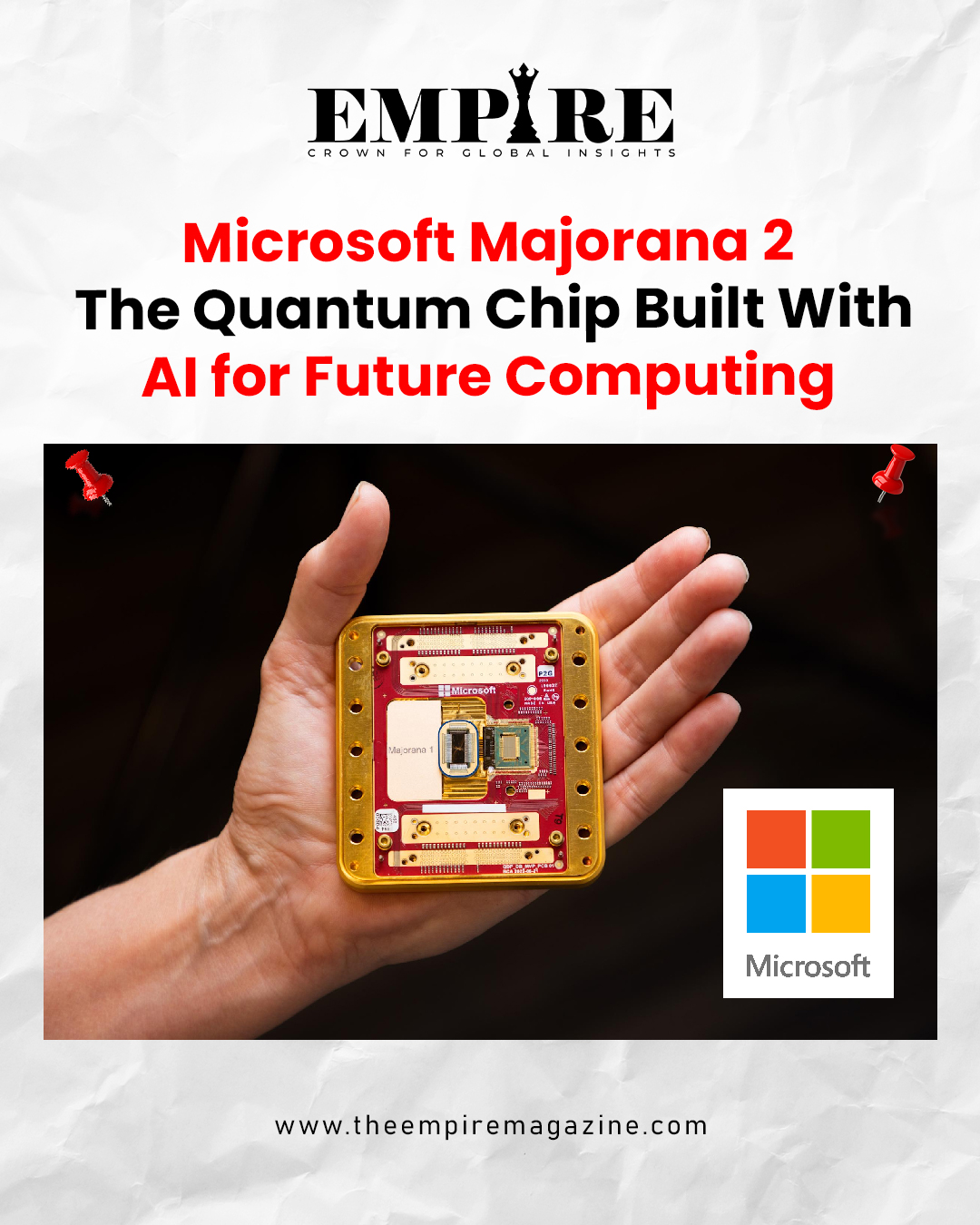
Microsoft Majorana 2 is the company’s next-generation quantum computing chip, developed with the help of Microsoft Discovery, an agentic AI platform designed to support scientific research, materials discovery, and engineering workflows. The chip represents Microsoft’s latest step toward building a practical quantum computer based on topological qubits, a long-researched approach that aims to make quantum information more stable and less vulnerable to errors.
Microsoft introduced Majorana 2 after its earlier Majorana 1 chip, which was presented as a breakthrough in topological quantum computing. The new chip is important because Microsoft says it delivers major improvements in qubit reliability and stability. According to the company, Majorana 2 uses a new materials stack and supports its updated target of achieving a scalable quantum computer by 2029.
Quantum computing is still an early and highly complex field. Companies such as Microsoft, IBM, Google, Amazon, and several research institutions are working on different approaches to make quantum machines useful for real-world problems. Microsoft’s strategy is different from many rivals because it is focused on topological qubits, which are designed to reduce errors at the hardware level.
Microsoft Majorana 2 and the Race for Practical Quantum Computing
Microsoft Majorana 2 arrives at a time when the quantum computing industry is moving from laboratory research toward more defined commercial roadmaps. Quantum computers are not meant to replace normal computers for everyday tasks. Instead, they are expected to help solve certain complex problems that are extremely difficult for classical computers.
These problems may include molecular simulation, advanced materials research, chemistry, optimization, and cryptography-related challenges. However, useful quantum computing requires qubits that can remain stable long enough to perform calculations accurately. This is one of the biggest barriers in the industry.
Traditional qubits are highly sensitive to noise, temperature changes, and environmental interference. These problems create errors, which means quantum computers need strong error correction. Microsoft’s topological approach is designed to make qubits more naturally protected from some of these issues.
What Makes Majorana 2 Different
Majorana 2 is built around Microsoft’s topological quantum computing research. The chip is linked to Majorana zero modes, which are exotic quasiparticles that scientists have studied for their potential role in creating more stable quantum systems.
The company says Majorana 2 uses a new materials design compared with Majorana 1. Reports describe the new version as replacing aluminum with lead in the superconducting layer and improving the semiconductor region with materials involving indium arsenide and indium arsenide antimonide. Microsoft says these changes helped improve reliability and qubit lifetime.
This matters because one of the central goals of quantum hardware is to keep qubits stable. If qubits lose their state too quickly, the system cannot perform reliable calculations. Microsoft has said Majorana 2 shows a large improvement in some performance areas compared with the earlier generation.
The Role of AI in Building the Chip
A major part of the Microsoft Majorana 2 story is the use of Microsoft Discovery. This platform uses agentic AI to help researchers explore scientific and engineering problems more efficiently. In the case of Majorana 2, Microsoft says AI helped support the search for better materials and chip design improvements.
This does not mean AI alone created the chip. The work still depends on quantum physicists, materials scientists, engineers, fabrication teams, and experimental testing. However, AI tools can help accelerate parts of the research process by analyzing possibilities, supporting simulations, and helping scientists narrow down promising material combinations.
In modern chip development, materials science is one of the hardest challenges. Small changes in a material stack can affect performance, stability, and reliability. By using AI-assisted research tools, Microsoft is trying to shorten the time needed to identify better combinations and improve device design.
Why Topological Qubits Matter
Topological qubits are important because they aim to store quantum information in a way that is less affected by local noise. In theory, this could reduce the amount of error correction needed to build useful quantum computers.
Most quantum computing systems require many physical qubits to create one reliable logical qubit. This creates a scaling challenge. If topological qubits can reduce errors at the hardware level, they could make it easier to build machines with many usable qubits.
Microsoft has promoted this approach for years, even though it is considered difficult and scientifically demanding. The company’s long-term goal is to create a quantum computer that can scale to solve industrial and scientific problems that are beyond classical computing.
Majorana Particles and Scientific Debate
The name Majorana comes from Ettore Majorana, the Italian physicist who theorized particles that could act as their own antiparticles. In quantum computing, Majorana zero modes are not ordinary particles found floating freely. They are quasiparticle states that may appear in special material systems under specific conditions.
Microsoft’s work in this area has attracted both interest and skepticism. The company has previously faced scientific scrutiny over Majorana-related claims, including debate around whether the evidence fully proves the creation and control of the needed states. This is why many researchers are watching Majorana 2 closely.
The technology may be promising, but quantum computing claims require careful evidence, repeatable experiments, and transparent scientific validation. Microsoft says it has shared data with relevant groups and continues to stand behind its work. Still, broader acceptance will depend on further results, peer review, and real-world performance.
Microsoft’s 2029 Quantum Computing Target
With Majorana 2, Microsoft has stated that it is targeting a scalable quantum computer by 2029. This timeline places the company in a competitive race with other major quantum players. IBM has also discussed ambitious plans for useful quantum systems by the end of the decade.
The 2029 target is significant because it suggests Microsoft believes its hardware progress is moving faster than before. However, building a commercially useful quantum computer remains extremely difficult. The industry still needs better hardware, better error correction, better software, and reliable ways to connect and control large numbers of qubits.
Microsoft is also active in quantum software and cloud services. Through Azure Quantum, the company provides access to quantum tools and hardware from different providers. This means Microsoft is not only building its own chip technology but also supporting a broader quantum ecosystem.
Potential Uses of Quantum Computing
If Microsoft Majorana 2 leads to scalable quantum systems, the impact could be important across several industries. Quantum computers may help scientists simulate molecules more accurately, which could support drug discovery and chemistry research.
They may also help in materials science, where researchers want to design better batteries, catalysts, superconductors, and industrial materials. In logistics and finance, quantum computing may eventually support complex optimization problems, although practical use cases still need more development.
For now, these applications remain future-focused. Majorana 2 is not a consumer chip, and it is not a finished commercial quantum computer. It is a step in Microsoft’s long-term hardware roadmap.
Why Businesses Are Paying Attention
Businesses are watching quantum computing because it could create major advantages in research, security, manufacturing, and data-heavy industries. Even though practical quantum machines are not widely available today, companies are preparing for the possibility that the technology may become useful in the coming years.
Microsoft’s work matters because the company already has a strong enterprise technology ecosystem. If it succeeds in building scalable quantum hardware, it could connect quantum computing with cloud services, developer tools, and scientific platforms.
This would make quantum computing more accessible to researchers, corporations, and institutions that already use Microsoft’s cloud and software products.
The Challenge Ahead for Majorana 2
Microsoft Majorana 2 is a major announcement, but the next challenge is proof at scale. A successful quantum chip must not only show improved qubit performance in controlled settings. It must also support error correction, integration, manufacturing consistency, and large-scale system operation.
The path from experimental chip to useful quantum computer is long. Microsoft must show that its topological approach can move from promising physics to reliable engineering. The company also needs to demonstrate that Majorana-based qubits can work in systems large enough to solve real problems.
This is why Majorana 2 should be seen as an important milestone, not a finished revolution. It strengthens Microsoft’s quantum roadmap and shows how AI-assisted scientific discovery may support advanced chip development. But the final test will be whether the technology can deliver practical quantum computing in the real world.
Readers can also explore more innovation and biotech insights through this related article: Ray Therapeutics: The Biotech Startup Working on Vision Restoration.
For more updates from The Empire Magazine, follow us on Facebook and Instagram.
– The Empire Magazine
Crown For Global Insights