
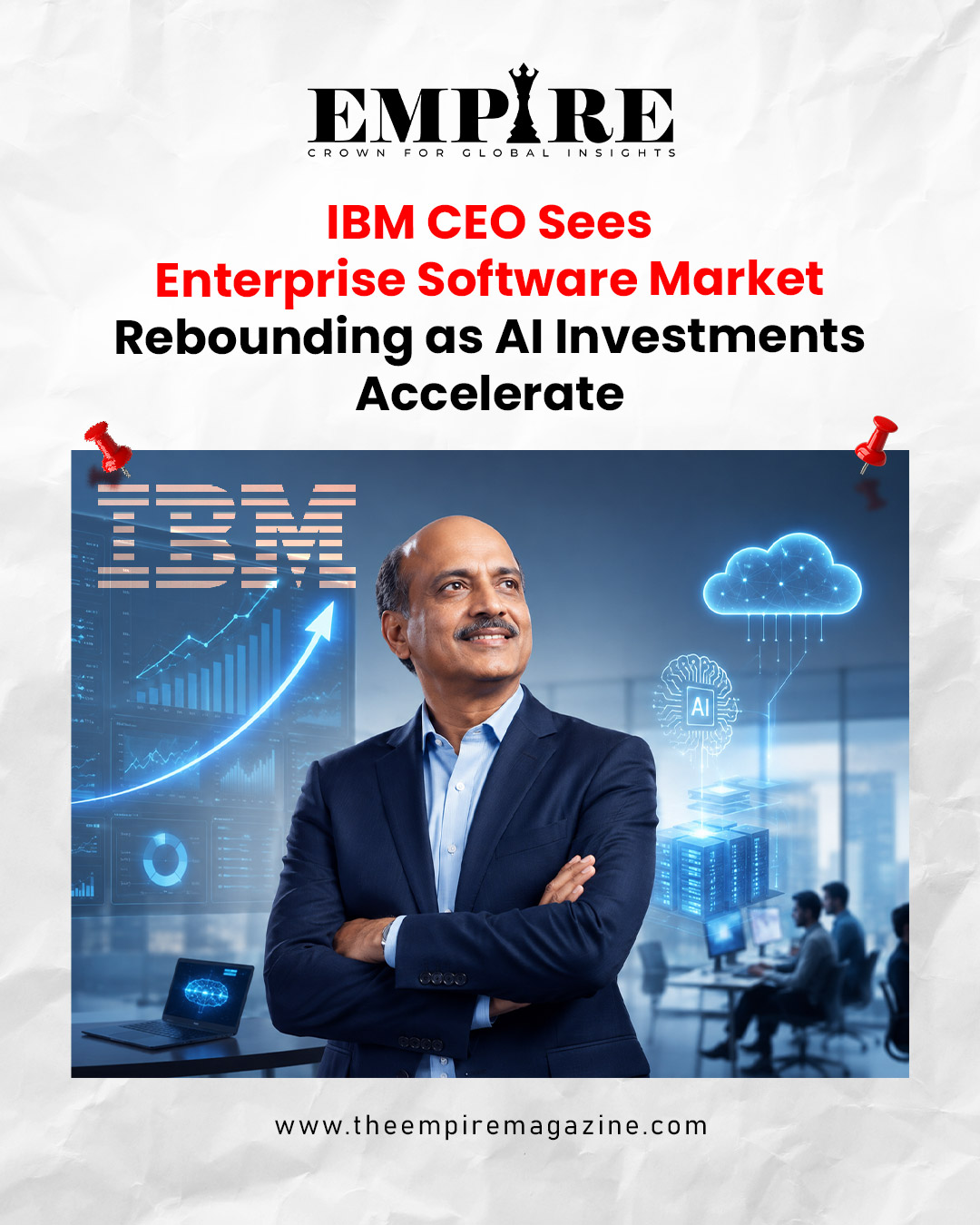
IBM CEO says enterprise software market is rebounding as AI investments accelerate. Discover how generative AI is reshaping enterprise technology, business growth, and digital transformation. IBM CEO Arvind Krishna believes the enterprise software market is entering a new phase of growth as organisations worldwide increase investments in artificial intelligence. With generative AI, hybrid cloud, automation, and enterprise software becoming strategic priorities, businesses are accelerating digital transformation despite ongoing economic uncertainty.
IBM CEO Sees Enterprise Software Market Rebounding as AI Investments Accelerate
The global technology industry is once again witnessing a shift in momentum, and this time, artificial intelligence is leading the transformation. After months of cautious spending caused by inflation, economic uncertainty, and tighter corporate budgets, enterprise technology appears to be regaining strength. According to IBM CEO Arvind Krishna, businesses are no longer treating artificial intelligence as an experimental technology but as a strategic necessity capable of delivering measurable business value. His optimism reflects a growing trend among global enterprises that are increasing investments in AI-powered software, automation, cloud infrastructure, and digital transformation initiatives. Organisations across industries—from banking and healthcare to manufacturing and retail are recognising that long-term competitiveness will increasingly depend on intelligent software capable of improving efficiency, enhancing customer experiences, and enabling data-driven decision-making. As generative AI matures and enterprises seek scalable solutions, the enterprise software market is showing clear signs of recovery, signalling the beginning of a new technology investment cycle that could redefine how businesses operate over the next decade.
Enterprise Software Market Enters a New AI Era
The IBM CEO Enterprise Software Market outlook comes at a time when businesses worldwide are reassessing their technology priorities. Over the past two years, many organisations delayed software upgrades and digital transformation projects because of rising interest rates and uncertain economic conditions. However, the rapid evolution of generative AI has fundamentally changed boardroom conversations. Rather than viewing technology spending purely as an operational expense, executives increasingly consider AI investments as essential growth drivers capable of improving productivity, reducing operational costs, and creating new revenue opportunities. Enterprise software vendors are responding by embedding AI capabilities directly into business applications, enabling companies to automate workflows, generate insights from massive datasets, and improve decision-making processes. As a result, enterprises are moving beyond isolated AI experiments and adopting integrated platforms that combine cloud computing, analytics, cybersecurity, and automation into comprehensive digital ecosystems. This renewed confidence is expected to stimulate software spending across industries while encouraging organisations to modernise legacy systems that are no longer capable of supporting intelligent business operations.
IBM CEO Enterprise Software Strategy Signals Confidence
IBM has positioned itself at the centre of this transformation through its long-term focus on hybrid cloud computing, enterprise AI, and consulting services. Arvind Krishna has consistently emphasised that businesses require practical AI solutions capable of delivering measurable returns rather than simply adopting emerging technologies for publicity. IBM’s strategy revolves around integrating generative AI into enterprise workflows while maintaining strong governance, security, and regulatory compliance. Products such as Watsonx have been designed to help organisations develop, train, and deploy AI models within secure environments suitable for highly regulated industries. This approach distinguishes IBM from companies focused primarily on consumer AI applications, as enterprise customers prioritise data privacy, transparency, and operational reliability. Krishna believes that organisations increasingly recognise the importance of trusted AI, particularly as governments introduce stricter regulations governing artificial intelligence. Consequently, IBM’s enterprise-focused strategy aligns with evolving customer expectations and positions the company to benefit from the growing demand for responsible AI adoption across global markets.
IBM CEO Enterprise Software Investments Drive Business Growth
One of the strongest indicators supporting the IBM CEO Enterprise Software Market outlook is the rising level of enterprise AI investment across multiple sectors. Financial institutions are deploying AI-powered systems for fraud detection and customer service, healthcare providers are using machine learning to improve diagnostics and patient care, manufacturers are implementing predictive maintenance solutions, while retailers are leveraging AI to personalise customer experiences and optimise supply chains. These applications demonstrate that artificial intelligence is delivering tangible business outcomes rather than remaining a theoretical innovation. As organisations witness measurable improvements in productivity and operational efficiency, confidence in enterprise software continues to strengthen. Technology budgets are increasingly being redirected toward platforms capable of integrating AI with existing enterprise systems, creating demand for software vendors that offer scalable and secure solutions. IBM believes this trend represents the beginning of a sustained investment cycle rather than a temporary surge, particularly as companies continue expanding digital transformation initiatives to remain competitive in rapidly evolving global markets.
AI Investments Are Changing Enterprise Decision-Making
Artificial intelligence is transforming not only business operations but also executive decision-making. Modern enterprise software equipped with AI capabilities enables organisations to analyse vast quantities of structured and unstructured data in real time, uncover patterns, forecast market trends, and automate routine administrative tasks. This significantly enhances strategic planning while allowing employees to focus on higher-value activities requiring creativity and human judgment. The emergence of generative AI has further expanded these possibilities by enabling software to create reports, draft documents, generate code, summarise research, and assist customer interactions with remarkable speed. IBM believes these capabilities will fundamentally reshape enterprise productivity over the coming years. Nevertheless, successful implementation depends on robust governance frameworks that ensure AI systems remain transparent, accurate, secure, and aligned with organisational objectives. Enterprises are therefore investing not only in AI technology itself but also in workforce training, cybersecurity, ethical AI policies, and data management practices that support sustainable long-term adoption.
Enterprise Software Market Faces New Opportunities
Although optimism surrounding AI remains strong, the enterprise software market continues to face several challenges that businesses must carefully navigate. Data privacy regulations, cybersecurity risks, infrastructure costs, integration complexity, and the shortage of skilled AI professionals remain significant concerns for organisations implementing advanced technologies. Many enterprises also struggle to modernise decades-old legacy systems that cannot easily support AI-driven applications. IBM argues that hybrid cloud environments provide an effective pathway by allowing businesses to integrate new AI capabilities without completely replacing existing infrastructure. This flexible approach enables organisations to innovate while managing costs and reducing operational disruption. Industry analysts similarly expect enterprise software providers capable of combining cloud computing, cybersecurity, automation, and AI into unified platforms to outperform competitors over the next several years. As regulatory frameworks mature and technology standards improve, enterprise adoption is likely to accelerate further, creating new growth opportunities for software companies, consulting firms, and technology service providers worldwide.
IBM CEO Enterprise Software Vision for the Future
Looking ahead, Arvind Krishna remains confident that artificial intelligence will become deeply embedded within every aspect of enterprise software, transforming industries in much the same way cloud computing reshaped business technology over the past decade. Rather than replacing human workers, IBM envisions AI augmenting employees by automating repetitive processes, improving decision-making, and enabling faster innovation across departments. Organisations that strategically combine AI with skilled talent, secure infrastructure, and responsible governance are expected to achieve sustainable competitive advantages in increasingly digital economies. For technology providers, the focus will shift from demonstrating AI capabilities to delivering measurable business outcomes that justify long-term investments. As enterprise leaders continue prioritising productivity, operational resilience, and customer experience, demand for intelligent software platforms is expected to remain strong. IBM’s outlook suggests that the enterprise software market is entering a new growth cycle powered by artificial intelligence, making this one of the most significant transformations in modern business technology.
IBM CEO Enterprise Software Market forecast reflects more than corporate optimism
The IBM CEO Enterprise Software Market forecast reflects more than corporate optimism it signals a broader transformation underway across the global business landscape. Artificial intelligence has evolved from an emerging innovation into a strategic business imperative, influencing investment decisions at every level of the enterprise. Organisations are increasingly recognising that future competitiveness depends on intelligent software capable of improving efficiency, accelerating innovation, and supporting better decision-making. IBM’s emphasis on trusted AI, hybrid cloud infrastructure, and enterprise-grade solutions demonstrates how technology providers are adapting to meet these evolving expectations. While challenges surrounding regulation, cybersecurity, and implementation remain, the momentum behind AI investments continues to strengthen. As businesses move beyond experimentation toward enterprise-wide adoption, the software market appears well-positioned for sustained growth. If current trends continue, AI-driven enterprise software will not simply support digital transformation—it will define the next generation of global business success.
For more business and retail insights, read more on The Empire Magazine
Previous article: https://theempiremagazine.com/china-military/
Magazine Feautures | Podcasts: Empire Global Talks
Follow The Empire Magazine on Facebook | Instagram | LinkedIn | YouTube
The Empire Magazine | Crown for Global Insights