
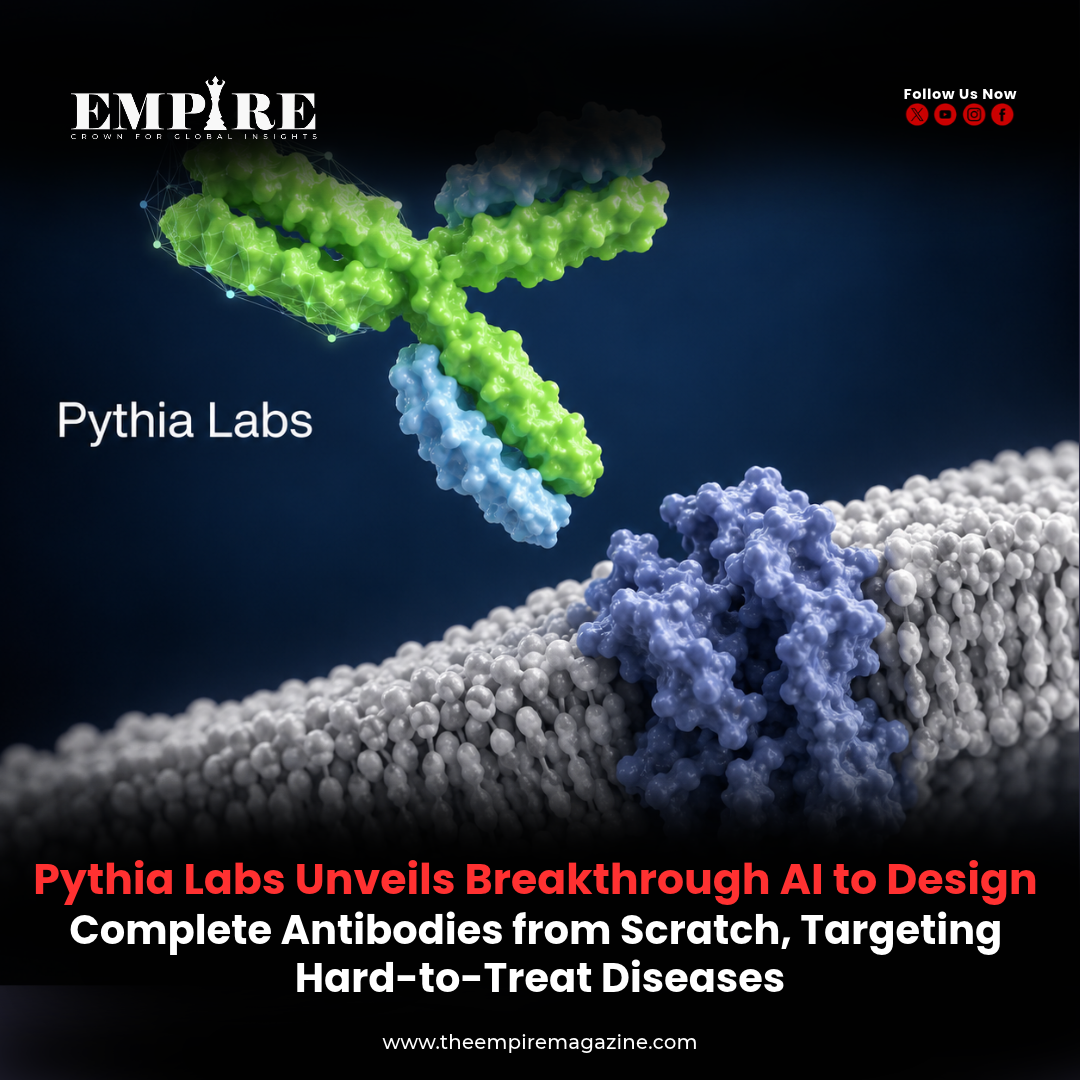
The biotechnology startup reports laboratory results from AI-designed antibodies, including candidates that activate or inhibit challenging cell-surface receptors.
United States | Artificial Intelligence, Biotechnology & Startups
Information checked on 28 October 2026.
Pythia-1, an artificial intelligence model developed by Pythia Labs, is designed to generate full-length antibody candidates with specific biological functions. The company announced its launch on 27 October 2026, alongside research describing its approach to targets that have challenged conventional antibody discovery.
The platform combines information about protein sequences, three-dimensional structures and design requirements to propose new molecules for experimental testing.
Pythia’s announcement highlights antibodies that can influence G protein-coupled receptors, commonly known as GPCRs. These proteins sit in cell membranes and help transmit signals into cells.
The findings represent an early research milestone. They have been presented in a bioRxiv preprint, with reported evidence from laboratory and cell-based experiments. Further development would be necessary before any candidate could be assessed as a medicine.
What Is Pythia-1?
Pythia-1 is an all-atom generative model at the centre of the company’s antibody-design platform.
According to Pythia Labs, the model considers an antibody’s amino acid sequence and three-dimensional atomic structure together, while working within specified design constraints.
The intended outcome is a molecule designed for a particular interaction with a biological target.
Designing for a Specific Function
Pythia lab says its platform can guide where an antibody binds and which shape, or conformational state, of a target it recognises.
These choices matter because attaching to a protein is only one part of antibody development. Researchers also need to establish what happens after binding.
For example, an antibody might be intended to prevent a receptor from responding to a signal. Another might be designed to activate it.
The platform aims to incorporate that intended function into the design process.
What Does Designing Antibodies “From Scratch” Mean?
The research concerns newly generated antibody candidates produced through computational design.
Pythia lab describes its outputs as full-length human immunoglobulin G, or IgG, antibodies. The study therefore evaluates candidates in a complete antibody format rather than reporting only a small binding fragment.
However, “from scratch” does not mean that the model works without existing biological knowledge.
Human Antibody Frameworks Guide the Process
Pythia lab says researchers can specify human antibody frameworks and apply constraints intended to avoid problematic sequence features.
Those requirements help direct the model towards molecules with properties relevant to further development.
The AI proposes designs, while laboratory experiments determine how the resulting molecules actually behave. Computational generation does not remove the need for physical testing.
What the Proof-of-Concept Study Examined
The researchers evaluated the approach across 22 therapeutic targets, including soluble proteins, receptor regions, cytokines, growth factors and GPCRs.
According to the authors’ abstract, experimental screening involved at most 48 candidates per target after a single computational design round.
| Study component | Reported approach |
|---|---|
| AI model | Pythia-1 |
| Antibody format | Full-length human IgG |
| Evaluation scope | 22 therapeutic targets |
| Computational process | One design round before experimental screening |
| Candidates screened | At most 48 per target |
| Reported testing | Protein-binding measurements and cell-based functional assays |
| Publication format | bioRxiv preprint |
Binding and Biological Activity Are Different Measurements
The authors reported examples of strong binding to soluble targets and cell-surface receptors, alongside functional effects in cell assays.
Some measurements reached the single-digit nanomolar range. These findings describe performance under the conditions of particular experiments.
Binding affinity, cell-binding response and functional potency measure different properties. They should not be treated as interchangeable results or translated directly into a human dose.
Why GPCRs Are Important to the Announcement
GPCRs help cells respond to signals from their surroundings. Their activity can influence downstream biological processes, making them important subjects for drug research.
Pythia lab identifies these receptors as a challenging class for antibody discovery.
Parts of a membrane protein may be difficult for an antibody to access, while changes in the protein’s shape can affect the interaction. These characteristics complicate efforts to find antibodies with a desired effect.
Activating and Blocking Receptor Signals
The company reported both agonist and antagonist activity in its experiments.
| Term | Meaning in this context |
|---|---|
| Agonist | A molecule that activates a receptor response |
| Antagonist | A molecule that blocks an activating signal or its effect |
The distinction is central to the research. A useful antibody-design platform needs to support an intended biological action, rather than merely produce a molecule that attaches to a target.
Functional Activity Does Not Establish Therapeutic Benefit
Whether activating or blocking a receptor would help a patient depends on the disease, the target’s role and the wider effects of the molecule.
The reported experiments establish particular laboratory responses. They do not demonstrate that those responses would produce a safe and effective treatment.
Why Developability Matters Alongside Binding
An antibody can perform well in an initial experiment and still present difficulties during development.
Pythia lab says it incorporates developability and manufacturing considerations into its designs. The authors reported biophysical profiles that compared favourably with clinical-stage therapeutic controls.
That comparison concerns the properties measured in the study. It does not mean that Pythia’s candidates have reached the same clinical stage or demonstrated equivalent benefits in patients.
For a drug-development programme, binding and functional activity are starting points. A candidate must also remain suitable for production, formulation and further testing.
Pythia Is Sharing Its Lead Antibody Sequences
The company says it is publishing the complete sequences of the lead antibodies presented in the study.
This gives other researchers information they can use to produce the molecules and investigate the reported findings.
Independent testing would be valuable because reproducibility is an important measure of whether a research result can support further work.
Sequence Disclosure and Model Access Are Different
Publishing antibody sequences does not, by itself, mean that the underlying AI model, training data or complete software pipeline has been released.
The disclosed sequences support investigation of the resulting molecules. Access to the system that generated them is a separate matter.
The Startup’s Commercial Opportunity
Pythia Labs identifies Joshua Laniado as its scientific founder and describes a team combining expertise in generative modelling, computational biology and antibody discovery.
Its initial focus is developing antibodies against difficult drug targets.
From a business perspective, the opportunity is to make early discovery more productive: helping researchers identify candidates with useful activity and suitable development characteristics.
The strongest evidence of commercial value would come from candidates progressing through subsequent research, alongside reproducible results across additional targets.
The number of molecules generated is only one measure. The more consequential question is how many become useful starting points for drug development.
What Must Happen Before These Candidates Could Become Medicines?
The FDA’s drug-development framework distinguishes discovery research, preclinical evaluation, clinical research and regulatory review.
Pythia’s reported work sits at the discovery and early experimental-validation end of that process.
Further development would need to address questions such as how a candidate behaves in a biological system, what unwanted effects it might produce, how it can be manufactured consistently and whether it provides a meaningful benefit in people.
The Next Evidence to Watch
Independent replication, broader target testing and more extensive safety and activity studies would strengthen the evidence supporting the platform.
Any eventual clinical programme would need to evaluate particular candidates for particular uses. A successful platform experiment cannot establish the outcome of those future studies.
For now, Pythia-1 presents a research approach to designing antibodies with intended functions. Its longer-term significance will depend on how reliably those designs progress beyond the initial laboratory results.
Explore more global business, technology and innovation coverage in The Empire Magazine’s article archive.
Read our related coverage: microsoft-voluntary-buyouts-60000-employees/
Follow The Empire Magazine:
Facebook | Instagram
The Empire Magazine | Crown For Global Insights