Google’s parent faces closer scrutiny of its AI investment strategy as slower Search growth and negative quarterly free cash flow overshadow rapid expansion in Google Cloud.
United States | Business News, Artificial Intelligence and Technology
Information checked on 30 October 2026.
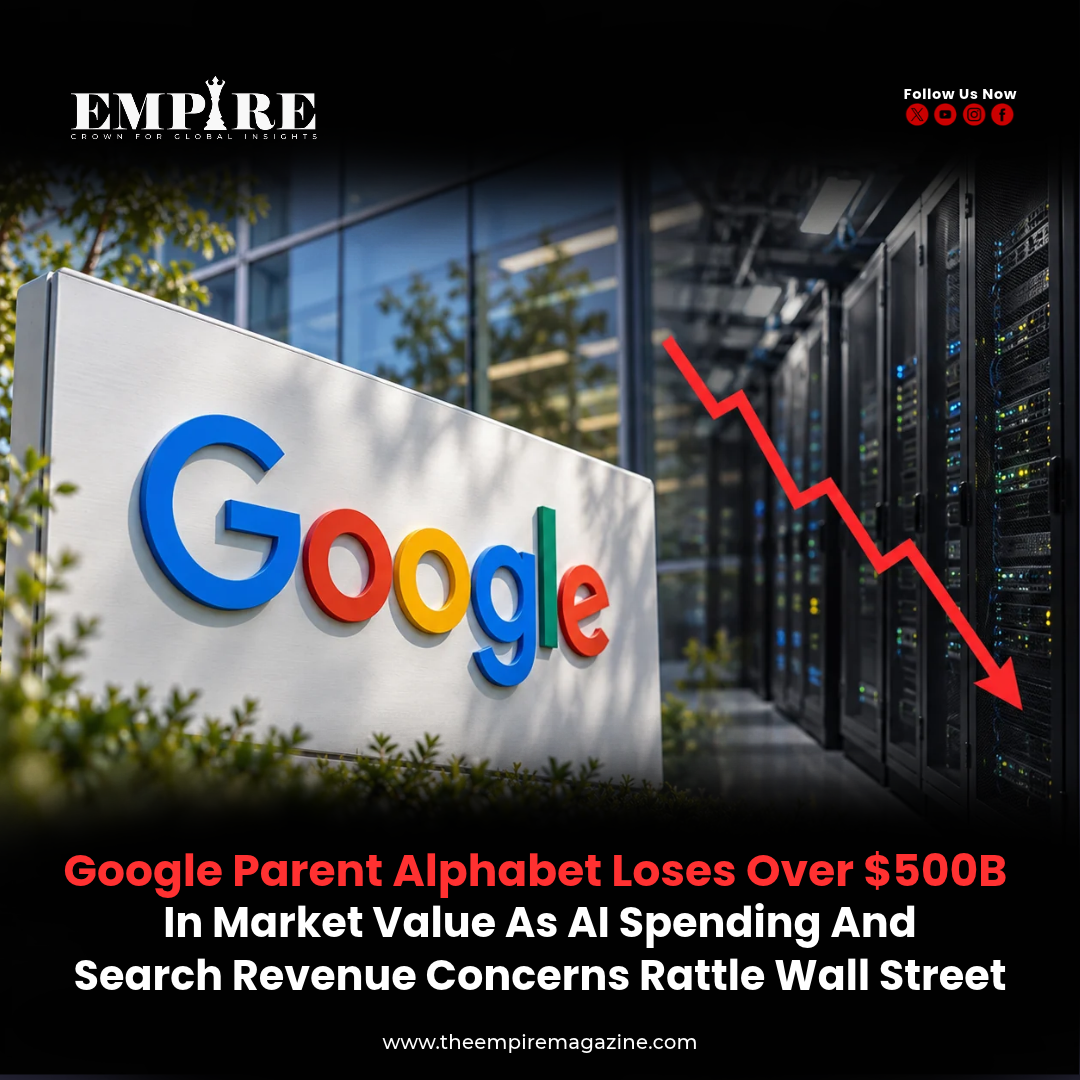
The Alphabet stock selloff erased more than $500 billion in market value during trading on 29 October, as investors assessed the company’s latest earnings and the financial demands of its artificial intelligence expansion.
Alphabet released its third-quarter results on 28 October. The report showed growing revenue and operating income, alongside substantial infrastructure spending and weaker earnings available to common shareholders.
The market reaction highlighted a central question for Google’s parent: how quickly can rising AI usage generate enough revenue and cash to support the investment required?
Search remains central to that calculation. Google is introducing new ways to find information while developing the advertising systems that will earn money from those experiences.
How Much Did Alphabet’s Market Value Fall?
Bloomberg reported that Alphabet shares were down approximately 13% at 9:35 a.m. in New York on 29 October, corresponding to an estimated $511 billion reduction in market value.
Alphabet’s Class A shares finished the session at $283.82, down approximately 12.6%.
The figure exceeding $500 billion therefore refers to an intraday estimate. Market-value calculations change as share prices move throughout a trading session.
Market capitalisation represents the value investors assign to a company’s outstanding shares. Its decline is separate from the cash a company spends on infrastructure or the profit it reports in its financial statements.
What Alphabet’s Third-Quarter Results Showed
Alphabet’s results for the quarter ended 30 September 2026 presented a mixed financial picture.
Revenue increased across its major businesses, and operating income rose. However, capital expenditure exceeded operating cash flow, while investment losses weighed on earnings.
| Financial measure | Third quarter of 2026 |
|---|---|
| Total revenue | $127.58 billion |
| Revenue growth from a year earlier | 25% |
| Google Search & other revenue | $63.35 billion |
| Google Cloud revenue | $30.71 billion |
| Operating income | $40.58 billion |
| Net income available to common shareholders | $26.17 billion |
| Diluted earnings per common share | $2.12 |
| Capital expenditure | $51.36 billion |
| Free cash flow | Negative $9.07 billion |
Figures are rounded from Alphabet’s unaudited quarterly disclosures.
These measures describe different aspects of the business. Revenue records sales, operating income reflects operating profitability, and free cash flow shows the cash remaining after capital expenditure under Alphabet’s definition.
Why Google Search Growth Concerned Investors
Google Search & other revenue increased 12% year on year.
The concern centred on slowing growth and the revenue generated by newer search experiences. A business can continue expanding while disappointing investors who expected stronger performance.
AI Mode Generates Revenue Differently
On the earnings call, Chief Business Officer Philipp Schindler said lower monetisation in AI Mode contributed to the slowdown.
He also identified currency movements as the largest factor behind Search’s deceleration from the previous quarter and cited changes in advertiser spending.
AI Mode was therefore one of several factors management discussed.
Schindler said Google was expanding advertising across AI Overviews and AI Mode, including additional users, queries and international markets.
More Searches Do Not Automatically Mean Proportionately More Revenue
AI can encourage people to ask longer questions, explore more information and return with follow-up requests. The commercial outcome depends on how advertising fits those interactions.
For Google, the task is to develop formats that advertisers value while maintaining an experience people want to use.
Usage growth can demonstrate demand for a product. Revenue growth also depends on advertising opportunities, advertiser demand and the effectiveness of the resulting campaigns.
Heavy Capital Spending Put Pressure on Cash Flow
Alphabet generated approximately $42.29 billion in operating cash flow during the quarter and spent $51.36 billion on property and equipment.
Under its definition of free cash flow—operating cash flow minus capital expenditure—the result was an outflow of approximately $9.07 billion.
The company’s infrastructure investment supports the computing capacity needed for AI products and cloud services. These projects require substantial spending before their commercial returns are fully established.
Other Cash Costs Also Mattered
The quarterly filing disclosed a $5.2 billion payment, including interest, connected with the European Commission’s Android competition case.
Management also said an inventory build for sales of its Tensor Processing Unit systems affected operating cash flow.
These items matter when interpreting the quarter. Infrastructure expenditure was a major pressure, but the cash-flow result reflected several demands on the business.
Negative free cash flow also differs from an accounting loss. Alphabet remained profitable during the quarter.
Why Earnings Fell Despite Higher Operating Income
Alphabet’s operating income increased approximately 30%, yet net income available to common shareholders declined from the previous year.
Investment performance helps explain that difference.
The company reported approximately $8.7 billion in losses on equity securities, including realised and unrealised movements. Alphabet said the after-tax effect reduced net income by approximately $6.7 billion.
The distinction is important when assessing the earnings decline. Operating performance, investment gains or losses, taxes and financing arrangements can all affect the amount ultimately available to shareholders.
Attributing the entire fall in earnings to AI infrastructure spending would overlook these separate factors.
Google Cloud Provided Evidence of Strong Demand
Google Cloud revenue increased 103% year on year, providing a substantial source of growth.
Chief Executive Sundar Pichai attributed that performance to demand for AI infrastructure and AI solutions. He also highlighted demand for Google’s TPU systems and the effort to bring additional computing capacity online.
The results demonstrate that Alphabet is generating revenue from the infrastructure it is building.
Capacity Expansion Comes With Costs
Management nevertheless expects near-term pressure on Cloud margins as it increases the use of third-party computing capacity.
That creates another test for the investment strategy: converting demand into revenue while managing the cost of delivering services.
Rapid growth can help support infrastructure investment, but its financial value also depends on margins, customer retention and the amount of cash required to sustain expansion.
Alphabet’s Spending Plans Extend Beyond This Quarter
Alphabet maintained its 2026 capital expenditure guidance of $195 billion to $205 billion.
Chief Financial Officer Anat Ashkenazi also said capital expenditure was expected to increase significantly in 2027, with further details planned for the next quarterly earnings call.
Those figures describe management’s spending outlook rather than expenditure already completed.
The company’s quarterly filing separately disclosed $924.4 billion in material purchase commitments, including $213.4 billion due within 12 months.
The commitments cover areas such as technical infrastructure, inventory, energy and content licensing. A significant majority of the relevant multiyear commitments are expected to be fulfilled through 2031.
Annual Spending and Future Commitments Are Different Measures
Capital expenditure guidance concerns investment during a particular financial year. Purchase commitments cover contractual arrangements with different delivery schedules and conditions.
Combining them without accounting for timing and scope would give a misleading impression of the company’s immediate cash requirements.
For Alphabet, the management challenge is coordinating those commitments with customer demand, infrastructure availability and cash generation.
What the Alphabet Stock Selloff Means for Its AI Strategy
The market reaction brings the financial execution of Alphabet’s AI strategy into sharper focus.
Google needs to preserve the strength of Search, improve revenue generation from AI experiences and expand Cloud capacity without allowing spending to outrun the business indefinitely.
Future results will help answer several practical questions:
- Search monetisation: Are AI experiences generating stronger advertising returns as usage grows?
- Cloud profitability: Can additional capacity support growth while maintaining attractive margins?
- Cash generation: Does operating cash flow begin covering more of the infrastructure investment?
- Spending discipline: How closely does expenditure follow demand and deployment needs?
- Earnings quality: How much profit comes from operations, and how much reflects investment-value changes?
Alphabet’s quarterly results show both commercial progress and substantial financial demands.
Its next phase will depend on turning AI adoption into dependable revenue, profitable services and stronger cash generation—the outcomes needed to support its expanding infrastructure commitments.
Explore more global business, technology and innovation coverage in The Empire Magazine’s article archive.
Read our related coverage: microsoft-voluntary-buyouts-60000-employees/
Follow The Empire Magazine:
Facebook | Instagram
The Empire Magazine | Crown For Global Insights