
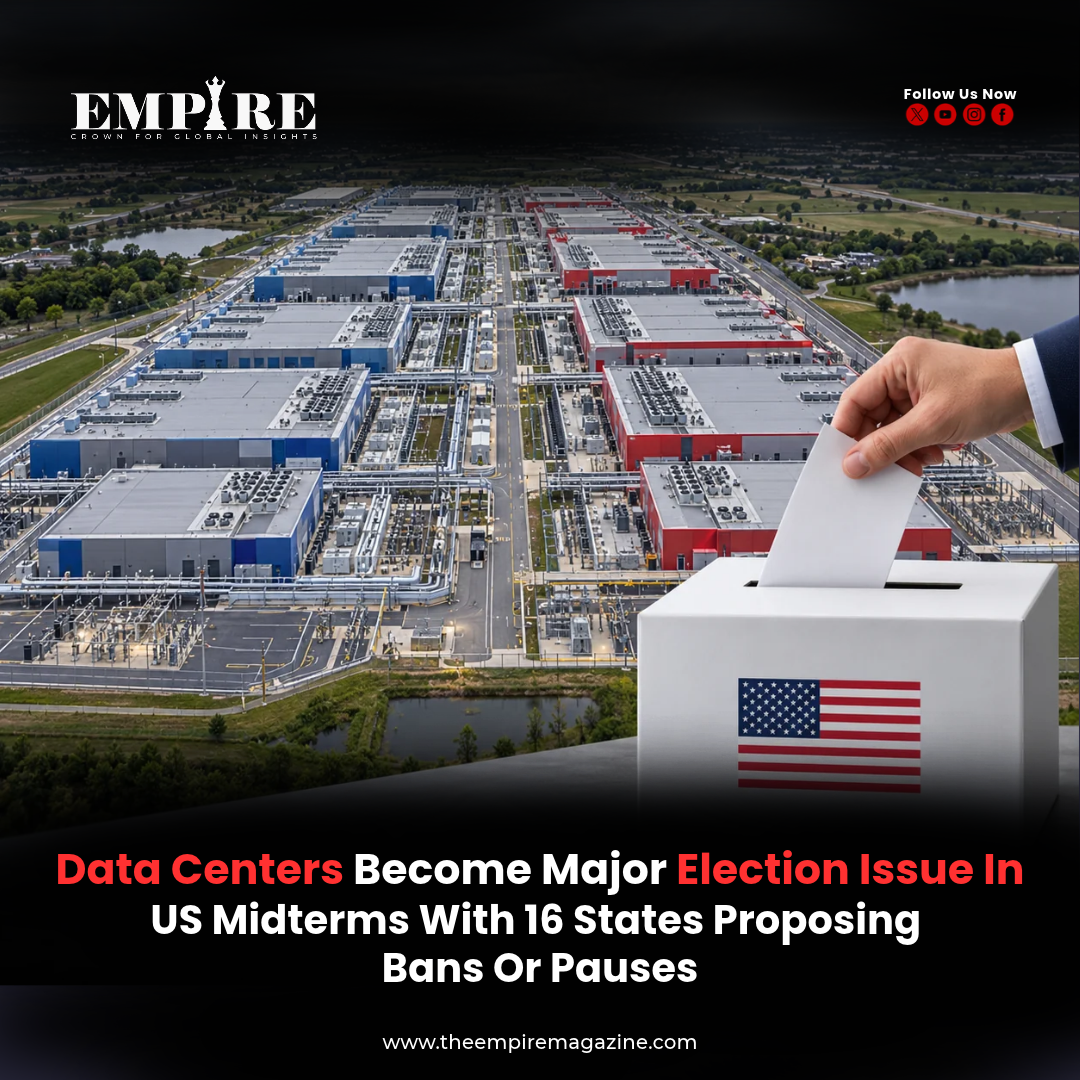
Electricity costs, water demand and local control are putting digital infrastructure on the election agenda, with communities weighing the benefits of investment against its demands on public resources.
United States | Business News, Technology & Public Policy
Information checked on 28 October 2026.
Data centre moratoriums have become a prominent issue ahead of the 3 November US midterm elections, as voters and policymakers debate how quickly computing infrastructure should expand—and who should pay for the resources it requires.
The National Conference of State Legislatures (NCSL) listed legislative proposals involving bans or development pauses across 16 states in its tracker updated on 15 September 2026.
That figure measures the spread of legislative activity. It does not mean that all 16 states have adopted restrictions or that every proposal remains active.
The issue is also appearing directly on local ballots. Ballotpedia’s tracker lists 49 local data-centre-related measures during 2026, including 41 scheduled for the November general election.
Together, these developments show how the expansion of AI and cloud infrastructure is becoming a practical political question involving household bills, development approvals and community priorities.
What the 16-State Data Centre Moratorium Figure Means
The NCSL tracker includes proposals at different stages of the legislative process.
Some were introduced, others failed, and Maine’s proposal was vetoed. New York’s listed legislation had passed the legislature, while Virginia’s measure was marked as continued.
The Legislative Snapshot
| Status in NCSL’s 15 September tracker | States |
|---|---|
| Introduced | Delaware, Georgia, Michigan, New Jersey, Pennsylvania, South Carolina and Vermont |
| Failed | Maryland, Minnesota, New Hampshire, Oklahoma, South Dakota and Wisconsin |
| Vetoed | Maine |
| Passed legislature | New York |
| Continued | Virginia |
These are the statuses recorded in that dated legislative snapshot. Executive orders and local restrictions are separate policy actions.
The distinction matters because an introduced bill, an enacted law and a governor’s executive order can have different consequences for a proposed development.
Why Data Centres Have Become an Election Issue
Data centres support services ranging from cloud computing and business software to artificial intelligence. Their development can attract investment, construction activity and tax revenue.
At the same time, large projects create questions about electricity supply, water availability and the infrastructure needed to serve them.
For residents, the debate often becomes tangible through a proposed facility near their community or concern about future utility bills.
Electricity Demand and Who Pays
A central question is how the cost of additional electricity infrastructure is allocated.
Developments may require new generation, transmission connections or other network upgrades. Policymakers are examining whether developers should fund those requirements and how existing customers can be protected from additional costs.
The scale of potential demand helps explain the attention.
Berkeley Lab’s United States Data Center Energy Usage Report: 2025 Update, published in June 2026, estimates that data centres could account for 11.8% of US electricity consumption by 2030 in its reference case.
Its alternative scenarios range from 9.5% to 15.3%.
These are projections, not measured future consumption. They illustrate why infrastructure planning has become important without establishing how any individual household’s bill will change.
Water Use and Local Infrastructure
Water demand is another concern in the development debate.
Communities need information about expected consumption, the available supply and any infrastructure improvements associated with a project.
The question extends beyond a developer’s environmental targets. Local authorities also need to understand how a facility would operate during periods of pressure on shared resources.
Investment, Jobs and Tax Revenue
Supporters of data-centre development point to construction work, operational employment and the contribution projects can make to local tax bases.
Assessing those benefits requires project-specific information. Construction employment, permanent staffing and tax revenue represent different outcomes and should be reported separately.
The practical policy debate is therefore about the terms of development as well as whether a project proceeds.
States Are Taking Different Approaches
The response is not a single national policy. State governments are using different combinations of temporary pauses, permitting requirements and utility oversight.
New York: A Pause on Certain Environmental Permits
On 14 July 2026, Governor Kathy Hochul announced an executive order creating a temporary moratorium affecting new hyperscale data-centre development.
The state described a pause of up to one year on certain environmental permitting while it develops broader standards addressing electricity demand, water use, air quality and community impacts.
The Executive Action Is Separate From Legislation
New York’s executive moratorium should be distinguished from the state bill listed in NCSL’s legislative tracker.
The executive action concerns the permitting process while standards are developed. It should not be described as a blanket order to close operating data centres.
Pennsylvania: Development Requirements and Electricity-Cost Oversight
Governor Josh Shapiro signed an executive order on 18 August 2026 establishing requirements covering energy affordability, environmental protection, transparency, workforce development and community involvement.
The policy seeks to make developers responsible for the electricity infrastructure their projects require.
Pennsylvania has also taken the issue into utility proceedings. On 15 October, Shapiro filed a petition seeking to intervene in a case concerning PPL Electric Utilities’ rate structure.
The administration supports changes intended to allocate costs associated with large data-centre demand to those customers. The proceeding concerns proposed protections and contested utility arrangements, rather than a completed finding that every project raises household bills.
Maine: A Proposed Pause Was Vetoed
Maine demonstrates why legislative proposals should not be counted automatically as operating restrictions.
Governor Janet Mills vetoed LD 307 on 24 April 2026. The proposal would have introduced a temporary limitation on certain data centres.
Its inclusion in the 16-state tracker reflects legislative activity, not the enactment of that proposed moratorium.
Local Ballots Bring the Debate Directly to Voters
Ballotpedia’s 2026 tracker identifies data-centre measures across 13 states. This is a different count from NCSL’s 16-state legislative tracker.
The local measures vary considerably. Some concern prohibitions, while others ask voters for advice on development policy.
Examples scheduled for 3 November include:
| Community | Measure being considered |
|---|---|
| Alhambra, California | Measure DB asks voters to affirm a citywide prohibition on data centres |
| Edgewater, Florida | A proposed restriction on new data-centre development |
| Bloomington, Illinois | An advisory measure asking the city to impose a moratorium on large-scale data centres |
An advisory question and a binding prohibition do not have the same legal effect. The wording and scope of each measure will determine what a result means locally.
The Political Debate Crosses Party Lines
Data-centre policy does not fit neatly into a single partisan position.
A September 2026 review by MultiState found that gubernatorial candidates commonly supported development alongside additional regulation or stronger local control. Support for moratoriums also appeared among candidates from both major parties.
The areas of disagreement include the pace of development, the role of local authorities and the conditions attached to approval.
For businesses, that makes local policy and community engagement important regardless of which party controls a state government.
Technology Companies Are Responding With Community Commitments
Developers and technology companies are also changing how they explain their projects.
Microsoft’s Community-First AI Infrastructure initiative, announced in January 2026, includes commitments concerning electricity costs, water use, local jobs, tax contributions and community training.
The company says it will work with utilities and regulators so that the electricity costs of serving its data centres are not passed to residential customers.
These are corporate commitments. Their practical value depends on implementation, the agreements governing individual projects and evidence showing whether the promised outcomes are achieved.
For communities, a public pledge and an enforceable permit condition remain different forms of assurance.
What the Debate Means for AI Infrastructure Investment
For developers, opposition and policy changes can affect site selection, permitting schedules and the timing of electricity connections.
Those factors influence when an expensive facility can begin operating. A project may have access to equipment and financing while still facing unresolved questions about power supply or local approval.
Temporary pauses can give authorities time to establish rules, but they can also delay investment. The business challenge is finding development terms that provide enough certainty for operators while addressing the concerns of host communities.
The election debate is making those terms more visible.
What Businesses Will Watch After 3 November
The immediate developments will be the outcomes of local ballot measures and the policy priorities of newly elected officials.
Beyond election night, utility proceedings, environmental standards and local planning decisions will continue to shape where data centres can be built.
The most useful evidence will come from specific projects: their approved power arrangements, water requirements, community agreements and operating performance.
The 16-state legislative tally shows the breadth of the debate. The consequences for investment will depend on which proposals become enforceable rules and how those rules are applied.
Explore more global business, technology and innovation coverage in The Empire Magazine’s article archive.
Read our related coverage:microsoft-voluntary-buyouts-60000-employees/
Follow The Empire Magazine:
Facebook | Instagram
The Empire Magazine | Crown For Global Insights