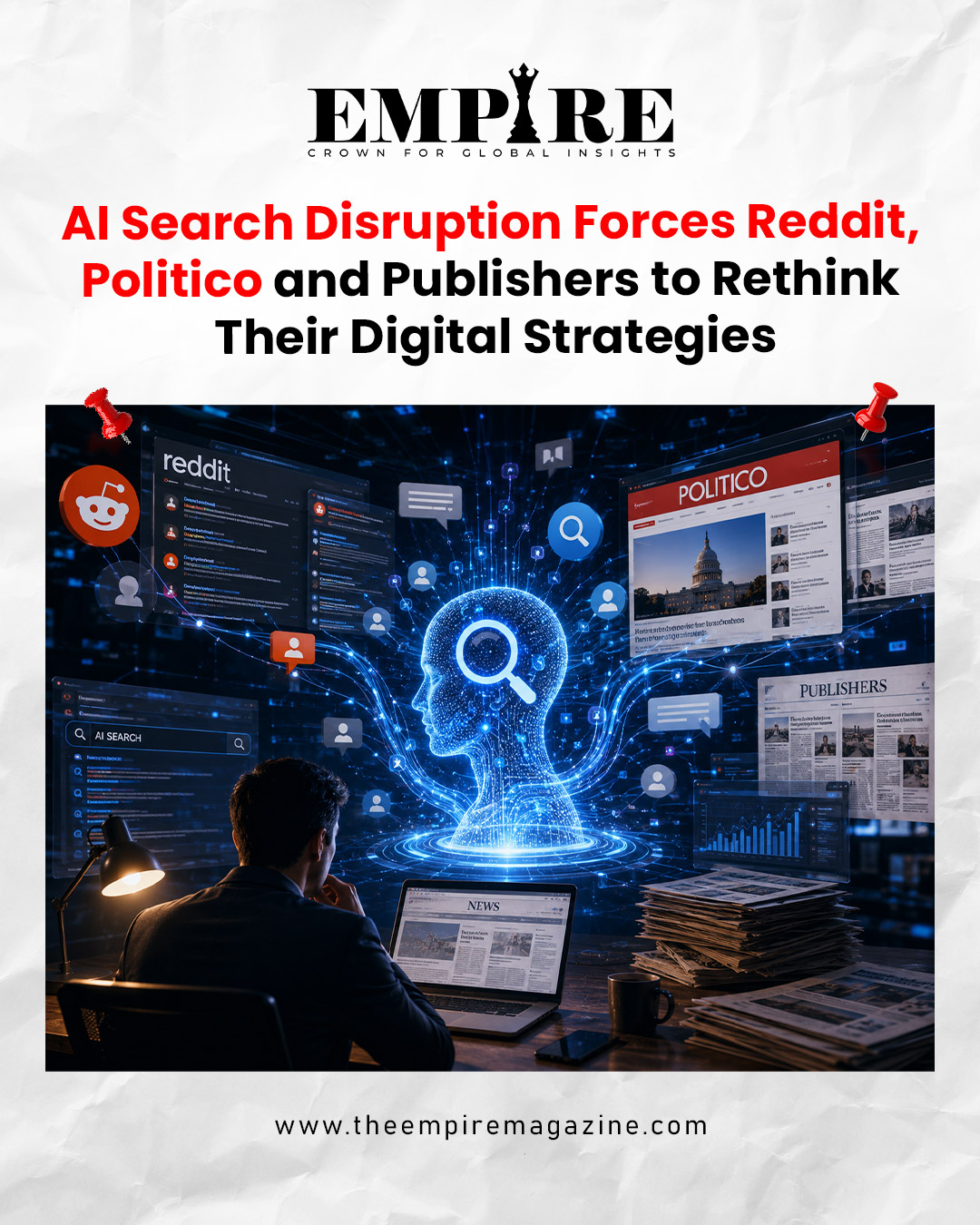
AI search disruption is reshaping digital publishing as Reddit, Politico, and leading media organizations rethink SEO, traffic, monetization, and content strategies. AI search disruption is fundamentally changing the way people discover information online. As AI-powered search engines provide direct answers instead of traditional search results, publishers like Reddit, Politico, and major media organizations are redesigning their digital strategies to protect traffic, revenue, and audience engagement.
AI Search Disruption Is Changing Digital Publishing
For nearly two decades, the digital publishing industry operated on a familiar formula. Search engines directed readers to websites, publishers produced high-quality articles to attract clicks, advertisers paid for audience attention, and media organizations continuously refined their SEO strategies to remain visible online. That long-standing ecosystem is now facing one of its biggest transformations as AI Search Disruption rapidly reshapes how information is discovered, consumed, and monetized. Artificial intelligence-powered search experiences are increasingly delivering complete answers directly within search interfaces, reducing the need for users to visit original publisher websites. Major technology companies including Google, Microsoft, and OpenAI are accelerating investments in AI-driven search experiences that prioritize conversational responses over traditional lists of blue links. This evolution is forcing publishers across industries to rethink not only how they create content but also how they maintain audience relationships, generate revenue, and preserve editorial authority. Companies such as Reddit and Politico have already begun adapting their strategies, recognizing that the future of digital publishing will depend less on conventional search rankings and more on building trusted brands, exclusive content, and loyal communities. As AI continues to redefine search behavior across global markets, publishers are entering a new era where visibility, credibility, and innovation must evolve together to remain competitive in an increasingly AI-first internet.
AI Search Disruption Challenges Traditional Website Traffic
The most immediate consequence of AI Search Disruption is the steady decline in referral traffic that publishers have historically relied upon to sustain readership and advertising revenue. Instead of clicking through multiple search results, users are increasingly receiving concise AI-generated summaries that answer questions instantly, reducing the need to visit the original source. For media organizations, this shift represents far more than a change in search behaviour, it challenges the economic foundation of digital journalism itself. Publications that once invested heavily in search engine optimization to secure top rankings are now competing with AI-generated responses that aggregate information from numerous sources without always driving meaningful traffic back to publishers. Reddit has responded by strengthening partnerships with AI companies while simultaneously encouraging users to engage directly within its communities, recognizing that authentic discussions cannot easily be replicated by AI summaries. Politico, known for its premium political reporting and policy analysis, has intensified its focus on exclusive journalism, subscriber-only insights, newsletters, and specialised coverage that offers readers value beyond what an AI-generated response can provide. Across the publishing landscape, executives are acknowledging that success will increasingly depend on cultivating direct relationships with audiences rather than relying exclusively on search engines as the primary gateway to content. This transition is encouraging publishers to diversify traffic sources through email subscriptions, mobile applications, podcasts, social media communities, events, and membership programmes, creating stronger audience loyalty while reducing dependence on fluctuating search algorithms. In many ways, AI Search Disruption is compelling publishers to return to the fundamentals of journalism producing trusted, original, and deeply reported stories that readers actively seek instead of passively discovering through search.
AI Search Disruption Is Redefining Content Strategy
Beyond traffic concerns, AI Search Disruption is fundamentally changing the way publishers approach content creation, editorial planning, and long-term digital strategy. The emphasis is shifting away from producing large volumes of keyword-driven articles toward creating original reporting, expert analysis, investigative journalism, opinion pieces, and exclusive interviews that artificial intelligence cannot easily reproduce. Publishers are increasingly investing in experienced journalists, subject-matter experts, data-driven research, and multimedia storytelling to establish authority in highly competitive sectors. This renewed focus aligns closely with Google’s growing emphasis on Experience, Expertise, Authoritativeness, and Trustworthiness (E-E-A-T), signalling that credibility will become even more valuable in an AI-powered search environment. Rather than chasing every trending keyword, editorial teams are building comprehensive content ecosystems that combine in-depth articles, podcasts, videos, explainers, newsletters, interactive graphics, and community engagement to create richer user experiences. Reddit exemplifies this evolution by highlighting the value of authentic human conversations and user-generated knowledge, while Politico continues to differentiate itself through insider reporting that cannot be replicated by generic AI summaries. Publishers are also redesigning their content for multiple discovery channels, ensuring that stories perform effectively across search engines, social media platforms, AI assistants, mobile applications, and voice search. As AI Search Disruption accelerates, the publishers that thrive will be those capable of delivering unique perspectives, exclusive information, and trusted editorial voices that encourage readers to engage directly with their brands rather than relying solely on AI-generated answers.
AI Search Disruption Creates New Revenue Opportunities
While many publishers initially viewed AI Search Disruption as a direct threat to their business models, the evolving landscape is also opening new avenues for growth and innovation. Traditional digital advertising, long dependent on page views and search-driven traffic, is gradually giving way to diversified revenue streams centred on subscriptions, memberships, premium content, licensing agreements, live events, branded experiences, and strategic technology partnerships. Reddit’s multi-million-dollar licensing agreements with AI companies demonstrate how publishers can monetise valuable content archives while maintaining control over intellectual property. Rather than allowing AI developers to freely scrape years of community-generated discussions, Reddit has positioned its content as a premium data asset, creating an additional revenue channel that extends beyond advertising. Similarly, publishers with trusted archives, proprietary research, investigative reporting, and expert analysis are beginning to recognise that their content holds significant value in training and improving AI models. This has encouraged many media companies to renegotiate content licensing arrangements, strengthen copyright protections, and establish clear frameworks for how AI platforms access and utilise published material. At the same time, publishers are investing heavily in first-party data strategies that enable them to better understand audience behaviour and deliver personalised experiences without relying excessively on third-party cookies or unpredictable search algorithms. Newsletter subscriptions, premium communities, exclusive podcasts, educational webinars, and industry-specific reports are becoming essential components of modern publishing businesses, providing sustainable revenue while fostering stronger reader loyalty. AI Search Disruption is therefore encouraging publishers to think beyond traditional advertising metrics and develop resilient business models built on trust, exclusivity, and direct audience engagement. Those that embrace innovation while protecting the value of their original journalism are likely to emerge stronger in an increasingly AI-driven digital economy.
AI Search Disruption Demands Smarter SEO
Search engine optimisation is not disappearing because of AI Search Disruption it is evolving into a far more sophisticated discipline where authority, user experience, and topical expertise matter more than keyword density alone. As AI-powered search engines increasingly generate conversational responses from multiple trusted sources, publishers must optimise their content not only for traditional search rankings but also for AI citation and discoverability. This means producing comprehensive articles that answer user intent, maintaining factual accuracy, updating content regularly, implementing structured data, and demonstrating genuine expertise through well-researched reporting. Rather than publishing dozens of short articles targeting similar keywords, successful publishers are building authoritative topic clusters that establish long-term credibility in their respective industries. Clear headings, concise introductions, compelling meta descriptions, internal linking, fast-loading pages, multimedia integration, and mobile-first experiences are becoming indispensable elements of modern SEO strategies. Publishers are also focusing on building recognisable editorial brands because users are more likely to trust and seek out familiar names even when AI provides summarised answers. The growing importance of E-E-A-T reinforces the need for transparent sourcing, expert bylines, and original insights that distinguish professional journalism from AI-generated content. Moreover, audience engagement metrics such as time on page, repeat visits, newsletter sign-ups, and social shares are emerging as stronger indicators of content value than search rankings alone. In this new environment, AI Search Disruption rewards publishers that consistently deliver accurate, original, and user-focused journalism while adapting their SEO strategies to meet the changing expectations of both search engines and AI-powered discovery platforms.
The Future of AI Search Disruption for Publishers
The future of AI Search Disruption will not be defined by the decline of digital publishing but by its reinvention. Every major technological shift from the rise of social media to the mobile internet has forced publishers to adapt, and artificial intelligence represents the next significant evolution in that journey. Media organisations that view AI solely as a competitor risk falling behind, while those that embrace it as a tool for enhancing journalism, audience engagement, and operational efficiency are better positioned for long-term success. Newsrooms are already integrating AI into research workflows, multilingual publishing, data analysis, content recommendations, and newsroom automation, allowing journalists to dedicate more time to investigative reporting and meaningful storytelling. At the same time, readers are becoming increasingly aware of the importance of trustworthy information in an era where AI-generated content can be created at unprecedented speed. This growing demand for credibility presents a unique opportunity for established publishers to strengthen their reputation as reliable sources of news and analysis. Companies such as Reddit and Politico illustrate that success in an AI-first world depends on offering something algorithms cannot replicate authentic communities, exclusive reporting, expert insights, and a distinct editorial voice. The publishers that invest in these strengths while embracing emerging technologies will continue to attract loyal audiences, regardless of how search engines evolve. Looking ahead, collaboration between technology companies and publishers is likely to become increasingly important, with transparent licensing agreements, responsible AI development, and fair attribution shaping the future relationship between content creators and AI platforms. AI Search Disruption is not simply altering how information is found; it is redefining how journalism creates value, builds trust, and sustains itself in a digital economy driven by intelligence, innovation, and authenticity.
AI Search Disruption
The rise of AI Search Disruption marks one of the most significant turning points in the history of digital publishing. As AI-powered search transforms the way users access information, publishers can no longer depend solely on search engine referrals or traditional SEO tactics to sustain growth. Instead, the future belongs to media organisations that prioritise original journalism, authoritative reporting, strong editorial brands, diversified revenue models, and direct audience relationships. Reddit, Politico, and other leading publishers have already begun adapting by investing in exclusive content, community engagement, subscriptions, strategic licensing, and AI-ready content strategies. Their experiences demonstrate that while artificial intelligence may reshape content discovery, it cannot replace the value of trusted journalism created by experienced professionals. For publishers worldwide, the challenge is not to compete against AI but to complement it with human insight, credibility, and storytelling that readers genuinely value. As the digital ecosystem continues to evolve, those who innovate while remaining committed to journalistic excellence will not only survive AI Search Disruption but also define the next generation of media leadership. In an AI-driven future, trust will remain the most powerful currency, and publishers that earn it consistently will continue to thrive, regardless of how technology transforms the search landscape.
For more business and retail insights, read more on The Empire Magazine
Previous article: https://theempiremagazine.com/nvidia-semiconductor/
Magazine Feautures | Podcasts: Empire Global Talks
Follow The Empire Magazine on Facebook | Instagram | LinkedIn | YouTube
The Empire Magazine | Crown for Global Insights