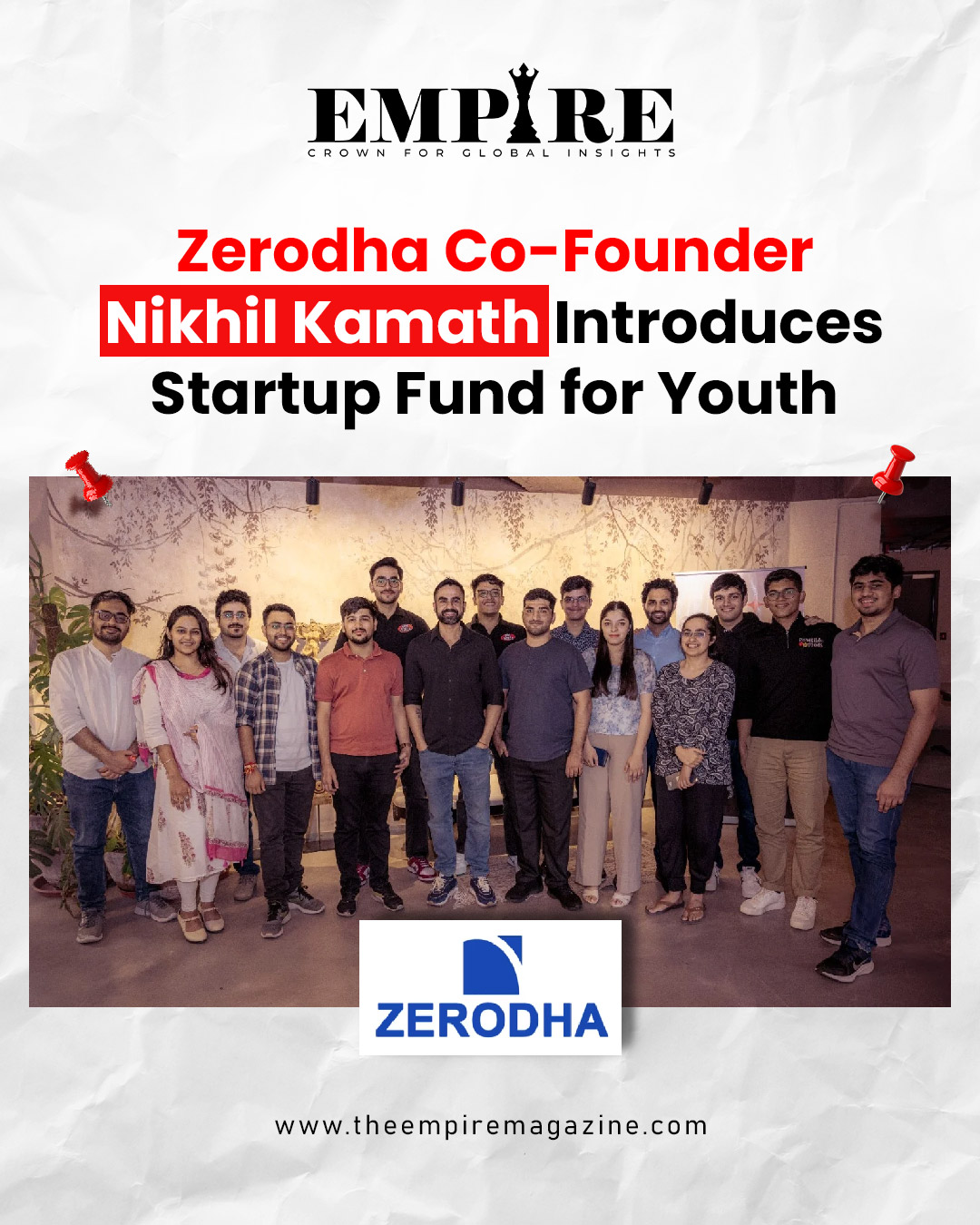
Zerodha co-founder Nikhil Kamath’s WTFund is transforming India’s startup ecosystem by offering equity-free grants, mentorship, and opportunities for entrepreneurs under 25. Zerodha co-founder Nikhil Kamath is encouraging India’s next generation of entrepreneurs through WTFund, a grant-based initiative offering up to ₹20 lakh in equity-free funding, mentorship, and strategic guidance for founders aged 25 and below. The initiative aims to democratize startup opportunities beyond India’s established technology hubs.
Zerodha Co-Founder Nikhil Kamath Introduces Startup Fund for Youth
India’s entrepreneurial landscape has evolved dramatically over the past decade. Once dominated by experienced founders with established professional networks, the country’s startup ecosystem is now witnessing an increasing number of young innovators building companies while still in college or shortly after graduation. Yet despite this transformation, access to early-stage funding remains one of the biggest barriers for first-time entrepreneurs. Many promising founders struggle not because their ideas lack potential, but because they lack access to investors, mentors, and industry connections. Recognising this challenge, Zerodha co-founder Nikhil Kamath has introduced a different approach to supporting young innovators through WTFund, a grant-based initiative designed specifically for entrepreneurs aged 25 years and below. Rather than investing in exchange for ownership, the initiative provides equity-free financial support alongside mentorship, networking opportunities, and operational guidance, allowing founders to retain complete control over their businesses. The programme reflects a broader shift in India’s startup ecosystem where enabling innovation is becoming just as important as funding it. As India aims to become one of the world’s largest innovation economies, initiatives like WTFund demonstrate how experienced entrepreneurs are now investing in the next generation of builders rather than merely backing established businesses.
Nikhil Kamath Startup Fund for Youth Through WTFund
The Nikhil Kamath Startup Fund for Youth, popularly known as WTFund, is not structured like a conventional venture capital fund. Instead of taking equity in exchange for capital, the initiative offers selected entrepreneurs grants of up to ₹20 lakh while allowing them to retain full ownership of their startups. Beyond funding, founders receive access to experienced operators, successful entrepreneurs, investors, legal experts, product specialists, and go-to-market advisors who help transform early ideas into scalable businesses. The initiative follows a sector-agnostic approach, welcoming founders working across artificial intelligence, healthcare, climate technology, fintech, consumer brands, education, manufacturing, deep technology, and other emerging industries. Kamath has repeatedly emphasised that talent exists across India and that geography should never determine entrepreneurial success. Through successive cohorts, WTFund has attracted thousands of applications from founders representing both metropolitan cities and smaller towns, reinforcing the belief that innovation today is no longer confined to Bengaluru, Mumbai, Delhi, or Hyderabad. Instead, the programme seeks individuals solving real-world problems with practical solutions capable of creating long-term economic and social impact.
Why the Nikhil Kamath Startup Fund for Youth Matters
The Nikhil Kamath Startup Fund for Youth arrives at a time when India’s entrepreneurial ambitions are stronger than ever, yet early-stage founders continue to face significant challenges in accessing capital. While India has become the world’s third-largest startup ecosystem with more than 1.5 lakh recognised startups and over 100 unicorns, a large funding gap still exists at the idea and prototype stage. Traditional venture capital firms typically prefer businesses that have already demonstrated revenue, customer traction, or scalable operations, leaving many first-time founders without institutional support. Young entrepreneurs, especially students and recent graduates, often lack collateral, professional networks, and business experience, making it even harder to secure investment. WTFund directly addresses this gap by backing founders based on their potential rather than their financial history. The programme enables entrepreneurs to experiment, validate products, and build sustainable businesses without the immediate pressure of investor expectations or equity dilution. This approach is particularly important in sectors such as artificial intelligence, biotechnology, clean energy, robotics, agritech, and climate innovation, where developing a commercially viable product often requires considerable time before generating meaningful revenue. By reducing financial barriers at the earliest stage, the initiative encourages innovation that may otherwise never reach the market, strengthening India’s long-term entrepreneurial pipeline.
How WTFund Is Different From Traditional Venture Capital
One of the defining strengths of the Nikhil Kamath Startup Fund for Youth is its departure from the conventional venture capital model. Venture capital investments generally involve acquiring equity in exchange for funding, with investors expecting rapid growth and significant financial returns over a defined period. While this model has powered some of India’s biggest startup success stories, it can also place considerable pressure on inexperienced founders to prioritise aggressive scaling over sustainable business development. WTFund adopts a fundamentally different philosophy by providing non-dilutive grants that allow entrepreneurs to retain complete ownership of their companies. This structure gives founders greater freedom to refine products, experiment with business models, and focus on solving meaningful problems instead of chasing short-term valuation milestones. Equally important is the programme’s mentorship ecosystem, which connects participants with accomplished entrepreneurs, industry experts, investors, legal advisors, product leaders, and marketing specialists who help navigate the complexities of building a startup. Such guidance often proves more valuable than capital alone, as many early-stage businesses fail due to strategic mistakes rather than insufficient funding. The combination of financial support and practical mentorship makes WTFund a holistic platform designed to nurture entrepreneurs rather than simply finance them.
The Growing Need for Youth Entrepreneurship in India
India is currently experiencing one of the youngest demographic profiles in the world, with a substantial proportion of its population under the age of 35. This demographic advantage presents an extraordinary opportunity to foster innovation, employment generation, and economic growth through entrepreneurship. However, transforming youthful ambition into successful enterprises requires an ecosystem that encourages calculated risk-taking and provides adequate institutional support. Programmes like the Nikhil Kamath Startup Fund for Youth recognise that innovation often emerges from individuals who challenge conventional thinking rather than those with extensive corporate experience. Today’s young entrepreneurs are building solutions across artificial intelligence, financial technology, health technology, educational technology, sustainability, manufacturing, and creator-driven digital businesses. They are increasingly leveraging affordable cloud infrastructure, open-source software, digital payments, and government-backed initiatives such as Startup India to launch businesses with relatively modest capital requirements. Nevertheless, access to experienced mentors, strategic guidance, and early financial assistance remains essential for translating ideas into sustainable enterprises. By encouraging young founders to pursue entrepreneurship at an early stage of their careers, WTFund contributes not only to individual business success but also to the broader development of an innovation-driven economy capable of generating high-quality employment, technological advancement, and global competitiveness.
How Mentorship Strengthens the Nikhil Kamath Startup Fund for Youth
While financial assistance often dominates discussions around startup support, the Nikhil Kamath Startup Fund for Youth demonstrates that mentorship can be equally transformative for first-time entrepreneurs. Many young founders possess exceptional technical abilities or innovative ideas but have limited exposure to building organisations, managing teams, attracting customers, navigating legal compliance, or raising subsequent rounds of investment. Through WTFund, entrepreneurs gain access to experienced founders, business leaders, investors, product strategists, and operational experts who provide practical guidance drawn from real entrepreneurial journeys. This mentorship ecosystem enables founders to avoid common mistakes, refine business models, strengthen market positioning, and develop long-term growth strategies. Learning directly from individuals who have successfully built and scaled companies significantly reduces the uncertainty associated with entrepreneurship. Moreover, the relationships developed through the programme often continue well beyond the funding period, creating a lasting support network that can influence future fundraising, partnerships, and business expansion. In an increasingly competitive startup landscape where execution matters as much as innovation, such mentorship represents a critical competitive advantage for young entrepreneurs striving to transform ambitious ideas into sustainable enterprises.
Nikhil Kamath Startup Fund for Youth Expands Opportunities Beyond Metro Cities
One of the most significant aspects of the Nikhil Kamath Startup Fund for Youth is its commitment to identifying entrepreneurial talent beyond India’s traditional startup hubs. For years, cities such as Bengaluru, Mumbai, Delhi-NCR, Hyderabad, and Pune have dominated the country’s venture capital landscape due to their concentration of investors, incubators, universities, and technology companies. However, India’s entrepreneurial potential extends far beyond metropolitan centres. Increasing internet penetration, affordable smartphones, digital public infrastructure, improved logistics, and online education have enabled aspiring entrepreneurs from Tier II and Tier III cities to develop innovative businesses addressing local and national challenges. WTFund actively encourages applications from founders irrespective of geography, recognising that groundbreaking ideas can emerge from any part of the country. This inclusive approach reflects a broader transformation in India’s startup ecosystem, where innovation is becoming increasingly decentralised. Entrepreneurs from smaller towns are building successful ventures in agriculture, manufacturing, healthcare, education, financial inclusion, and consumer technology, often developing solutions that directly address underserved markets. By providing equal access to funding and mentorship, the initiative helps reduce regional disparities in entrepreneurial opportunities while encouraging more balanced economic development across India.
Challenges the Nikhil Kamath Startup Fund for Youth Cannot Solve Alone
Despite the optimism surrounding the Nikhil Kamath Startup Fund for Youth, it is important to recognise that no single initiative can eliminate all the structural challenges facing India’s startup ecosystem. Access to early-stage funding is only one piece of a much larger entrepreneurial journey. Founders continue to encounter difficulties related to regulatory compliance, taxation, talent acquisition, intellectual property protection, market competition, customer acquisition costs, and evolving technological landscapes. Many startups also struggle with achieving product-market fit, managing cash flows, and sustaining growth after exhausting initial financial support. Furthermore, macroeconomic conditions and fluctuations in global investment sentiment have made fundraising increasingly selective, compelling entrepreneurs to focus on profitability and operational discipline rather than rapid expansion alone. Initiatives like WTFund can provide an essential launchpad, but sustained success ultimately depends on the founders’ ability to execute their vision, adapt to changing market conditions, and build resilient organisations. This reality highlights the importance of combining financial support with continuous learning, strategic mentorship, strong governance, and customer-centric innovation. India’s entrepreneurial ecosystem will continue to require collaborative efforts from government, private investors, educational institutions, incubators, and successful founders to ensure that promising startups receive the comprehensive support necessary to thrive over the long term.
The Future of the Nikhil Kamath Startup Fund for Youth and India’s Innovation Economy
As India progresses towards becoming a global innovation powerhouse, initiatives such as the Nikhil Kamath Startup Fund for Youth are likely to play an increasingly influential role in shaping the country’s entrepreneurial future. The rapid adoption of artificial intelligence, digital commerce, financial technology, biotechnology, climate innovation, advanced manufacturing, and deep technology is creating unprecedented opportunities for young founders to develop globally competitive businesses from India. Government initiatives such as Startup India, Digital India, and improved digital public infrastructure have already laid a strong foundation for entrepreneurship, while private initiatives like WTFund complement these efforts by addressing gaps in early-stage support. By encouraging ambitious young innovators to pursue entrepreneurship without the immediate burden of equity dilution, the programme promotes a culture where creativity, experimentation, and long-term value creation take precedence over short-term financial outcomes. As more successful entrepreneurs choose to mentor and support the next generation, India is gradually building a self-sustaining innovation ecosystem in which experienced founders reinvest their knowledge, capital, and networks into emerging talent. Such a cycle of entrepreneurial collaboration has the potential to accelerate technological progress, strengthen job creation, and enhance India’s competitiveness on the global stage.
Nikhil Kamath Startup Fund for Youth represents far more than a funding initiative
The Nikhil Kamath Startup Fund for Youth represents far more than a funding initiative, it reflects a changing philosophy within India’s entrepreneurial ecosystem. By combining equity-free grants with structured mentorship and nationwide accessibility, WTFund empowers young innovators to pursue bold ideas while retaining ownership of their ventures. At a time when access to early-stage capital remains one of the greatest barriers to entrepreneurship, the programme offers a practical solution that prioritises potential over pedigree and innovation over immediate returns. Its emphasis on supporting founders from diverse backgrounds and regions reinforces the belief that transformative businesses can emerge from anywhere in the country. While challenges such as market competition, regulatory complexity, and long-term funding persist, initiatives like WTFund provide aspiring entrepreneurs with the confidence and resources needed to take the crucial first step. As India continues its journey towards becoming one of the world’s leading innovation-driven economies, empowering young founders today will determine the strength, resilience, and global impact of the country’s startup ecosystem tomorrow. Through this vision, Nikhil Kamath is not merely funding startups he is helping cultivate the next generation of entrepreneurs who may shape India’s economic future for decades to come.
For more business and retail insights, read more on The Empire Magazine
Previous article: https://theempiremagazine.com/cipla-fy27-profit/
Magazine Feautures | Podcasts: Empire Global Talks
Follow The Empire Magazine on Facebook | Instagram | LinkedIn | YouTube
The Empire Magazine | Crown for Global Insights