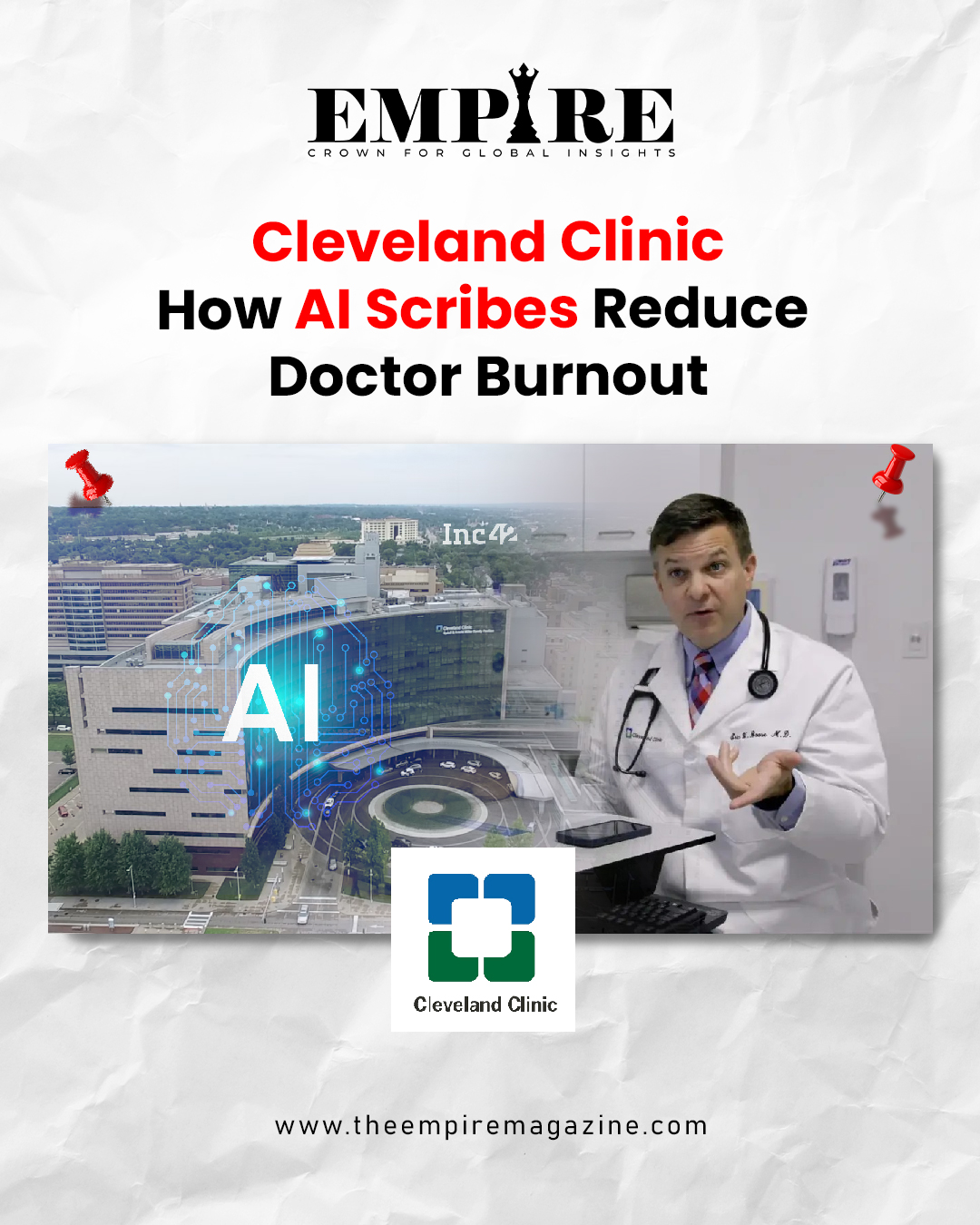
Cleveland Clinic is showing how artificial intelligence can reduce doctor burnout by cutting the time physicians spend on clinical documentation. In healthcare, doctors often face heavy administrative work after patient visits. Electronic health records improved access to patient information, but they also increased the amount of typing, clicking, and after-hours charting required from clinicians.
AI scribes, also called ambient AI documentation tools, are designed to reduce this burden. These systems listen to doctor-patient conversations with consent, create draft medical notes, summarize the encounter, and prepare documentation for review. The physician still checks, edits, and approves the note before it becomes part of the medical record.
Cleveland Clinic piloted multiple ambient AI products in 2024 with about 250 doctors. After testing, the organization selected Ambience Healthcare’s AI platform and rolled it out in 2025. Within 15 weeks, more than 4,000 clinicians adopted the technology voluntarily, and by August 2025 the system had documented more than one million patient encounters.
Why Doctor Burnout Is a Healthcare Problem
Doctor burnout is a serious issue in modern healthcare. It is commonly linked to emotional exhaustion, administrative overload, long working hours, pressure from patient volume, and documentation demands. When doctors spend too much time on screens, it can reduce the time and attention they give to patients.
AI scribes are being adopted because documentation is one of the clearest pain points in clinical work. Many physicians spend time finishing notes after clinic hours, often called “pajama time.” This after-hours documentation can affect work-life balance and increase burnout risk.
Documentation Takes Time Away From Care
A medical visit requires more than conversation. Clinicians must document symptoms, history, physical findings, assessment, diagnosis, treatment plan, medications, orders, and follow-up instructions. The note must be accurate because it supports continuity of care, billing, compliance, quality review, and communication with other medical professionals.
When documentation becomes too time-consuming, it creates pressure on doctors. AI scribes are intended to reduce that pressure by turning the patient conversation into a structured draft note.
How AI Scribes Work
AI scribes use speech recognition, natural language processing, and generative AI to capture and summarize clinical encounters. During a visit, the system listens to the conversation between the clinician and patient. It then produces a draft note in a medical format such as SOAP, which stands for Subjective, Objective, Assessment, and Plan.
The physician reviews the draft, corrects errors, adds clinical judgment, and signs the final note. The AI does not replace the doctor’s responsibility. It works as a documentation assistant.
Ambient Listening in the Exam Room
Ambient AI works in the background during a visit. The goal is to allow doctors to spend more time looking at patients instead of typing into a computer. Cleveland Clinic’s internal reporting described the shift as “less typing, more talking,” with ambient AI helping physicians focus more directly on patient conversations.
This matters because patient trust often depends on attention, eye contact, and clear communication. If documentation can happen more naturally in the background, the clinical visit can feel less screen-focused.
Cleveland Clinic’s Rollout of Ambient AI
Cleveland Clinic’s AI scribe rollout became notable because of its scale and speed. The organization tested multiple products before selecting Ambience Healthcare. The technology is used through a mobile app and can tailor documentation based on medical specialty.
The AI scribe creates drafts, patient instructions, and visit summaries. Physicians must review the documentation before it is submitted. This review step is important because clinical notes must be accurate and legally reliable.
Voluntary Adoption by Clinicians
The voluntary adoption of the system by thousands of clinicians is significant. In healthcare technology, adoption can be difficult because doctors already manage demanding workflows. When clinicians choose to use a tool, it usually means the tool solves a real pain point.
Cleveland Clinic’s chief digital officer has said the AI scribe is helping some doctors regain “joy” in clinical work by reducing documentation burden and improving the patient interaction experience.
Evidence That AI Scribes Can Reduce Burnout
Research on ambient AI scribes is still developing, but early studies show promising results. A 2025 JAMA Network Open quality improvement study found that ambient AI scribes were associated with significant improvements in burnout, note-related cognitive task load, ability to give patients undivided attention, and after-hours documentation time. The study reported a 0.90-hour reduction in time spent documenting after hours on 10-point scale-related measures and other improvements in clinician experience.
Another 2025 study on ambient clinical intelligence found that the technology significantly reduced provider documentation burden, frustration, and burnout. It also reported reductions in daily documentation time and 2.5 hours per week of off-hours documentation.
Better Attention During Visits
One important benefit of AI scribes is the ability to give patients more attention. When doctors spend less time typing during an appointment, they can listen more closely and maintain better communication.
The JAMA Network Open study also found improvement in clinicians’ ability to provide undivided attention during visits. This supports the idea that AI scribes may improve not only documentation time but also the quality of the patient-clinician interaction.
Why AI Scribes Matter for Hospitals
Hospitals and health systems are interested in AI scribes because clinical documentation affects operations, clinician satisfaction, patient experience, and revenue cycle processes. Accurate notes are needed for care coordination, referrals, insurance claims, coding, compliance, and quality measurement.
AI scribes can help standardize documentation workflows and reduce the administrative load on clinicians. This is especially important in large systems such as Cleveland Clinic, where thousands of doctors and advanced practice providers manage high patient volumes.
Supporting Clinician Retention
Burnout can contribute to physician turnover, reduced productivity, and lower job satisfaction. If AI scribes reduce after-hours work and documentation stress, they may support clinician retention.
Hospitals are looking for technology that helps clinicians rather than adding more complexity. AI scribes are gaining attention because they address a daily workflow issue that many doctors experience directly.
Patient Experience and Communication
AI scribes can also affect patients. Many patients notice when doctors spend much of the visit looking at a computer screen. Ambient AI may allow more natural conversation and better eye contact.
Cleveland Clinic reported that most patients appreciated the improved focus during visits after AI scribe adoption. The technology can also create patient-friendly summaries and instructions, which may help patients understand care plans more clearly.
Patient Consent and Transparency
Patient consent is important when AI scribes are used. Since the system listens to clinical conversations, patients should understand how the technology works, what information is captured, and how privacy is protected.
Hospitals must also explain that the AI creates a draft and that the clinician remains responsible for reviewing the final note.
Risks and Limitations of AI Scribes
AI scribes are promising, but they are not risk-free. They can make transcription errors, misunderstand clinical context, omit important details, or generate inaccurate wording. This is why physician review remains essential.
Research has also raised concerns about patient safety risks from AI scribe errors, especially around medication and treatment details. These findings show the need for careful monitoring, quality review, and strong clinical governance.
Privacy and Data Security
Privacy is another key concern. Clinical conversations include sensitive health information. AI scribe vendors and hospitals must follow strict rules around data storage, access, consent, security, and compliance.
Large health systems must evaluate vendors carefully to ensure patient data is protected and that AI tools meet healthcare regulatory standards.
AI Scribes and the Future of Healthcare Workflows
AI scribes are part of a larger shift toward AI-assisted healthcare workflows. Companies such as Microsoft, Ambience Healthcare, Abridge, Nabla, Suki, and others are building tools to reduce administrative burden and support clinicians. Microsoft’s Dragon Copilot is positioned as an AI clinical assistant that streamlines documentation and automates routine workflows so care teams can focus on patients.
From Documentation to Clinical Support
The first major use case is documentation, but AI tools may later support chart review, patient summaries, prior authorization, care coordination, and follow-up communication. These applications will require strong oversight because healthcare decisions affect patient safety.
Cleveland Clinic’s adoption shows that AI in healthcare is moving from pilot projects into real clinical operations. The strongest use cases are those that reduce administrative burden while keeping clinicians in control.
Why Cleveland Clinic’s AI Scribe Strategy Matters
Cleveland Clinic’s AI scribe strategy matters because it shows how a major health system can use AI to address a practical workforce problem. Doctor burnout is not solved by technology alone, but documentation support can reduce one of the biggest daily burdens in medical practice.
AI scribes allow physicians to spend less time typing and more time communicating with patients. They also show how healthcare AI can create value without replacing clinicians. The technology works best when it supports doctors, improves workflow, protects privacy, and keeps final medical judgment in human hands.
For more healthcare technology and business insights, read this feature on The Empire Magazine.
Follow The Empire Magazine on Instagram and Facebook.
– The Empire Magazine
Crown For Global Insights