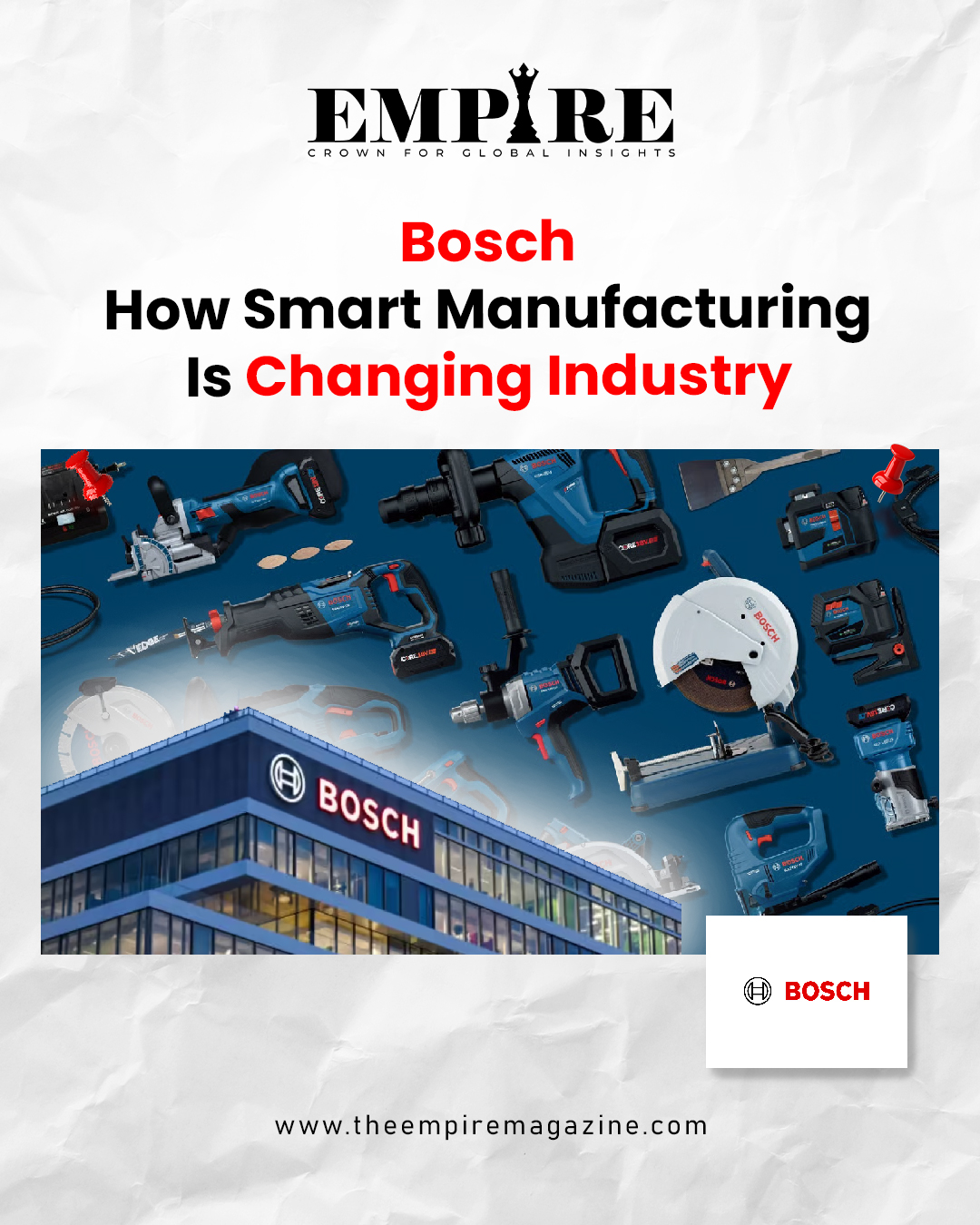
Bosch is one of the world’s leading technology and engineering companies, and its industrial technology business shows how traditional manufacturing is moving toward smart manufacturing. The Bosch Group operates across mobility, industrial technology, consumer goods, and energy and building technology. In 2025, the company generated sales of €91 billion and employed roughly 413,000 associates worldwide.
Smart manufacturing is becoming important because factories now need higher productivity, better quality control, lower downtime, stronger supply chain visibility, and more flexible production systems. Companies are using automation, artificial intelligence, robotics, industrial software, sensors, cloud systems, and connected machines to improve how products are made.
Bosch is directly connected to this shift because it is both a manufacturer and a supplier of industrial technology. The company uses smart factory systems in its own plants and also provides automation, software, and manufacturing solutions to other companies.
What Smart Manufacturing Means
Smart manufacturing refers to the use of connected technology, data, software, and automation inside factories. Instead of machines working separately, smart factories connect equipment, production lines, workers, logistics systems, and quality control tools through digital platforms.
This allows manufacturers to collect real-time data, analyze production performance, detect problems early, reduce waste, and improve decision-making.
From Traditional Factories to Connected Factories
Traditional factories often depend on manual checks, isolated machines, paper records, and fixed production systems. Smart factories work differently. Machines can share data. Sensors can monitor performance. Software can track production quality. AI systems can identify patterns and predict problems.
This connected model helps manufacturers respond faster when demand changes or when production issues appear.
Bosch Rexroth and Industrial Automation
Bosch Rexroth is one of the major parts of Bosch’s industrial technology business. It provides drive and control technologies, automation systems, hydraulics, electric drives, linear motion products, and factory automation solutions.
Bosch Rexroth supports companies that want to modernize production lines and make machines more connected, flexible, and efficient.
ctrlX AUTOMATION
Bosch Rexroth’s ctrlX AUTOMATION platform is designed to bring more openness and flexibility to industrial automation. In 2025, Bosch Rexroth announced expanded ctrlX AUTOMATION capabilities with more safety, more AI, and more computing power for automation.
This matters because factories need automation systems that can adapt quickly. Traditional industrial control systems can be rigid, while modern systems need software-based flexibility, app-based functions, and easier integration with data and AI tools.
Nexeed and the Smart Factory
Bosch’s Nexeed software is another important example of its smart manufacturing strategy. Nexeed is designed to connect data streams in manufacturing and logistics so factories can become smarter and more transparent.
Bosch says many of its own plants use Industry 4.0 solutions and that more than half use Nexeed. The company also says more than 100 Bosch customers worldwide benefit from its smart factory expertise.
Why Factory Data Matters
Factory data is valuable because it shows what is happening on the production floor. Data can reveal machine performance, energy use, production speed, quality problems, inventory movement, and maintenance needs.
When this data is connected and analyzed, companies can make better decisions. They can reduce machine downtime, improve product quality, and avoid unnecessary costs.
Artificial Intelligence in Manufacturing
Artificial intelligence is becoming a major part of smart manufacturing. AI can help factories detect defects, predict equipment failures, optimize production schedules, improve logistics, and support workers with better information.
Reuters reported in 2026 that Bosch expects higher sales and profitability driven by investments in emerging technologies and structural reforms. Bosch CEO Stefan Hartung highlighted automation, digitalization, electrification, and artificial intelligence as key focus areas, while the company reported major spending on research and development and capital expenditure.
Predictive Maintenance
Predictive maintenance is one of the most practical AI use cases in manufacturing. Instead of waiting for machines to fail, factories can use sensor data and AI models to identify warning signs before breakdowns happen.
This helps reduce downtime and maintenance costs. For manufacturers, even a short production stoppage can be expensive, especially in automotive, electronics, industrial equipment, and consumer goods production.
Quality Control and Visual Inspection
AI can also support quality control. Cameras and sensors can inspect products during production. AI systems can detect defects, surface issues, measurement problems, or process errors faster than manual inspection in some settings.
This improves consistency and helps companies reduce waste. For industries with strict quality standards, smart inspection systems can protect both product quality and brand trust.
Industry 4.0 and Bosch’s Manufacturing Experience
Industry 4.0 refers to the fourth industrial revolution, where manufacturing becomes connected through cyber-physical systems, data, automation, cloud computing, and intelligent machines. Bosch has been closely linked to Industry 4.0 because it applies these technologies inside its own factories and develops solutions for customers.
Bosch as User and Supplier
Bosch has a unique position because it is not only selling smart manufacturing solutions. It also uses them in its own global production network. This gives the company practical experience with real factory challenges.
Factories need solutions that work under pressure, not only in demonstrations. Bosch’s internal manufacturing experience helps it build tools that are designed for production environments.
Robotics and Human-Machine Collaboration
Robotics is another important part of smart manufacturing. Modern factories use robots for repetitive, heavy, precise, or dangerous tasks. Collaborative robots can work closer to humans and support flexible production.
Bosch Rexroth’s Industry 4.0 solutions include connectivity, data acquisition, collaborative robots, data analysis, and software supporting production processes.
Why Collaborative Robots Matter
Collaborative robots, also known as cobots, are designed to work near human workers. They can support assembly, handling, inspection, packaging, and testing tasks.
Cobots are useful because many factories need flexibility. A production line may need to change quickly for new products or smaller batch sizes. Collaborative robots can help companies automate without fully redesigning every process.
Supply Chain and Logistics Visibility
Smart manufacturing also includes logistics. Factories depend on parts, materials, inventory, transport, warehouses, and suppliers. If one part is delayed, the entire production line can be affected.
Connected logistics systems help manufacturers track materials and production flows. This can improve planning and reduce disruption.
Smarter Internal Logistics
Inside a factory, internal logistics can include moving parts from storage to production lines, managing inventory, and coordinating deliveries between departments. Digital tools can improve this movement and help reduce waiting time.
Bosch’s smart factory approach connects manufacturing and logistics data, which helps companies understand the full production flow, not only isolated machines.
Smart Manufacturing and Energy Efficiency
Energy efficiency is becoming more important in industry. Factories use electricity, compressed air, heating, cooling, and process energy. Rising energy costs and sustainability goals are pushing manufacturers to monitor and reduce energy use.
Smart manufacturing systems can track energy consumption by machine, line, or process. This helps companies identify where energy is being wasted.
Sustainability in Industrial Operations
Manufacturers are under pressure to reduce emissions, improve resource efficiency, and meet sustainability targets. Smart manufacturing supports this by reducing scrap, improving machine efficiency, optimizing energy use, and improving production planning.
For a global company such as Bosch, sustainability and industrial technology are connected because efficient production can support both cost control and environmental goals.
Challenges in Smart Manufacturing
Smart manufacturing also creates challenges. Companies need investment, skilled workers, cybersecurity systems, data standards, integration tools, and clear return on investment. Older machines may not easily connect to modern software platforms.
Cybersecurity and Factory Data
Connected factories create cybersecurity risks. Machines, sensors, production systems, and cloud platforms must be protected from attacks. A cyber incident in a factory can stop production or expose sensitive business data.
Manufacturers must build secure systems with access controls, software updates, monitoring, and strong governance.
Why Bosch Matters in Smart Manufacturing
Bosch matters because it combines industrial heritage with modern software, automation, AI, and factory technology. Its role as both a global manufacturer and technology supplier gives it a practical position in the smart manufacturing transition.
The company’s smart factory tools, Bosch Rexroth automation systems, Nexeed software, AI investments, and Industry 4.0 experience show how industrial technology is moving from mechanical systems toward connected and intelligent production.
For more technology and business insights, read this feature on The Empire Magazine.
Follow The Empire Magazine on Instagram and Facebook.
– The Empire Magazine
Crown For Global Insights