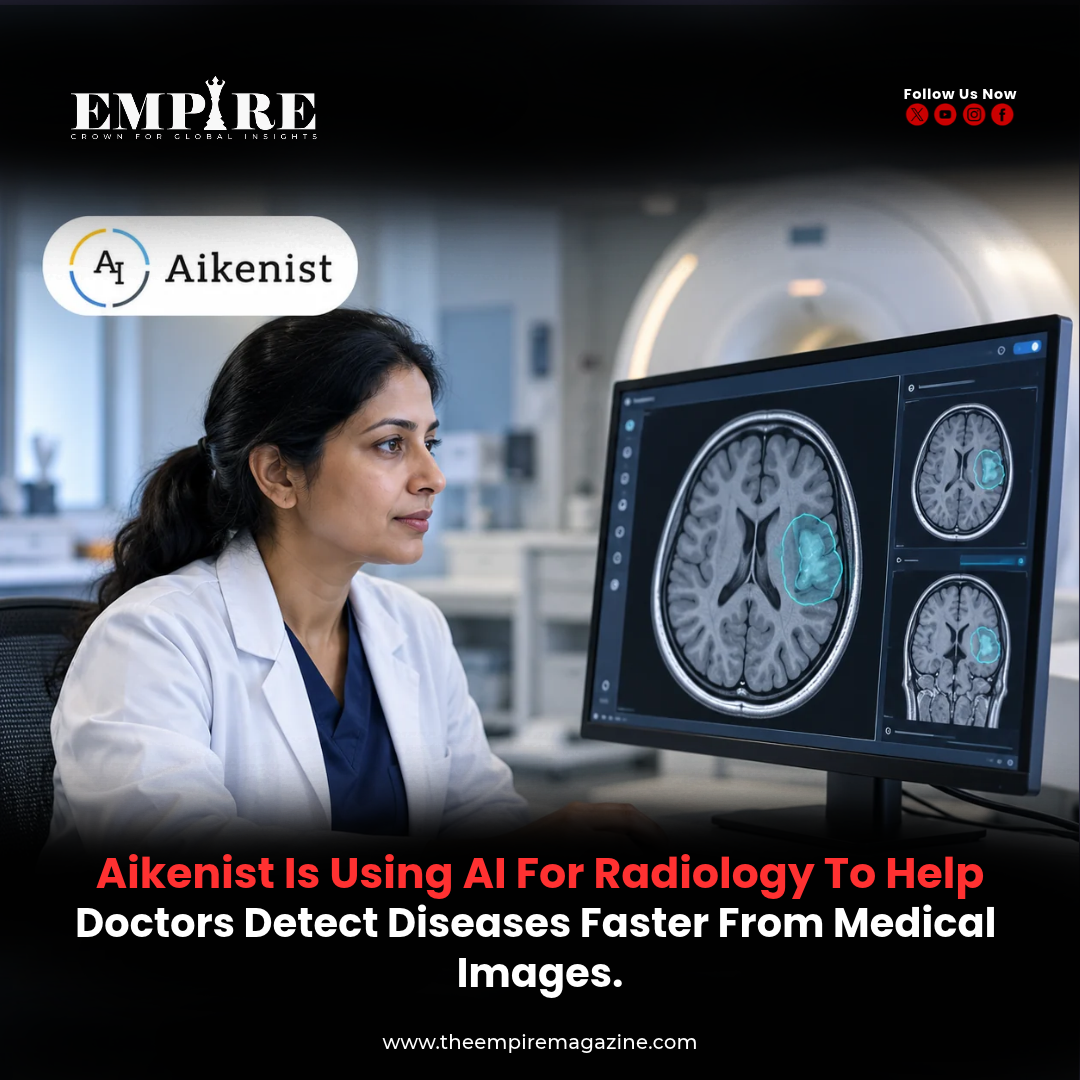
The Bengaluru-based company combines MRI enhancement, image analysis and reporting tools to help radiology departments manage the journey from scan acquisition to a reviewed report.
India | Healthcare, Artificial Intelligence and Technology
Information checked on 1 November 2026.
Aikenist AI radiology software is designed to help healthcare professionals acquire, analyse and report medical images more efficiently. Its products address several stages of an examination, including appointment coordination, MRI enhancement, identification of potential abnormalities and preparation of reports.
The company’s approach centres on connecting these tasks. A faster scan can help a department, but the wider benefit depends on how quickly the images reach a radiologist, how findings are reviewed and when the referring doctor receives the report.
Aikenist positions its technology as support for healthcare professionals. Its clinical outputs require review, and its published performance figures should be understood in the context of the particular product, imaging protocol and deployment.
What Is Aikenist AI Radiology?
Aikenist Technologies is a medical technology company headquartered in Bengaluru. Founded in 2019, it is led by co-founder and chief executive Ashwin Amarapur.
Its QuickSuite portfolio brings together software for different parts of radiology operations:
| Product | Main role |
|---|---|
| QuickFlow | Scheduling, worklist coordination, patient tracking and operational monitoring |
| QuickScan | MRI enhancement and support for faster scanning protocols |
| QuickDiag | AI-assisted image analysis, measurements and identification of potential findings |
| QuickRad | Medical image storage, viewing, sharing and reporting |
These products address related but distinct problems. Improving image quality, identifying a possible abnormality and distributing a completed report each require different capabilities.
For hospitals and diagnostic centres, the proposition is to connect those capabilities within their existing imaging workflows.
How QuickScan Supports Faster MRI Examinations
QuickScan uses AI-based image enhancement to support shorter MRI acquisition protocols. Aikenist says the software can enable up to four times faster scan protocols without replacing the scanner.
The company describes functions that reduce image noise and improve the visibility of anatomical detail. Its published compatibility information includes imaging systems from major manufacturers and applications involving the brain, spine, musculoskeletal system and other anatomical regions.
Why Image Quality Matters Alongside Speed
A shorter examination is useful only when the resulting images remain suitable for the clinical question.
Aikenist’s stated acceleration figure is a product claim, rather than a guaranteed reduction for every examination. Results can depend on the scanner, acquisition settings, anatomy and patient movement.
For an imaging centre, shorter acquisition could create additional appointment capacity. However, the time saved across an entire visit would also depend on preparation, positioning, room turnover and the need for any additional sequences.
The responsible radiologist must determine whether the images provide adequate diagnostic information.
How QuickDiag Assists Medical Image Analysis
QuickDiag is Aikenist’s diagnostic assistance suite. The company describes modules for analysing images, identifying potential abnormalities and producing measurements that clinicians can review.
Supporting the Review of Urgent Findings
Aikenist’s StrokeSuite includes functions intended to assist with stroke-related assessment, identification of bleeding and traumatic brain injury analysis.
The company also describes alerts and worklist prioritisation intended to bring potentially urgent examinations to clinical attention.
These features support established clinical processes. Aikenist’s own product terms state that its software is not validated as a standalone emergency-triage decision-maker.
Measuring and Tracking Lesions
The company’s OncoSuite focuses on tumour-related imaging tasks, including outlining lesions, measuring them and comparing examinations over time.
Such tools could help clinicians organise information for follow-up assessments. For example, a radiologist reviewing a new scan may need to compare the size and appearance of a lesion with earlier examinations.
The measurements and suggested findings still need clinical interpretation. An automated change in lesion size does not, by itself, establish a treatment decision.
QuickRad Connects Images, Reporting and Remote Access
QuickRad combines a Picture Archiving and Communication System, commonly called PACS, with viewing and reporting functions.
A PACS allows healthcare teams to store, retrieve and share medical images. QuickRad works with images using DICOM, the widely used standard for exchanging medical imaging information.
Aikenist describes features including:
- Browser-based image viewing and measurement tools.
- Structured report templates.
- Speech-to-text dictation.
- AI-assisted report drafting.
- Access to previous examinations.
- Sharing of studies and reports with authorised users.
The company says its reporting tools can reduce reporting time by up to 60%. This is a company-reported figure; the reduction achieved by an individual department would need to be measured in its own workflow.
Aikenist requires reports generated through QuickRad to be reviewed and signed by a qualified radiologist before release.
QuickFlow Addresses Delays Around the Examination
QuickFlow focuses on the administrative and operational work surrounding medical imaging.
Its published capabilities include appointment scheduling, worklist management, billing, patient tracking and integration with hospital information systems. It also provides dashboards for monitoring turnaround times.
These functions matter because a delay can occur at several points. Images may be ready for interpretation while a case is still waiting to be assigned, or a completed report may be awaiting distribution.
From an operational perspective, tracking these stages can help a department identify where work is accumulating. Whether automation improves the process depends on the quality of integration and how consistently staff use the system.
What QuickRad’s FDA Clearance Covers
The US Food and Drug Administration issued 510(k) clearance for QuickRad on 21 February 2025, under submission number K242838.
The record identifies QuickRad as a Class II medical image management and processing system. Its stated purpose includes receiving, storing, transmitting, processing and displaying medical images and associated information.
The cleared indications also describe optional integration with separately FDA-cleared third-party AI models. QuickRad displays those models’ outputs, while their safety and effectiveness remain covered by the original manufacturers’ clearances.
This scope matters when describing the company’s regulatory position. The QuickRad clearance does not establish blanket FDA clearance for every Aikenist product, disease-detection function or subsequent software feature.
For a hospital evaluating the technology, the relevant information is the authorisation and intended use of the particular product and version being considered.
What Published Research Shows About MRI Enhancement
A clinical assessment listed by the European Society of Radiology examined Aikenist’s deep-learning enhancement of MRI data comprising 30 brain scans and 32 abdominal subjects.
The conference abstract reported improvements in image-quality measurements and clinicians’ assessment of anatomical visibility. The data involved different scanners and acquisition protocols.
The researchers also identified limitations: the results came from particular anatomical regions and scanner types, and performance could vary with other MRI parameters.
The study provides evidence about image enhancement within that assessment. Its findings do not, on their own, establish that every Aikenist diagnostic module improves disease detection or that the complete platform produces better patient outcomes.
Those broader questions require evidence matched to the clinical task and setting.
Where Aikenist’s Business Value Could Emerge
Aikenist’s commercial opportunity lies in making radiology departments more productive while maintaining the quality of clinical work.
Software that fits existing scanners and reporting systems could appeal to providers seeking to improve capacity without replacing their imaging equipment. Aikenist also offers cloud, local-server and hybrid deployment options, allowing institutions to consider different infrastructure arrangements.
However, purchasing an integrated platform does not automatically produce an efficient department. Implementation, staff training, system compatibility and ongoing support influence the result.
Useful measures for evaluating a deployment include:
| Area | Practical measure |
|---|---|
| Examination efficiency | Acquisition time and completed examinations per scanner |
| Image quality | Adequacy for interpretation and frequency of repeat imaging |
| Reporting | Time from examination completion to a signed report |
| AI assistance | Missed findings, false alerts and corrections required |
| Clinical workflow | Time taken for urgent findings to reach the appropriate team |
| Commercial performance | Total implementation and operating costs relative to capacity gained |
These measures help distinguish a faster software operation from a meaningful improvement in care delivery.
Aikenist’s approach brings several parts of the imaging process into one product portfolio. Its long-term value will depend on how reliably those components work together and whether healthcare providers can demonstrate sustained improvements in their own clinical environments.
Explore more global business, technology and innovation coverage in The Empire Magazine’s article archive.
Read our related coverage: binance-hack-6-3-billion-north-korea/
Follow The Empire Magazine:
Facebook | Instagram
The Empire Magazine | Crown For Global Insights