
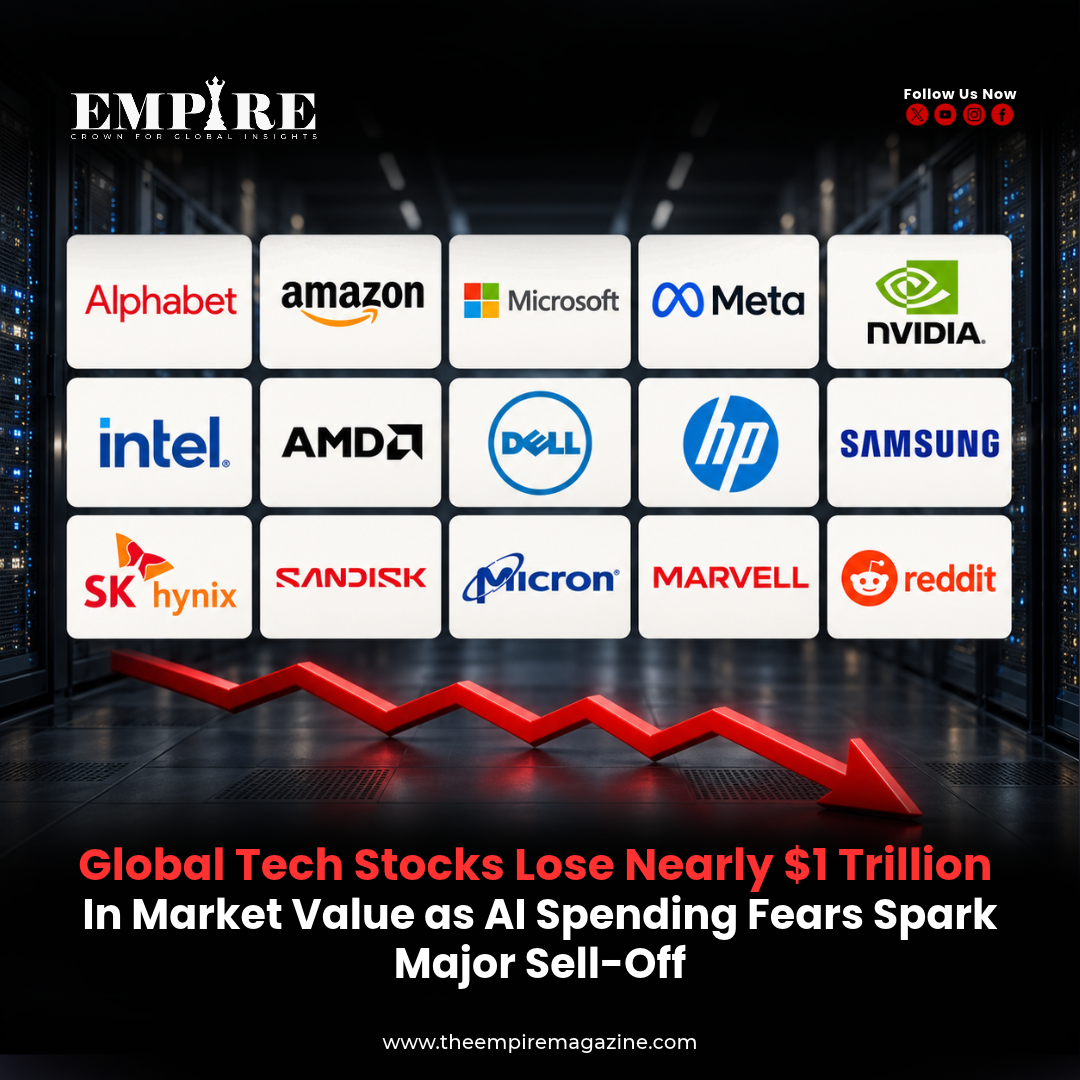
Strong cloud growth failed to reassure investors as heavy infrastructure spending, weaker cash flow and semiconductor industry pressures unsettled markets.
Global | Business News, Technology and Artificial Intelligence
Information checked on 31 October 2026.
The tech stock sell-off intensified on 30 October 2026, as investors questioned whether enormous investments in artificial intelligence would generate sufficient financial returns. In its review of the week’s earnings and Friday’s trading, Cboe said the decline had erased more than $1 trillion in market value.
Technology shares led a sharp retreat on Wall Street, while selling also affected Asian semiconductor companies and European markets.
Recent results from Amazon, Alphabet and Intel exposed different pressures: rising infrastructure costs, negative free cash flow, manufacturing constraints and weakness in parts of the consumer technology market.
At the same time, cloud revenue continued to grow rapidly. The tension between expanding demand and the cost of serving it became central to the market reaction.
How Far Did Technology Stocks Fall?
US stocks closed sharply lower on Friday, with semiconductor shares suffering particularly steep declines.
| Market measure | Change on 30 October 2026 |
|---|---|
| Nasdaq Composite | Down 2.86% |
| S&P 500 | Down 1.82% |
| Dow Jones Industrial Average | Down 1.09% |
| Philadelphia Semiconductor Index | Down approximately 7.2% |
| MSCI global stock index | Down 1.51% |
| European STOXX 600 | Down 0.36% |
Individual chipmakers recorded larger losses. Intel fell 28.6%, AMD declined 10.9% and NVIDIA dropped 4.2%.
These daily percentage moves should be distinguished from the broader market-value estimate in Cboe’s review.
A decline in market value reflects lower share prices and investors’ changing assessment of companies. It does not mean the affected businesses spent that amount in cash or recorded an equivalent operating loss.
What Drove the Tech Stock Sell-Off?
The earnings reports showed that growing sales can coexist with considerable pressure on cash generation.
AI infrastructure requires spending on processors, servers, networking equipment and data centres. The financial return depends on how effectively companies use that capacity and how much customers pay for the resulting services.
Three company reports illustrate why investors were reassessing the economics.
Amazon: Rapid AWS Growth Accompanied by Cash Outflows
Amazon reported third-quarter revenue of $201.9 billion, up 12% from a year earlier.
Its cloud business, Amazon Web Services, generated $46 billion in sales, increasing approximately 39%. AWS also produced $17.8 billion in operating income.
However, Amazon reported negative free cash flow of $42.4 billion for the trailing 12 months ended 30 September 2026. A year earlier, the corresponding period had produced positive free cash flow of $14.8 billion.
The company attributed the deterioration primarily to increased purchases of property and equipment, largely reflecting AI investment.
Amazon maintained its expectation of approximately $220 billion in cash capital expenditure for 2026. Management also indicated that spending would increase meaningfully in 2027.
The $42.4 billion figure covers a full 12-month period. It is not a loss incurred solely during the third quarter.
The results demonstrate the financial challenge: a growing, profitable cloud operation can sit within a company whose infrastructure spending exceeds the cash its operations generate.
Alphabet: Cloud Expansion Did Not Remove Cash-Flow Pressure
Alphabet’s third-quarter results showed Google Cloud revenue rising 103% to approximately $30.7 billion.
Google Search and other revenue increased 12% to approximately $63.4 billion. Search remained a growing business, although its performance became a concern for investors assessing the company’s outlook.
Alphabet generated approximately $42.3 billion in operating cash flow during the quarter, while purchases of property and equipment reached approximately $51.4 billion.
That left quarterly free cash flow at approximately negative $9.1 billion.
These figures describe the company’s overall cash generation and expenditure. They are not a standalone profit-and-loss statement for its AI products.
Alphabet’s results nevertheless highlighted the scale of the funding requirement. Even substantial operating cash generation was insufficient to cover the quarter’s capital spending.
Intel: Manufacturing Constraints and PC Weakness Added Pressure
Intel reported third-quarter revenue of approximately $16.5 billion, up 21% year on year.
Its businesses moved in different directions. Data Center and AI revenue increased 78%, while revenue in its Client Computing and Physical AI Group declined 5%.
The company forecast fourth-quarter revenue of $15 billion to $16 billion, below the approximately $17.07 billion analyst estimate reported by Reuters.
Intel also warned that PC-market weakness could continue into the first half of 2027. Manufacturing constraints limited its ability to meet demand for data-centre chips, while expansion required substantial investment.
These pressures help explain why the market reaction extended beyond a general debate about AI spending. Investors were also evaluating production capacity, product demand and the credibility of near-term financial expectations.
Why Free Cash Flow Has Become a Focus
Operating profit and free cash flow answer different questions.
Operating profit measures earnings from business activities after operating expenses. Free cash flow generally measures operating cash generation after capital spending, although companies’ definitions can differ.
A business can report rising operating income while producing negative free cash flow if investment in infrastructure absorbs more cash than its operations generate.
For companies building AI capacity, this creates several questions:
- How quickly will new infrastructure generate additional revenue?
- How much capacity will customers use?
- What margins will those services produce?
- How much further spending will be required?
- How will any funding gap be financed?
Negative free cash flow during expansion does not establish that an investment will fail. It does make the timing and quality of future returns more important to the investment case.
The Market Pressure Extended Beyond Wall Street
The sell-off also affected companies outside the United States.
Reuters’ reporting on Friday’s Asian session described declines in South Korean and Taiwanese equities, with Samsung Electronics and SK Hynix among the semiconductor companies under pressure.
European stocks also weakened, while the MSCI global Tech Stock index finished lower.
These movements reflect the international reach of the technology industry. US cloud companies purchase equipment and components from suppliers operating across multiple markets.
From a business perspective, changing expectations about infrastructure spending can therefore influence valuations throughout the supply chain. Investors must assess both the companies building AI services and the suppliers whose growth depends on those projects.
Strong Cloud Results Show That Demand Remains Substantial
The earnings picture included significant growth alongside the spending concerns.
Microsoft reported revenue of $92.3 billion, up 19%, for its fiscal first quarter ended 30 September 2026. Microsoft Cloud revenue increased 30% to $63.9 billion, while Azure revenue rose 48%.
Together with the results from AWS and Google Cloud, these figures demonstrate continuing expansion in cloud services.
Cloud revenue includes activities beyond AI, so the figures should not be treated as AI-only sales. They nevertheless provide evidence that major infrastructure businesses are attracting substantial customer spending.
The market’s concern is how that demand translates into returns after the costs of building and operating additional capacity.
What the Sell-Off Means for Technology Valuations
The company results suggest that investors are becoming more demanding about the relationship between growth and spending.
Revenue growth provides evidence of demand. Capital expenditure shows the resources committed to serving that demand. Cash flow helps reveal how much funding remains available after those commitments.
A company may perform well on one measure while disappointing on another.
That makes broad conclusions about the entire AI industry less useful than examining individual businesses. A cloud provider, chip designer and semiconductor manufacturer face different costs, production requirements and competitive pressures.
The sharp declines also show how sensitive share prices can become when expectations leave limited room for weaker guidance or unexpected expenditure.
The Next Test Is Cash Generation
The next earnings cycle will provide further evidence on whether infrastructure investment is producing sustainable financial benefits.
The most useful measures will include:
- Revenue conversion: whether customer commitments become recognised sales.
- Profitability: margins after the costs of delivering services.
- Cash generation: operating cash flow relative to capital expenditure.
- Spending discipline: clearer explanations of investment priorities and expected returns.
- Execution: progress in resolving production constraints and bringing capacity into use.
The tech stock sell-off has increased scrutiny of how companies fund the AI expansion. Future results will need to show how growing demand, infrastructure investment and dependable cash generation fit together.
Explore more global business, technology and innovation coverage in The Empire Magazine’s article archive.
Read our related coverage: binance-hack-6-3-billion-north-korea/
Follow The Empire Magazine:
Facebook | Instagram
The Empire Magazine | Crown For Global Insights