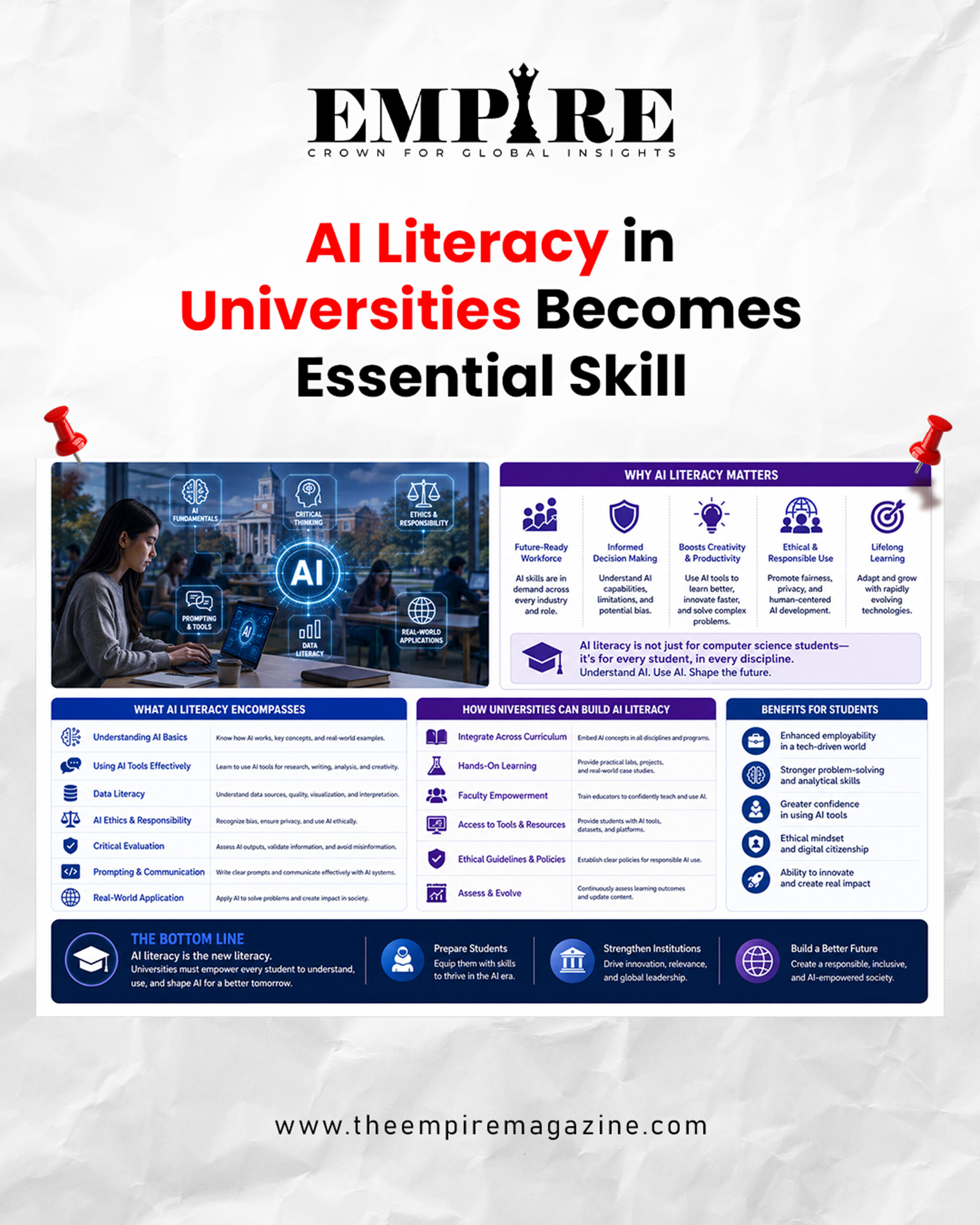
AI Literacy in Universities is rapidly becoming a core component of higher education as institutions prepare students for a world increasingly influenced by artificial intelligence. Leading universities, including Harvard University, Stanford University, and several other academic institutions, are integrating AI literacy into teaching, learning, and professional development programs. The goal is not simply to teach students how to use AI tools but to help them understand how artificial intelligence works, recognize its limitations, evaluate its outputs critically, and use it responsibly.
As AI technologies become part of everyday life, employers across industries are seeking graduates who possess both technical knowledge and the ability to work effectively with AI systems. This shift is encouraging universities worldwide to rethink traditional curricula and introduce AI literacy as an essential educational competency.
AI Literacy in Universities Is Reshaping Higher Education
The growing focus on AI Literacy in Universities reflects the increasing role of artificial intelligence across business, healthcare, law, science, engineering, and education.
Universities have traditionally adapted their curricula to technological changes. Just as computer literacy became an essential skill during the digital age, AI literacy is now emerging as a foundational requirement for modern students.
Educational institutions are moving beyond teaching coding or computer science alone. They are increasingly emphasizing critical thinking, ethics, responsible AI use, and understanding the broader societal implications of artificial intelligence. Harvard University has expanded AI-related educational offerings and resources that support learning across multiple disciplines, including medicine, law, public policy, business, and science.
Why AI Literacy Matters
AI literacy helps students:
- Understand how AI systems operate
- Evaluate AI-generated information
- Identify limitations and biases
- Use AI tools responsibly
- Make informed decisions about AI applications
These skills are becoming increasingly valuable as AI technologies enter workplaces across nearly every sector of the economy.
AI Literacy in Universities and Harvard University’s Approach
Harvard University has emerged as one of the institutions actively promoting AI Literacy in Universities through a variety of academic initiatives, resources, and interdisciplinary programs.
Harvard’s AI-related educational efforts extend across numerous schools and departments, reflecting the broad impact of artificial intelligence on modern society. The university provides students, researchers, faculty, and staff with resources designed to support learning, teaching, research, and responsible AI adoption.
In addition to academic programs, Harvard has established resources focused on helping educators integrate AI into teaching while supporting student understanding of ethical and responsible AI use. The university’s Derek Bok Center for Teaching and Learning specifically emphasizes AI literacy and ethics as part of modern education.
Harvard’s Focus on Responsible AI Education
Harvard’s approach highlights several important areas:
- AI literacy and ethics
- Responsible use of generative AI
- Understanding AI limitations
- Academic integrity
- Interdisciplinary AI education
The university has also encouraged discussions among students and faculty regarding the future role of AI in classrooms and learning environments. Student-led and institution-supported AI initiatives continue to expand across campus.
AI Literacy in Universities Extends Beyond Harvard
While Harvard is receiving significant attention for its AI initiatives, it is far from alone. Many universities are actively developing programs that promote AI Literacy in Universities.
Stanford University has launched multiple efforts focused on AI education and critical engagement with artificial intelligence. Through programs such as AI Meets Education (AIMES), Stanford supports faculty and students in understanding and integrating AI into learning experiences.
Stanford also supports AI literacy resources designed to help students understand the opportunities and challenges associated with generative AI technologies.
Universities Are Expanding AI Education
Across higher education, institutions are introducing:
- AI literacy courses
- AI ethics programs
- Generative AI workshops
- Faculty training initiatives
- Student AI certification programs
The objective is to ensure graduates possess the skills needed to navigate AI-driven workplaces and societies.
AI Literacy in Universities Goes Beyond Learning AI Tools
A common misconception about AI Literacy in Universities is that it focuses solely on teaching students how to use AI platforms.
In reality, AI literacy encompasses a much broader range of competencies.
Students are learning:
Understanding AI Systems
Universities increasingly teach students the fundamentals of:
- Machine learning
- Neural networks
- Generative AI
- Data-driven decision-making
This foundational knowledge helps students understand what AI can and cannot do.
Critical Evaluation Skills
AI literacy also involves teaching students to critically assess AI-generated content.
Students must learn to:
- Verify information
- Identify inaccuracies
- Recognize hallucinations
- Evaluate credibility
These skills are particularly important as AI-generated content becomes more common across digital platforms.
Ethics and Social Impact
Another major component of AI literacy involves ethical considerations.
Universities are encouraging students to examine issues such as:
- Algorithmic bias
- Data privacy
- Transparency
- Accountability
- Responsible innovation
These discussions help students understand the broader societal implications of artificial intelligence technologies.
AI Literacy in Universities Supports Workforce Readiness
The expansion of AI Literacy in Universities is closely linked to changing workforce requirements.
Employers increasingly expect graduates to possess AI-related knowledge regardless of their academic discipline. AI is now influencing fields such as:
- Healthcare
- Finance
- Marketing
- Law
- Engineering
- Education
- Manufacturing
Students entering these industries must understand how AI tools affect workflows, decision-making, and productivity.
Growing Employer Demand
Organizations are looking for professionals who can:
- Work alongside AI systems
- Interpret AI-generated insights
- Apply AI responsibly
- Maintain critical human judgment
Universities view AI literacy as an important component of career readiness in the modern economy.
AI Literacy in Universities and Future Learning Models
The rise of AI Literacy in Universities is also influencing how education itself is delivered.
Institutions are increasingly exploring ways AI can support:
- Personalized learning
- Academic research
- Student support services
- Teaching innovation
- Educational accessibility
At the same time, universities continue emphasizing that AI should complement—not replace—human learning, critical thinking, and intellectual development.
Educational leaders generally agree that students must learn both how to use AI effectively and when human judgment remains essential. This balance is becoming a central theme in university AI literacy programs worldwide.
For more business, technology, and education insights, read: https://theempiremagazine.com/?p=7112
Follow The Empire Magazine on Facebook: https://www.facebook.com/profile.php?id=61573749076160
Follow The Empire Magazine on Instagram: https://www.instagram.com/the_empire_magazine/
– The Empire Magazine
Crown For Global Insights