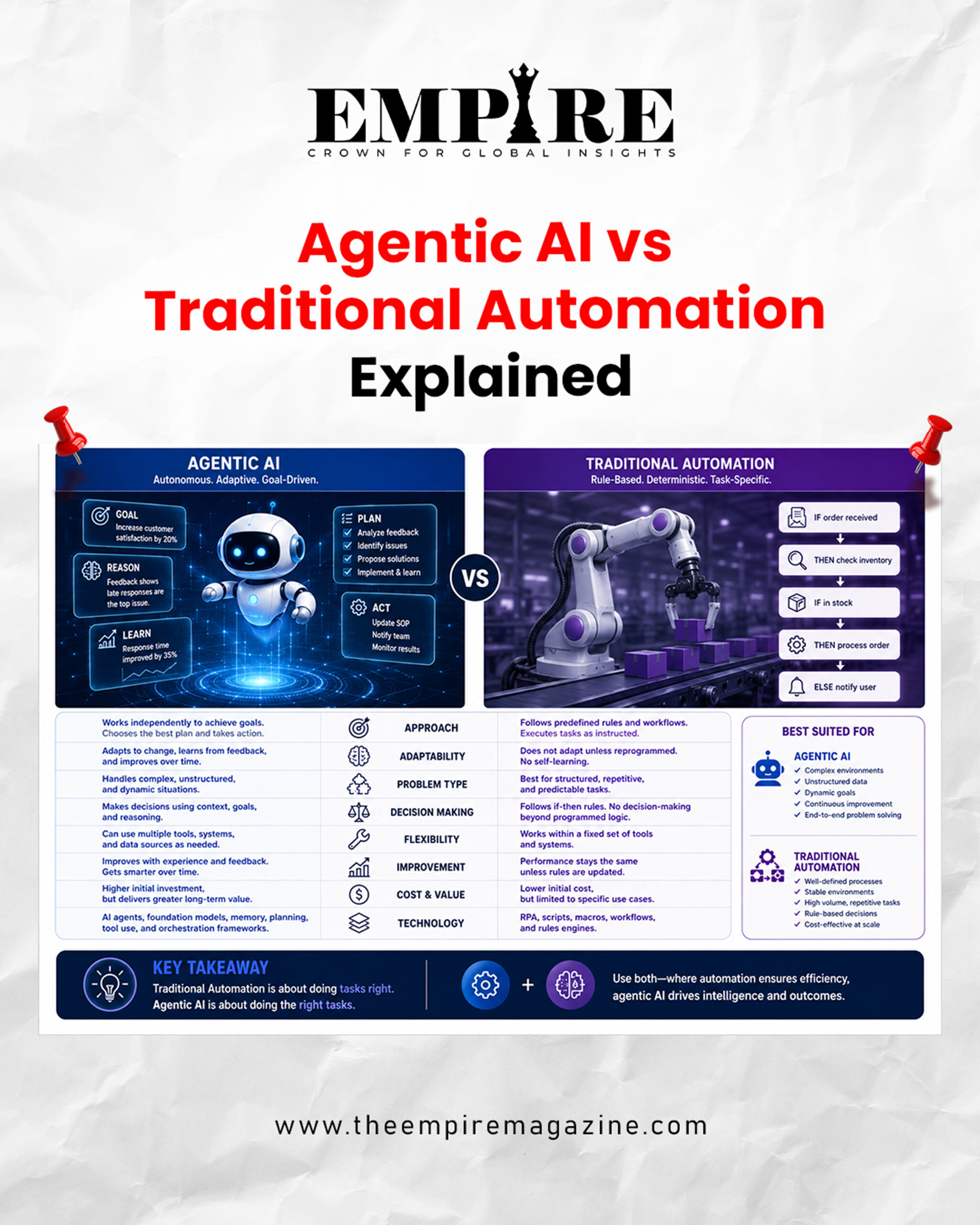
Agentic AI vs Traditional Automation is becoming one of the most important discussions in the technology industry as organizations seek smarter ways to improve efficiency, reduce costs, and increase productivity. While traditional automation has been transforming businesses for decades by handling repetitive tasks through predefined rules, Agentic AI introduces a more advanced approach that enables systems to make decisions, adapt to changing conditions, and pursue goals with limited human intervention.
As artificial intelligence continues to evolve, understanding the difference between Agentic AI and traditional automation has become essential for business leaders, technology professionals, and organizations planning their digital transformation strategies.
Agentic AI vs Traditional Automation: Understanding the Basics
The primary difference between Agentic AI vs Traditional Automation lies in how each system operates.
Traditional automation follows predefined instructions and rules created by humans. These systems perform specific tasks repeatedly and consistently, but they generally cannot adapt when conditions change unexpectedly.
Agentic AI, on the other hand, is designed to pursue objectives, make decisions, and take actions based on goals rather than strictly following predefined workflows. Agentic systems can analyze information, evaluate options, and determine the best course of action within their assigned parameters.
What Is Traditional Automation?
Traditional automation refers to technologies that execute tasks according to programmed instructions.
Examples include:
- Automated invoice processing
- Manufacturing assembly line systems
- Email workflow automation
- Data entry automation
- Robotic Process Automation (RPA)
These systems are highly effective when processes remain predictable and structured. They improve efficiency by eliminating repetitive manual work and reducing human error.
What Is Agentic AI?
Agentic AI refers to AI systems capable of independently planning, reasoning, and executing actions to achieve specific goals.
Unlike traditional automation, Agentic AI can:
- Analyze changing situations
- Adapt strategies
- Make decisions
- Learn from outcomes
- Coordinate multiple tasks
These capabilities allow Agentic AI to operate in dynamic environments where fixed rules alone may not be sufficient.
Agentic AI vs Traditional Automation: How Decision-Making Differs
One of the most significant distinctions in the Agentic AI vs Traditional Automation debate involves decision-making capabilities.
Traditional automation follows a “if this happens, do that” approach. Every possible action must be predefined by developers or business analysts.
Agentic AI operates differently by evaluating situations and selecting actions based on objectives and available information.
Traditional Automation Relies on Rules
In traditional automation systems:
- Rules are predefined.
- Outcomes are predictable.
- Processes follow fixed workflows.
- Human intervention is required for exceptions.
For example, an automated approval system may approve invoices below a certain amount and send larger invoices for manual review.
Agentic AI Relies on Goals
Agentic AI focuses on achieving outcomes rather than following fixed instructions.
For example, an AI-powered procurement agent may:
- Evaluate supplier options
- Compare pricing
- Analyze delivery schedules
- Negotiate recommendations
- Select the most efficient purchasing strategy
The system determines how to reach the goal instead of simply executing predefined steps.
Agentic AI vs Traditional Automation in Business Operations
Businesses across industries are exploring both technologies to improve operational performance.
The comparison between Agentic AI vs Traditional Automation often depends on the complexity of the task being performed.
Traditional Automation Works Best for Repetitive Tasks
Traditional automation is ideal when processes are:
- Highly structured
- Predictable
- Rule-based
- Repetitive
Common use cases include:
Finance
- Invoice processing
- Payroll management
- Expense reporting
Human Resources
- Employee onboarding
- Benefits administration
- Attendance tracking
Manufacturing
- Production line automation
- Quality checks
- Equipment monitoring
These tasks benefit from consistency and repeatability.
Agentic AI Works Best for Complex Tasks
Agentic AI is particularly useful when situations require adaptability and judgment.
Examples include:
Customer Service
AI agents can handle customer inquiries, understand context, and determine appropriate responses.
Supply Chain Management
Agentic systems can adjust logistics plans based on weather conditions, inventory shortages, or transportation disruptions.
Cybersecurity
AI agents can monitor threats, investigate suspicious activities, and recommend defensive actions.
These applications require ongoing evaluation and decision-making capabilities.
Agentic AI vs Traditional Automation: Learning and Adaptability
Another major difference between Agentic AI vs Traditional Automation involves adaptability.
Traditional Automation Has Limited Flexibility
Traditional automation systems generally do not learn from experience.
When business requirements change, organizations often need to:
- Rewrite workflows
- Update rules
- Modify software configurations
- Add new exceptions
As a result, maintaining traditional automation systems can become increasingly complex over time.
Agentic AI Can Adapt
Agentic AI systems can adjust their behavior based on new information and changing conditions.
These systems often use:
- Machine learning
- Large language models
- Reasoning frameworks
- Planning algorithms
This allows them to improve performance and respond more effectively to new situations.
The ability to adapt makes Agentic AI attractive for rapidly changing business environments.
Agentic AI vs Traditional Automation: Human Involvement
The level of human involvement also differs significantly.
Traditional Automation Requires Ongoing Oversight
Traditional automation depends heavily on humans to:
- Define rules
- Monitor workflows
- Handle exceptions
- Update processes
Organizations must continually maintain these systems to ensure they remain effective.
Agentic AI Supports Greater Autonomy
Agentic AI can perform many tasks with reduced human supervision.
Human involvement typically focuses on:
- Defining objectives
- Establishing boundaries
- Monitoring performance
- Managing governance
This shift allows employees to focus on higher-value activities rather than repetitive operational work.
Agentic AI vs Traditional Automation: Benefits and Challenges
Understanding both advantages and limitations is essential when evaluating Agentic AI vs Traditional Automation.
Benefits of Traditional Automation
Traditional automation offers:
- Reliability
- Predictability
- Lower implementation complexity
- Easier compliance management
- Proven business value
Organizations often use traditional automation as the foundation of their digital transformation efforts.
Challenges of Traditional Automation
Limitations include:
- Limited adaptability
- Dependence on predefined rules
- Difficulty handling exceptions
- Increased maintenance as processes grow more complex
Benefits of Agentic AI
Agentic AI provides:
- Greater flexibility
- Adaptive decision-making
- Goal-oriented execution
- Improved productivity
- Enhanced operational efficiency
These capabilities make Agentic AI suitable for more advanced business processes.
Challenges of Agentic AI
Organizations must also address:
- Governance requirements
- Security considerations
- Transparency concerns
- Regulatory compliance
- Performance monitoring
Because Agentic AI systems can make decisions independently, strong oversight frameworks remain essential.
Agentic AI vs Traditional Automation: Industry Adoption Trends
Organizations worldwide are increasingly combining both approaches rather than choosing one over the other.
Many businesses continue using traditional automation for routine workflows while deploying Agentic AI for tasks requiring reasoning, adaptability, and decision-making.
Technology leaders including major cloud providers, enterprise software companies, and AI developers are investing heavily in Agentic AI platforms as demand for intelligent automation continues to grow.
Industry analysts expect Agentic AI to become a significant component of enterprise technology strategies over the coming years, particularly in sectors such as finance, healthcare, manufacturing, logistics, and customer service.
For more business and technology insights, read: https://theempiremagazine.com/?p=7110
Follow The Empire Magazine on Facebook: https://www.facebook.com/profile.php?id=61573749076160
Follow The Empire Magazine on Instagram: https://www.instagram.com/the_empire_magazine/
– The Empire Magazine
Crown For Global Insights