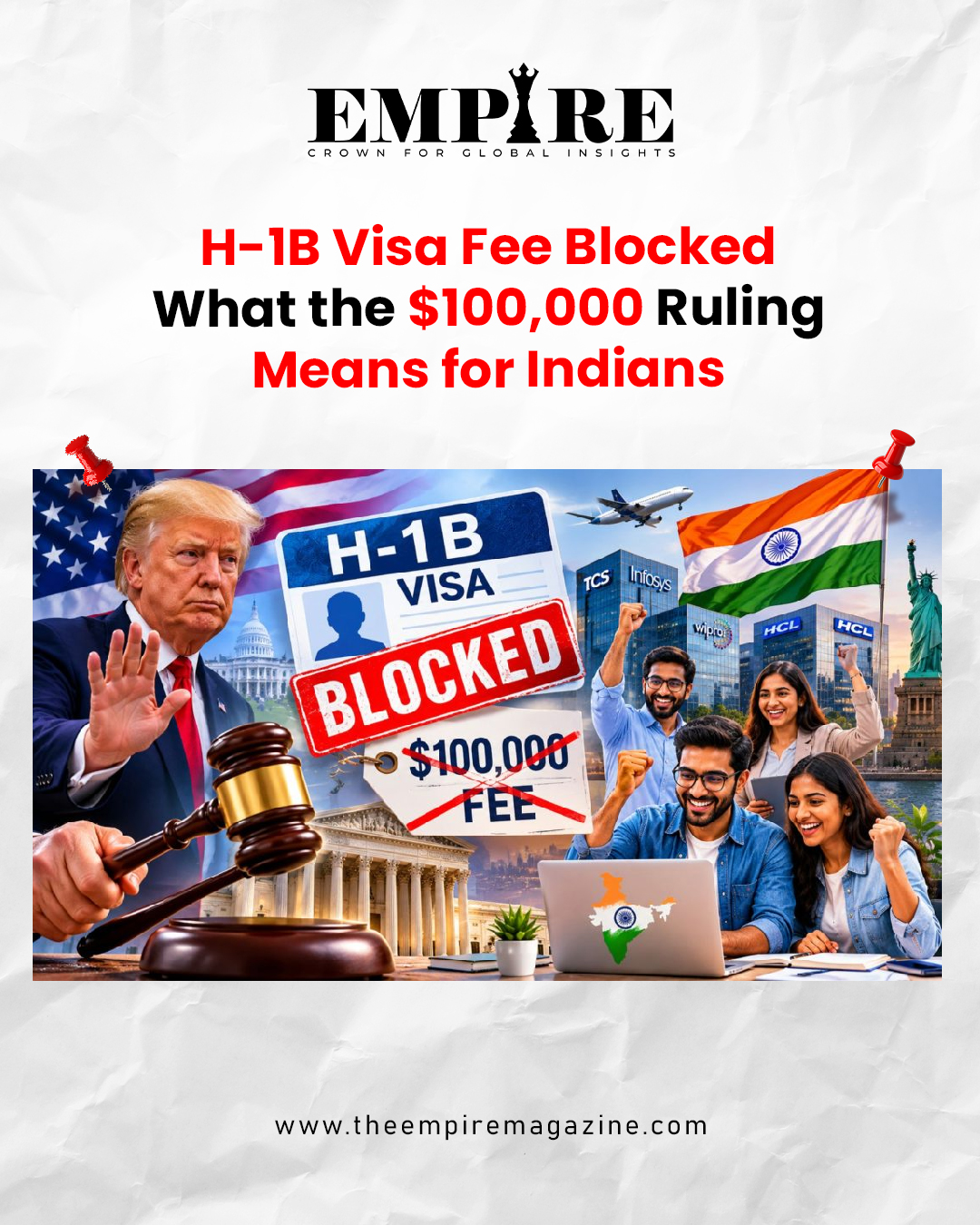
H-1B Visa Fee changes have become a major issue for Indian professionals, students, technology workers, employers, universities, and families connected to the United States. A U.S. federal judge has blocked the $100,000 H-1B visa fee imposed by the Trump administration, calling it unlawful. The ruling is important because the H-1B visa is one of the most important legal work routes for skilled foreign professionals, especially Indians working in technology, engineering, healthcare, finance, research, and higher education.
The $100,000 fee had created serious concern among Indian applicants and U.S. employers. Many feared that such a high cost would make companies less willing to sponsor foreign workers, especially early-career professionals, fresh graduates, and employees outside the highest-paying technology roles. For Indian workers, the court ruling brings relief, but it does not remove all uncertainty. The U.S. government may still appeal, and the wider debate around H-1B reform is likely to continue.
The ruling matters because Indians make up the largest share of H-1B visa holders. For decades, Indian engineers, software developers, data scientists, doctors, researchers, and business professionals have used the H-1B route to work in the U.S. The blocked fee therefore has direct consequences for Indian talent mobility, American companies, and the global technology workforce.
H-1B Visa Fee and the Court Ruling
The H-1B Visa Fee ruling came from U.S. District Judge Leo Sorokin in Boston. The judge struck down the $100,000 fee, concluding that the administration did not have the legal authority to impose such a charge through presidential action.
The court treated the fee as more than a normal administrative charge. It was considered an unauthorized tax because it created a major financial burden that Congress had not approved. In the U.S. system, Congress has the power to create taxes and major fee structures. The judge found that the executive branch had gone beyond its authority.
This is why the ruling is significant. It is not only about immigration policy. It is also about separation of powers, administrative law, and whether a president can impose a major cost on visa applicants without congressional approval.
What the $100,000 Fee Was Designed to Do
The $100,000 fee was introduced as part of a broader effort to make the H-1B program more expensive and more restrictive. Supporters of the policy argued that it would push companies to hire American workers first and reduce reliance on foreign labor.
Critics argued that the fee was extreme, damaging, and legally weak. A $100,000 charge would have dramatically increased the cost of hiring foreign skilled workers. For many employers, especially startups, universities, hospitals, research institutions, and smaller companies, the cost could have been too high.
The H-1B program already includes filing fees, legal costs, compliance obligations, wage rules, and lottery uncertainty. Adding a $100,000 fee would have made sponsorship far more difficult.
Why Employers Were Concerned
Employers were concerned because the H-1B program helps them hire skilled workers when they cannot find enough qualified talent locally. Technology companies, AI startups, hospitals, universities, engineering firms, and financial institutions all use H-1B visas for specialized roles.
A sudden high fee could have forced employers to reduce sponsorship, delay hiring, move roles outside the U.S., or focus only on very senior candidates. This would have affected not only foreign workers but also American businesses trying to compete in artificial intelligence, cloud computing, semiconductors, healthcare, and research.
For Indian applicants, employer willingness is critical because an H-1B visa requires sponsorship. If sponsorship becomes too expensive, even qualified candidates may lose opportunities.
What It Means for Indians
For Indians, the blocked H-1B Visa Fee is a major relief. Indian workers receive the largest number of H-1B visas each year, especially in technology and professional services. Many Indian students also study in the U.S. with the hope of moving from Optional Practical Training to H-1B sponsorship.
If the $100,000 fee had continued, employers may have become much more selective. Fresh graduates, mid-level professionals, and workers in lower-margin sectors may have faced fewer sponsorship opportunities. Some companies may have preferred hiring overseas teams in India instead of moving workers to the U.S.
The court ruling means that the massive fee cannot be enforced for now. This gives Indian professionals and employers more breathing room. However, Indians should still remain cautious because the legal and political battle may continue.
Relief for Indian Students in the U.S.
Indian students in the U.S. were among the groups most worried about the fee. Many international students invest heavily in American education with the goal of building careers in the U.S. After graduation, they often depend on employer sponsorship to move into H-1B status.
A $100,000 fee could have made employers hesitate before sponsoring new graduates, especially those with limited work experience. This could have reduced the value of U.S. education for many Indian families.
The court ruling helps protect the current pathway, but it does not guarantee easy access. The H-1B lottery remains competitive, and newer rules may still favor higher-wage or more experienced candidates.
Impact on Indian IT Companies
Indian IT companies have historically used the H-1B program to serve U.S. clients, move skilled employees, and manage technology projects. A steep fee would have increased costs sharply for these companies.
Over the years, Indian IT firms have already adjusted their U.S. hiring strategies by hiring more local employees, increasing offshore delivery, and reducing dependency on visa-based staffing. The $100,000 fee would have accelerated that shift.
With the fee blocked, Indian IT companies may avoid an immediate cost shock. However, they will still have to manage changing U.S. visa rules, wage expectations, compliance requirements, and political scrutiny around outsourcing.
Impact on U.S. Technology and AI Companies
The H-1B Visa Fee ruling is also important for U.S. technology companies. The U.S. tech industry depends heavily on global talent, including Indian engineers and researchers. AI companies, cloud firms, semiconductor companies, and software startups often need highly specialized workers.
In recent years, competition for AI talent has become intense. Companies working in machine learning, chips, cybersecurity, robotics, and advanced software may struggle if immigration pathways become too costly or uncertain.
Blocking the fee gives companies more flexibility to hire skilled foreign professionals. It may also reduce pressure to move teams overseas simply to avoid visa costs.
Why AI Talent Makes H-1B More Important
Artificial intelligence has increased demand for highly skilled technical workers. AI research, model training, data infrastructure, chip design, safety engineering, and enterprise AI deployment all need specialized talent.
Many skilled professionals in these fields come from India. Indian engineers and researchers are active across major U.S. technology companies, startups, universities, and labs. If the H-1B route becomes too restricted, the U.S. could lose talent to Canada, Europe, the Middle East, Singapore, or India’s own growing technology market.
This is why the fee ruling has broader economic importance. It affects not only immigration but also innovation competitiveness.
Why the Case Is Not Fully Over
The ruling blocks the fee, but the story may not be fully over. The Trump administration is expected to appeal. If an appeals court grants a stay or reverses the decision, the policy could return in some form.
There may also be separate legal cases involving similar arguments. Immigration policy often changes through court rulings, appeals, agency guidance, and new rules. This means employers and applicants must continue watching official updates.
For Indians planning H-1B applications, the safest approach is to follow current official filing rules, work closely with employers and immigration lawyers, and avoid relying on rumors.
H-1B Lottery and Other Challenges Remain
Even without the $100,000 fee, the H-1B system remains difficult. The annual cap is limited, and demand is usually much higher than available visas. Many qualified applicants are not selected in the lottery.
The U.S. has also been moving toward rules that favor higher-wage applicants and more specialized roles. This could make it harder for fresh graduates and entry-level candidates. Employers may also become more careful about sponsorship because of legal costs and compliance risks.
So, while the court ruling is positive for Indians, it does not make the H-1B process easy. It mainly removes one major financial barrier.
What Indian Applicants Should Watch
Indian applicants should watch three things carefully. First, whether the government appeals the ruling and whether any higher court changes the decision. Second, whether new H-1B rules affect lottery selection, wage levels, or employer requirements. Third, whether employers change sponsorship policies because of uncertainty.
Applicants should also strengthen their profiles. Specialized skills, strong work experience, advanced degrees, AI knowledge, cloud skills, cybersecurity, healthcare technology, finance technology, and research experience can improve career opportunities even in a competitive visa environment.
What It Means for Families and Long-Term Immigration
For many Indian professionals, H-1B is not only a work visa. It is part of a longer immigration journey that may include permanent residency. The U.S. green card backlog for Indians is already a major challenge, especially for employment-based categories.
The blocked fee does not solve the green card backlog. It also does not change the uncertainty many Indian families face around renewals, job changes, dependents, and long-term settlement.
However, keeping the H-1B route financially accessible is still important. If sponsorship becomes too expensive, fewer Indians may even enter the system, making long-term U.S. career planning harder.
Business Impact of the Ruling
The ruling is positive for businesses that depend on skilled workers. It reduces the risk of sudden cost increases and allows companies to continue hiring through the existing H-1B process.
For startups, this is especially important. A $100,000 fee could have been impossible for many young companies. Startups often need specialized engineers but may not have the budget of large tech firms. Blocking the fee protects their ability to compete for global talent.
Universities and hospitals also benefit. These institutions may need researchers, doctors, professors, and technical experts but may not be able to afford extreme visa fees.
Why the H-1B Debate Will Continue
The H-1B debate will continue because it sits at the center of larger questions about jobs, wages, immigration, innovation, and national competitiveness. Supporters of stricter rules argue that companies should hire Americans first and avoid using foreign workers to reduce wages. Supporters of the program argue that the U.S. needs skilled global talent to fill gaps, grow businesses, and remain competitive.
For Indians, this means the H-1B route will remain politically sensitive. The blocked $100,000 fee is a victory for applicants and employers, but future administrations may still try to reform the system.
The key issue is balance. The U.S. must protect domestic workers while also attracting high-skilled talent. Indian professionals are central to that discussion because they form the largest group in the H-1B workforce.
Readers can also explore more luxury business insights through this related article: Alexander McQueen: Can a New CEO Revive the British Luxury House?.
For more updates from The Empire Magazine, follow us on Facebook and Instagram.
– The Empire Magazine
Crown For Global Insights