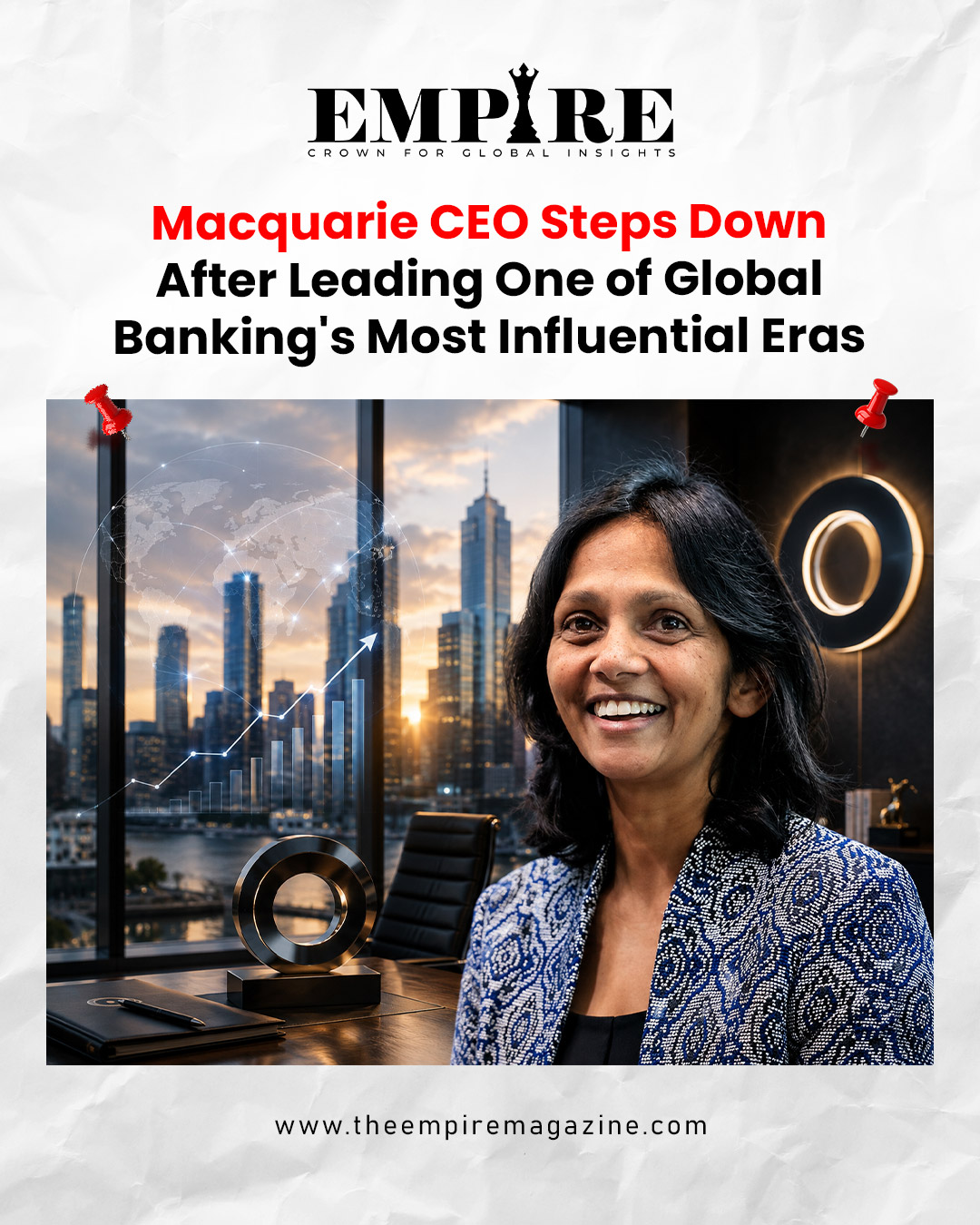
Macquarie CEO Shemara Wikramanayake announces retirement after nearly four decades. Explore her leadership legacy, Greg Ward’s appointment, and what lies ahead. Macquarie Group has announced that CEO Shemara Wikramanayake will retire in November 2026 after nearly 40 years with the company. Her successor, Greg Ward, inherits one of the world’s most respected investment banking institutions at a time of evolving global financial markets and renewed investor confidence.
A Defining Moment as Macquarie CEO Steps Down
The announcement that Macquarie CEO Shemara Wikramanayake will retire in November 2026 marks the end of one of the most remarkable leadership journeys in modern global banking. After nearly four decades at Macquarie Group and almost eight years as its Chief Executive Officer, Wikramanayake leaves behind a financial institution that has strengthened its reputation as one of the world’s most innovative investment banks. Her successor, veteran executive Greg Ward, steps into the role with more than three decades of experience inside the organisation, signalling continuity rather than disruption in Macquarie’s long-term strategy. The transition comes as the Australian financial powerhouse continues to deliver resilient financial performance despite geopolitical uncertainty, shifting interest rate cycles, and increasingly complex global markets. Investors, employees, regulators, and industry observers have largely viewed the carefully planned succession as evidence of Macquarie’s disciplined governance and deep leadership bench, reflecting the institution’s long-standing preference for promoting experienced internal leaders.
Macquarie CEO Steps Down After Transforming the Business
When Shemara Wikramanayake became Chief Executive Officer in late 2018, she inherited an institution already respected across international financial markets. However, her tenure would elevate Macquarie to an entirely new level of global influence. Having joined the company in 1987, she built her career across corporate advisory, infrastructure investment, asset management, and international operations, working across multiple countries before taking the organisation’s highest office. Under her leadership, Macquarie significantly expanded its international footprint while strengthening businesses spanning infrastructure investment, renewable energy, commodities trading, digital infrastructure, and asset management. During her tenure, the company’s share price more than doubled, supported by disciplined capital allocation, diversified revenue streams, and an ability to navigate periods of extraordinary market volatility, including the COVID-19 pandemic and global energy disruptions. Beyond financial achievements, Wikramanayake became widely recognised for demonstrating that long-term strategic thinking, measured risk management, and operational discipline could coexist with innovation, positioning Macquarie as one of the most respected financial institutions in the global investment banking industry.
Macquarie CEO Steps Down as Greg Ward Prepares to Lead the Next Chapter
With the Macquarie CEO stepping down, the appointment of Greg Ward signals continuity backed by experience rather than an abrupt strategic shift. Having spent more than three decades within Macquarie Group, Ward has played a key role across several of the bank’s major businesses, earning a reputation for disciplined execution and deep institutional knowledge. His elevation to Chief Executive Officer reflects Macquarie’s long-standing philosophy of nurturing leadership from within, ensuring that organisational culture and strategic priorities remain intact during periods of transition. However, the environment he inherits is considerably different from the one that shaped his predecessor’s tenure. Global banking is undergoing rapid transformation driven by artificial intelligence, digital finance, geopolitical uncertainty, evolving regulations, and the accelerating demand for sustainable investments. Investors will expect Ward to preserve Macquarie’s entrepreneurial spirit while identifying new avenues of growth in infrastructure, private markets, clean energy, and institutional asset management. His leadership will also be measured by how effectively he manages global economic volatility while maintaining the company’s disciplined approach to capital allocation and risk management. Rather than steering the organisation in a completely new direction, Ward is widely expected to build upon the strong strategic foundation established over decades, ensuring that Macquarie remains one of the world’s most respected investment banking institutions.
Macquarie CEO Steps Down During a Transformational Period for Global Banking
The timing of the Macquarie CEO steps down announcement is significant because it coincides with one of the most transformative periods the global financial services industry has witnessed in decades. Central banks continue to balance inflation and interest-rate policies, financial institutions are investing heavily in digital capabilities, and governments worldwide are prioritising infrastructure development and energy transition projects. Macquarie has strategically positioned itself at the intersection of these long-term trends through investments in renewable energy, transport infrastructure, digital connectivity, commodities, and alternative assets. Unlike many traditional banks that rely predominantly on lending income, Macquarie’s diversified business model has enabled it to generate resilient earnings from multiple revenue streams even during periods of market disruption. This diversification has become one of the company’s greatest competitive advantages, helping it navigate economic uncertainty while continuing to identify new investment opportunities globally. As leadership changes hands, stakeholders will closely monitor whether Macquarie can sustain this momentum, particularly as competition intensifies among international investment banks seeking growth in private capital, infrastructure finance, and sustainable investment solutions.
Macquarie CEO Steps Down but Leaves a Legacy Beyond Financial Performance
When the Macquarie CEO steps down, the conversation extends well beyond shareholder returns and financial metrics. Shemara Wikramanayake’s legacy is equally defined by her ability to cultivate a culture of resilience, accountability, and long-term thinking across one of Australia’s most globally recognised financial institutions. Since joining Macquarie in 1987, she progressed through multiple leadership roles before becoming Chief Executive Officer, demonstrating how institutional knowledge combined with strategic vision can produce enduring organisational success. Under her stewardship, the company strengthened its international presence, expanded its infrastructure and asset management capabilities, enhanced its commodities franchise, and consistently adapted to changing market dynamics without compromising financial discipline. Her leadership style, characterised by measured decision-making and calculated risk-taking, earned widespread respect from investors, regulators, employees, and industry peers alike. Beyond operational achievements, Wikramanayake has become an influential figure in global corporate leadership, inspiring greater conversations around inclusive leadership, succession planning, and sustainable business growth. Her tenure demonstrates that lasting success in financial services is built not through short-term market cycles but through consistent strategic execution over many years.
What the Macquarie CEO Steps Down Means for Investors and the Banking Industry
The decision that the Macquarie CEO steps down is more than an internal leadership announcement; it represents an important milestone for the broader global banking sector. Leadership transitions at institutions of Macquarie’s scale are closely watched because they often signal how organisations intend to navigate future economic and technological challenges. Fortunately for shareholders, the succession has been carefully planned, reducing uncertainty and reinforcing confidence in the company’s governance framework. Greg Ward inherits a financially strong organisation with a diversified global portfolio, experienced leadership team, and a reputation for disciplined investment decisions. Nevertheless, expectations remain high. Investors will closely evaluate how the new leadership approaches capital deployment, digital transformation, artificial intelligence, ESG investment opportunities, and evolving client demands. At the same time, Macquarie’s continued focus on infrastructure financing, renewable energy, private markets, and institutional asset management is expected to remain central to its long-term strategy. If Ward successfully balances innovation with the disciplined culture that has defined Macquarie for decades, the leadership transition may ultimately strengthen the institution’s position as one of the world’s leading investment banking groups.
Macquarie CEO Steps Down but the Legacy Continues
As the Macquarie CEO steps down, the transition symbolises the close of one of the most influential leadership chapters in modern global banking. Shemara Wikramanayake transformed Macquarie into an even stronger international financial powerhouse by combining disciplined governance, strategic investments, and a long-term vision that consistently created value for clients and shareholders. Her nearly four-decade journey with the organisation reflects the importance of institutional experience, adaptability, and leadership rooted in purpose rather than short-term results. Greg Ward now assumes responsibility for guiding Macquarie through the next phase of its evolution at a time when technology, sustainability, infrastructure investment, and changing global economic conditions are reshaping financial markets. Although every new leader brings fresh perspectives, Macquarie enters this new era from a position of considerable strength. The carefully managed succession demonstrates the organisation’s commitment to stability, leadership continuity, and sustainable growth. For the global banking community, the transition is not simply about one executive stepping aside; it is about how one of the world’s most admired investment institutions prepares itself for the opportunities and challenges of the future while preserving the values that have defined its remarkable success.
For more business and retail insights, read more on The Empire Magazine
Previous article: https://theempiremagazine.com/cambodia-online-scam/
Magazine Feautures | Podcasts: Empire Global Talks
Follow The Empire Magazine on Facebook | Instagram | LinkedIn | YouTube
The Empire Magazine | Crown for Global Insights