
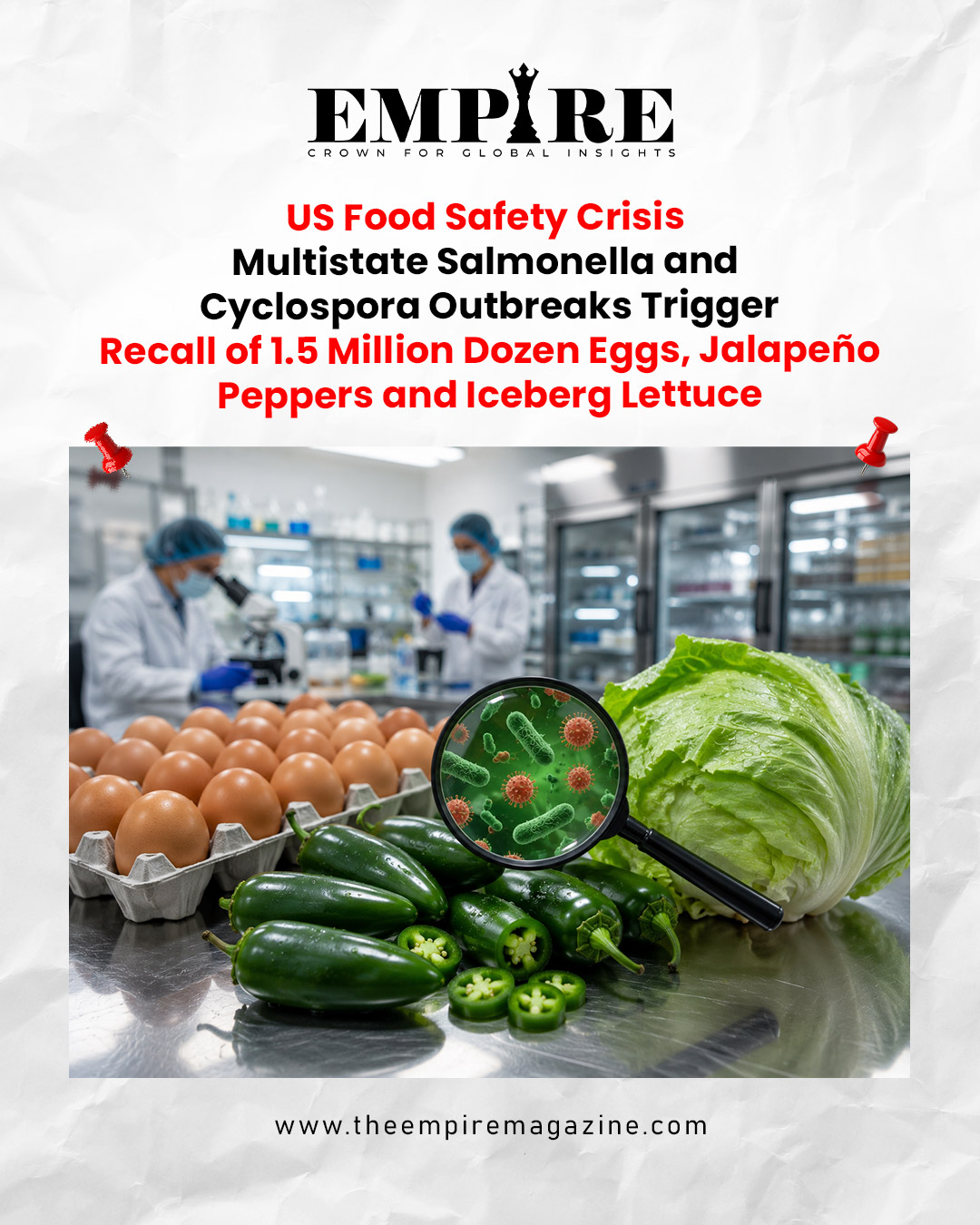
The US food safety crisis deepens as Salmonella and Cyclospora outbreaks trigger recalls of 1.5 million dozen eggs, jalapeño peppers, and iceberg lettuce across multiple states. The US food safety crisis has intensified after nationwide Salmonella and Cyclospora outbreaks prompted recalls of nearly 1.5 million dozen eggs, jalapeño peppers, and iceberg lettuce. Federal health agencies are investigating multiple foodborne illness outbreaks affecting thousands of consumers, highlighting growing concerns over food safety, supply chain monitoring, and public health.
The US Food Safety Crisis Raises New Public Health Concerns
The US Food Safety Crisis has once again placed food safety at the forefront of national attention as multiple foodborne illness outbreaks continue to spread across several states. Within a short span, federal authorities have announced large-scale recalls involving approximately 1.5 million dozen eggs, fresh jalapeño peppers, and iceberg lettuce following investigations into Salmonella and Cyclospora infections. The simultaneous emergence of multiple outbreaks has raised concerns among consumers, retailers, farmers, and public health experts alike, highlighting the complex challenges involved in maintaining food safety throughout America’s vast agricultural supply chain. While food recalls are not uncommon, the scale and timing of these investigations have amplified fears about contamination risks reaching households across the country. Health officials from the US Food and Drug Administration (FDA) and the Centers for Disease Control and Prevention (CDC) continue to investigate the source of these outbreaks while urging consumers to remain vigilant. For millions of Americans, the situation serves as an important reminder that food safety begins long before products reach supermarket shelves and requires constant oversight from farms to processing facilities and distribution networks.
US Food Safety Crisis: Salmonella Outbreak Leads to Massive Egg Recall
A significant chapter in the ongoing US Food Safety Crisis revolves around one of the largest egg recalls in recent years. Federal investigators linked a growing Salmonella outbreak to eggs distributed across numerous states, prompting the recall of nearly 1.5 million dozen eggs as a precautionary measure. Salmonella is among the most common causes of foodborne illness in the United States and can lead to symptoms including fever, diarrhea, abdominal cramps, nausea, and vomiting, particularly affecting young children, elderly individuals, pregnant women, and people with weakened immune systems. According to public health officials, several consumers reported illnesses before epidemiological investigations connected the infections to contaminated eggs. The recall was initiated to prevent additional illnesses while authorities traced the contamination to its source within the production and supply chain. Retailers were instructed to remove affected products immediately, while consumers were advised to check packaging details and discard recalled eggs or return them to the place of purchase. Experts note that although modern poultry farms follow stringent safety protocols, even a single contamination event can rapidly affect products distributed nationwide because of today’s highly interconnected food supply system.
US Food Safety Crisis Expands as Jalapeño Peppers Face Salmonella Investigation
Beyond the egg recall, the US Food Safety Crisis has expanded following a multistate Salmonella outbreak associated with fresh jalapeño peppers, another staple ingredient found in countless American kitchens and restaurants. Investigators from the CDC and FDA identified a growing number of illnesses linked to peppers supplied through commercial distribution channels, prompting additional recalls and public health advisories. Fresh produce presents unique food safety challenges because it is often consumed raw, eliminating the cooking process that would normally destroy harmful bacteria. As investigators continue tracing shipments, officials are examining farms, packaging facilities, transportation practices, and retail distribution networks to determine exactly where contamination occurred. The outbreak has affected consumers across multiple states, reinforcing the importance of rapid disease surveillance and coordinated response efforts between federal agencies, state health departments, food manufacturers, wholesalers, and retailers. Consumers have been encouraged to dispose of recalled peppers, thoroughly sanitize food preparation surfaces, and monitor themselves for symptoms if they recently consumed potentially contaminated products. The incident further demonstrates how quickly foodborne pathogens can spread through modern distribution systems, making swift recalls essential for protecting public health.
US Food Safety Crisis Deepens with Cyclospora Outbreak Linked to Iceberg Lettuce
The US Food Safety Crisis became even more alarming as federal health authorities expanded their investigation into a widespread Cyclospora outbreak linked to iceberg lettuce, affecting consumers across several states. Unlike Salmonella, Cyclospora is a microscopic parasite that causes cyclosporiasis, an intestinal illness known for prolonged watery diarrhea, fatigue, nausea, stomach cramps, bloating, and weight loss. Symptoms often appear several days after consuming contaminated food, making it more difficult for investigators to identify the original source of infection. Preliminary investigations by the FDA and CDC traced multiple illness reports to iceberg lettuce distributed through commercial supply chains, prompting recalls while officials conducted traceback investigations involving farms, processors, distributors, and retailers. Public health experts note that fresh leafy vegetables remain particularly vulnerable because they are commonly eaten raw and require extensive handling before reaching consumers. The outbreak has renewed discussions about improving sanitation standards during cultivation, harvesting, washing, packaging, and transportation, while consumers have been urged to avoid recalled products, maintain strict kitchen hygiene, and seek medical attention if symptoms develop after consuming potentially contaminated produce.
How Federal Agencies Are Responding to the US Food Safety Crisis
Containing the US Food Safety Crisis has required an extensive and coordinated response from federal and state authorities working to protect public health while maintaining confidence in the nation’s food supply. The Food and Drug Administration (FDA) has launched comprehensive traceback investigations to determine the precise origin of contamination, while the Centers for Disease Control and Prevention (CDC) continues to monitor reported illnesses, identify epidemiological links, and issue regular public health updates. State health departments have also intensified surveillance by interviewing affected individuals, collecting food samples, and coordinating laboratory testing to establish definitive connections between illnesses and recalled products. At the same time, food producers and retailers have been instructed to remove affected products from shelves, notify distribution partners, and strengthen internal food safety protocols to prevent additional contamination. Officials emphasize that food recalls demonstrate the effectiveness of surveillance systems rather than a failure of regulation alone, as rapid identification and removal of contaminated products significantly reduce the risk of further illnesses. Nevertheless, the simultaneous investigations involving eggs, jalapeño peppers, and iceberg lettuce illustrate the growing complexity of managing food safety across an increasingly interconnected agricultural and distribution network.
Why Foodborne Illnesses Continue to Challenge the Food Industry
The ongoing US Food Safety Crisis also highlights broader challenges facing the global food industry, where increasingly complex supply chains create more opportunities for contamination before products reach consumers. Fresh produce often passes through multiple farms, processing facilities, packaging centers, transportation networks, wholesalers, and retailers, making traceback investigations both technically demanding and time-consuming. Climate variability, changing agricultural practices, expanding international trade, and the growing consumer preference for minimally processed foods have further complicated efforts to eliminate foodborne pathogens completely. Experts explain that microorganisms such as Salmonella can contaminate poultry environments, while parasites like Cyclospora may enter produce through contaminated irrigation water or unsanitary handling during harvesting and processing. Although technological advancements, including genome sequencing and digital traceability systems, have significantly improved outbreak detection and response times, preventing contamination remains a shared responsibility involving growers, manufacturers, regulators, distributors, retailers, and consumers. The latest outbreaks serve as a reminder that maintaining food safety requires continuous investment in preventive measures, employee training, sanitation practices, and transparent monitoring systems capable of identifying risks before they escalate into nationwide public health emergencies.
Consumer Safety Measures During the US Food Safety Crisis
As the US Food Safety Crisis continues to evolve, health authorities are urging consumers to take proactive steps to reduce their risk of foodborne illness. The FDA and CDC have advised households to immediately check refrigerators and kitchen pantries for recalled eggs, jalapeño peppers, and iceberg lettuce, disposing of affected products or returning them to the place of purchase. Consumers should thoroughly wash their hands before and after handling food, sanitize cutting boards, knives, and countertops that may have come into contact with contaminated produce, and avoid cross-contamination by keeping raw foods separate from ready-to-eat items. Eggs should always be cooked until both the yolk and white are firm, while fresh produce should be rinsed under running water even though washing alone may not eliminate all harmful pathogens or parasites. Individuals experiencing symptoms such as persistent diarrhea, fever, vomiting, severe abdominal cramps, dehydration, or prolonged gastrointestinal discomfort after consuming potentially contaminated food should seek immediate medical attention, particularly children, older adults, pregnant women, and those with weakened immune systems. Public health experts stress that early reporting of illnesses also helps investigators identify outbreak sources more quickly and prevents additional cases from occurring.
Economic Impact of the US Food Safety Crisis on the Food Industry
Beyond its public health implications, the US Food Safety Crisis is creating significant economic challenges for farmers, food processors, distributors, retailers, and restaurant chains. Large-scale recalls often result in millions of dollars in direct losses through product destruction, halted distribution, legal expenses, regulatory investigations, and reputational damage. Businesses associated with recalled products frequently experience declining consumer confidence, reduced sales, and increased compliance costs as they strengthen food safety protocols. The latest investigations have also affected major restaurant operators that temporarily removed certain ingredients from their menus while switching suppliers to protect customers and maintain operational continuity. Farmers whose products are not directly linked to contamination may also suffer reduced demand because consumers often become cautious about purchasing similar products during widespread outbreaks. Industry analysts note that every major foodborne illness outbreak reinforces the importance of investment in traceability technology, laboratory testing, supply chain transparency, and preventive food safety systems. Although recalls can be financially devastating in the short term, experts agree that swift action ultimately protects both consumers and the long-term credibility of food manufacturers and retailers.
Looking Ahead: Strengthening the US Food Safety Crisis Response
The ongoing US Food Safety Crisis serves as a powerful reminder that ensuring food safety requires constant vigilance across every stage of the food supply chain. While the recalls of approximately 1.5 million dozen eggs, fresh jalapeño peppers, and iceberg lettuce have disrupted businesses and alarmed consumers, they also demonstrate the importance of surveillance systems capable of identifying contamination before outbreaks become even more widespread. As FDA and CDC investigations continue, health officials are expected to introduce additional findings and recommendations aimed at strengthening agricultural practices, improving traceability, and enhancing coordination between growers, distributors, retailers, and public health agencies. For consumers, the incident reinforces the value of staying informed about recall notices, practising proper food handling, and seeking medical care promptly if symptoms arise. Ultimately, protecting the nation’s food supply is a shared responsibility that extends from farms and food manufacturers to regulators and households alike. The lessons emerging from the current US Food Safety Crisis will likely shape future food safety policies and industry standards, helping build a more resilient and transparent food system capable of responding quickly to emerging public health threats while restoring consumer confidence in the products that reach their tables every day.
For more business and retail insights, read more on The Empire Magazine
Previous article: https://theempiremagazine.com/greece-wildfire-crisis/
Magazine Feautures | Podcasts: Empire Global Talks
Follow The Empire Magazine on Facebook | Instagram | LinkedIn | YouTube
The Empire Magazine | Crown for Global Insights