
Firefighting Helicopter Collision Reveals the Human Cost of Greece Wildfire Crisis
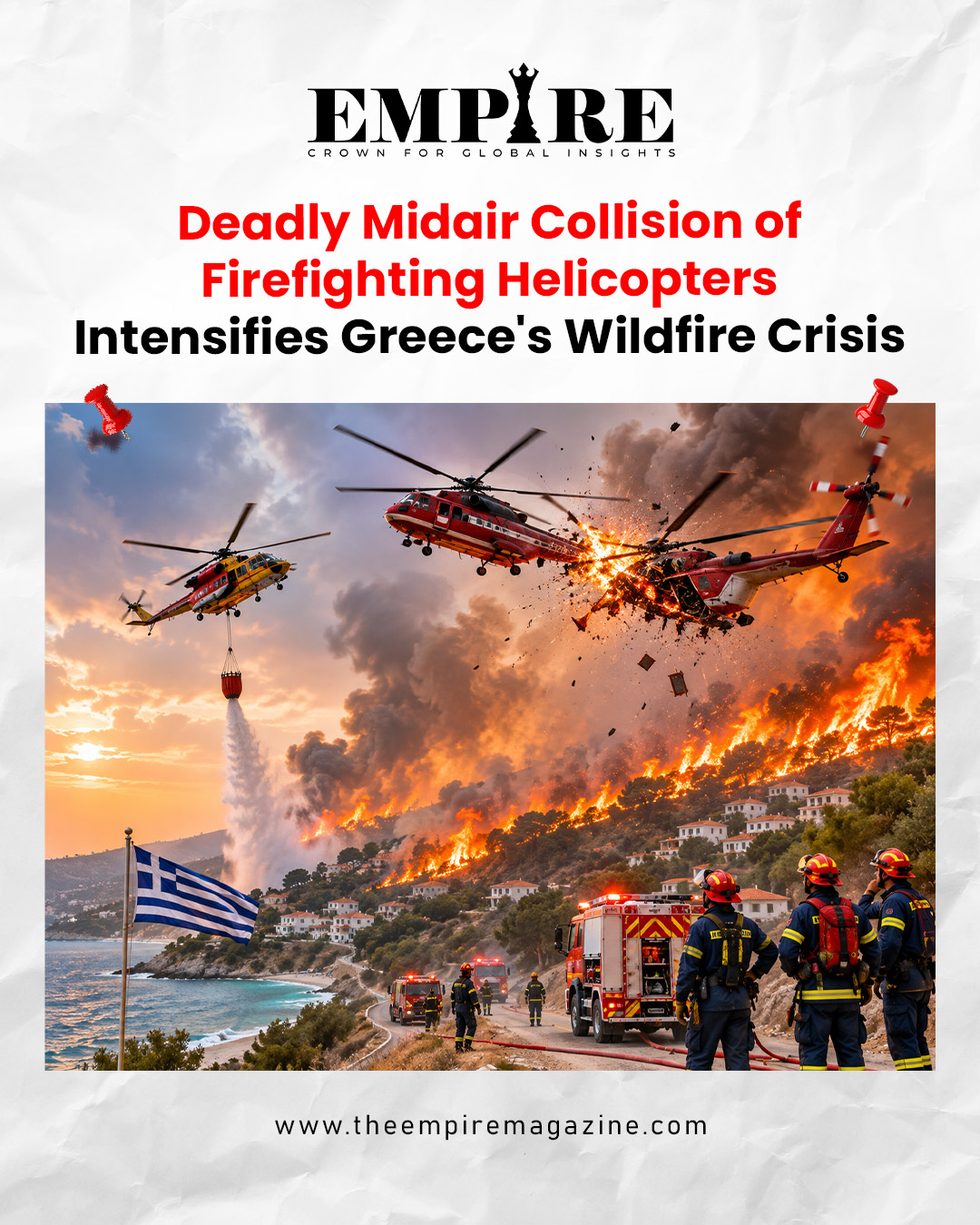
The firefighting helicopter collision in Greece has become much more than a tragic aviation accident it has emerged as one of the defining moments of the country’s worsening Greece wildfire crisis. As wildfires continue to spread across forests and residential areas near Athens, the loss of two experienced crew members has highlighted the extraordinary dangers faced by aerial firefighters every single day. The helicopters were carrying out repeated water-dropping missions over an active wildfire when they collided midair, sending one aircraft crashing to the ground while the other made an emergency landing. Authorities confirmed the deaths of two crew members, while survivors were rescued and taken for medical treatment. The accident has prompted an extensive investigation into possible causes, including challenging weather conditions, reduced visibility caused by dense smoke, and the complexities of coordinating multiple aircraft operating simultaneously over an active wildfire. Aviation specialists have long regarded aerial firefighting as one of the world’s most hazardous flying operations because pilots must manoeuvre at extremely low altitudes, avoid mountainous terrain, navigate powerful updrafts generated by intense heat, and work under immense pressure to protect lives and property. The firefighting helicopter collision is therefore not merely a tragic incident but a reminder of the immense courage displayed by emergency responders who willingly place themselves in harm’s way to prevent even greater destruction during the ongoing Greece wildfire crisis.
Greece Wildfire Crisis Intensifies After Firefighting Helicopter Collision
The Greece wildfire crisis has once again demonstrated how climate-driven disasters are becoming increasingly difficult for emergency agencies to manage despite significant investments in firefighting resources. Record-breaking summer temperatures, prolonged drought conditions and powerful seasonal winds have transformed vast stretches of Greece into highly combustible landscapes where wildfires spread with alarming speed. Against this backdrop, the firefighting helicopter collision has intensified national concern, not only because of the tragic loss of life but also because it underscores the growing operational risks faced by aerial firefighting teams working in extreme environments. Experts believe that climate change is extending wildfire seasons, increasing fire intensity and forcing pilots to undertake longer, more dangerous missions than ever before. Across southern Europe, countries including Spain, Portugal, Italy and France are experiencing similar challenges as governments deploy aircraft, helicopters and thousands of firefighters to contain rapidly expanding blazes. The tragic accident has therefore become symbolic of a much larger global challenge where rising temperatures are placing unprecedented pressure on emergency services, aviation safety and disaster management systems. As Greece mourns the lives lost in the firefighting helicopter collision, the incident also serves as a powerful reminder that the true cost of the Greece wildfire crisis is measured not only in burnt forests and damaged homes but also in the brave individuals who risk and sometimes sacrifice their own lives to protect others.
Firefighting Helicopter Collision Sparks Calls for Better Aerial Fire Safety
The devastating firefighting helicopter collision has also reignited an important conversation about aerial firefighting safety and whether emergency aviation systems are adequately equipped to handle increasingly complex wildfire operations. As Greece expands its fleet of helicopters and fixed-wing aircraft to combat more frequent and intense fires, aviation experts argue that operational protocols must evolve alongside the growing climate threat. Flying multiple aircraft simultaneously over active wildfire zones requires flawless coordination between pilots, ground commanders and air traffic supervisors, especially when thick smoke, unpredictable winds and rapidly changing fire behaviour reduce visibility within seconds. Investigators are expected to examine flight data, communication records and weather conditions before determining the exact sequence of events that led to the collision, while authorities have reiterated that no conclusions should be drawn until the official inquiry is completed. Beyond identifying the immediate cause, the investigation could influence future firefighting aviation practices, including improved airspace management, enhanced pilot training, upgraded communication systems and greater use of advanced technologies such as real-time aerial mapping and drone surveillance. As wildfire seasons become longer and more destructive across Europe, ensuring the safety of the professionals battling these disasters from the air has become just as important as protecting forests, infrastructure and civilian lives. The firefighting helicopter collision may therefore serve as a turning point in strengthening operational standards for aerial firefighting missions across the region.
Firefighting Helicopter Collision Leaves Greece Seeking Answers
As Greece continues battling one of its most challenging wildfire seasons in recent years, the firefighting helicopter collision stands as a heartbreaking reminder that every emergency operation carries immense human risk. While firefighters on the ground continue protecting homes and evacuating vulnerable communities, the nation is mourning two dedicated crew members who lost their lives while serving the public during an extraordinary crisis. Their sacrifice reflects the courage and commitment displayed daily by emergency responders who often work in dangerous conditions with little margin for error. The coming weeks will focus on the official investigation, support for the affected families and efforts to strengthen aviation safety so that similar tragedies can be prevented in the future. Yet the broader lesson extends beyond a single accident. The Greece wildfire crisis continues to demonstrate how climate change, prolonged heatwaves and increasingly severe wildfires are testing emergency response systems across Europe like never before. As governments invest in stronger firefighting capabilities and improved disaster preparedness, the memory of those lost in the firefighting helicopter collision is likely to shape future policies aimed at protecting both the communities threatened by wildfires and the brave men and women who risk their lives from the skies to keep them safe.
Firefighting Helicopter Collision Highlights the Need for Climate Resilience
The tragic firefighting helicopter collision has reinforced the urgent need for stronger climate resilience strategies as countries across southern Europe confront increasingly destructive wildfire seasons. Scientists have consistently warned that rising global temperatures, prolonged droughts and extreme heatwaves are creating conditions where wildfires ignite more easily, spread more rapidly and become significantly harder to contain. Greece has invested heavily in expanding its firefighting capabilities through additional aircraft, international cooperation and enhanced emergency response mechanisms, yet the scale and intensity of modern wildfires continue to stretch available resources. The loss of experienced aerial firefighters has therefore become a sobering reminder that effective disaster management extends beyond firefighting equipment alone. It requires continuous investment in advanced weather forecasting, artificial intelligence-driven fire detection, satellite monitoring, cross-border emergency coordination and specialised pilot training to safely manage increasingly crowded airspace during major fire suppression missions. Experts believe that combining technology with stronger preventive measures such as forest management, fuel reduction programmes and community preparedness can significantly reduce both wildfire damage and risks to emergency responders. The firefighting helicopter collision ultimately illustrates how climate adaptation is no longer a future objective but an immediate necessity for safeguarding lives, protecting ecosystems and ensuring that emergency personnel have the resources needed to respond safely to ever-growing natural disasters.
Firefighting Helicopter Collision: A Tragedy That Will Shape Greece’s Future
The firefighting helicopter collision will undoubtedly be remembered as one of the most heartbreaking moments of Greece’s ongoing wildfire emergency, but it also carries lessons that extend well beyond the country’s borders. As investigators work to determine the exact cause of the accident, governments, aviation authorities and emergency agencies across Europe will closely study the findings to identify improvements that can enhance aerial firefighting safety. The incident has reminded the world that behind every successful wildfire response are highly trained pilots, engineers, firefighters and rescue teams whose dedication often goes unnoticed until tragedy strikes. Their work protects thousands of families, preserves natural habitats and prevents economic losses that can take years to recover from. While no investigation can undo the loss suffered by the victims’ families, it can help build safer operational standards for future generations of emergency responders. As Greece honours the courage and sacrifice of the fallen crew members, the firefighting helicopter collision also serves as a powerful call for stronger climate action, better disaster preparedness and continued investment in modern firefighting capabilities. In an era of increasingly unpredictable wildfires, protecting those who protect others has become one of the most important responsibilities shared by governments, institutions and society alike.
For more business and retail insights, read more on The Empire Magazine
Previous article: https://theempiremagazine.com/elon-musk/
Magazine Feautures | Podcasts: Empire Global Talks
Follow The Empire Magazine on Facebook | Instagram | LinkedIn | YouTube
The Empire Magazine | Crown for Global Insights