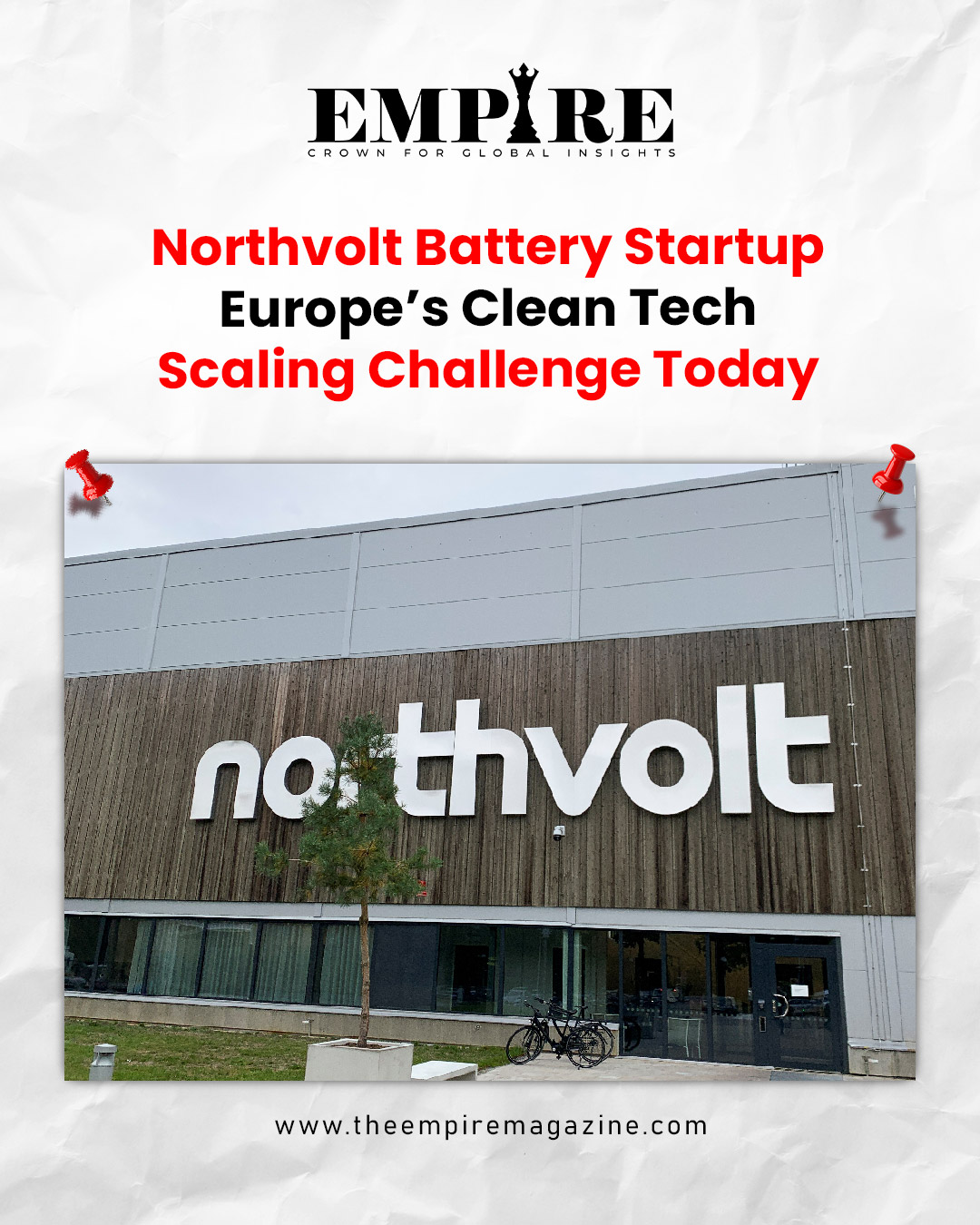
Northvolt Battery Startup became one of Europe’s most important clean technology stories because it represented a bold attempt to build a homegrown battery manufacturing champion. The Swedish company was founded with a mission to produce sustainable lithium-ion batteries for electric vehicles and energy storage while reducing Europe’s dependence on Asian battery suppliers.
For years, Northvolt was seen as a symbol of Europe’s green industrial future. Governments, automakers, investors, and climate-focused industries wanted Europe to build its own battery supply chain. Batteries are central to electric vehicles, renewable energy storage, industrial electrification, and national energy security. Without strong battery manufacturing capacity, Europe risked depending heavily on suppliers from China, South Korea, and Japan.
Northvolt’s original vision was powerful. The company aimed to manufacture batteries using clean energy, especially renewable electricity in Sweden, and build a circular battery ecosystem with recycling. This made Northvolt more than a battery company. It became a symbol of green reindustrialization, European technology sovereignty, and the clean energy transition.
However, Northvolt also became a major example of how difficult it is to scale clean tech manufacturing. The company attracted large investments, signed major customer agreements, built factories, and promised a low-carbon battery supply chain. But it also faced production delays, quality challenges, financial pressure, and eventually bankruptcy in Sweden.
Northvolt Battery Startup and the Promise of Clean Batteries
Northvolt Battery Startup was built around the idea that batteries could be produced with a much lower carbon footprint. Battery manufacturing is energy-intensive, and the electricity source matters. Producing batteries with coal-heavy electricity can increase emissions across the supply chain. Northvolt promoted its use of clean energy as a competitive advantage.
The company’s flagship factory, Northvolt Ett, was located in Skellefteå in northern Sweden. This location was strategically important because the region has access to renewable hydropower and industrial infrastructure. The factory was designed to become one of Europe’s most important battery cell production sites.
Northvolt’s clean battery vision also included recycling. The company worked on battery recycling through its Revolt program, aiming to recover valuable materials and reduce dependence on newly mined raw materials. This circular model was important because battery production depends on lithium, nickel, cobalt, graphite, and other materials that are exposed to price swings, supply risks, and environmental concerns.
Northvolt Battery Startup and Europe’s EV Supply Chain
Northvolt Battery Startup became closely connected to Europe’s electric vehicle supply chain. European automakers needed reliable battery suppliers as they shifted toward electric mobility. Battery cells are one of the most expensive and strategic components in an electric vehicle, so automakers wanted local supply to reduce risk.
Northvolt secured partnerships and customer relationships with major automotive companies. These agreements were important because a battery manufacturer needs long-term demand to justify expensive factory investments. Gigafactories require billions in capital, advanced equipment, trained workers, quality systems, and stable supply chains.
Europe’s broader policy environment also supported the company’s mission. The European Union pushed for battery manufacturing, clean industry, and reduced supply chain dependence. Northvolt fit directly into this agenda. It promised jobs, climate impact, industrial competitiveness, and a European answer to global battery dominance.
Northvolt Battery Startup and the Challenge of Scaling Manufacturing
Northvolt Battery Startup faced the most difficult part of clean tech: scaling from vision to mass production. Battery manufacturing is not like software development. It involves complex chemistry, precision manufacturing, strict quality control, industrial safety, raw material sourcing, and customer certification.
A battery cell must meet demanding performance standards. Automakers require consistency, safety, durability, and high production quality. A small defect can create serious risk. This means battery companies cannot simply build capacity; they must build reliable capacity.
Northvolt’s challenges showed how hard it is to move from pilot production to large-scale output. The company had to ramp up factory operations, train workers, manage suppliers, produce cells at consistent quality, and deliver on customer contracts. These tasks are difficult even for established battery giants, and they are even harder for a fast-growing startup.
Northvolt Battery Startup and Production Delays
Northvolt Battery Startup experienced production delays that affected customer confidence. Reports showed that the company struggled with quality and output at its flagship Northvolt Ett plant. In 2024, BMW cancelled a major battery order after Northvolt failed to deliver as expected.
That cancellation became a major warning sign. For a battery startup, losing a major customer contract can create pressure across financing, operations, and market confidence. Investors and lenders want proof that a company can produce at scale. Customers want reliable delivery. If production falls short, the business model becomes fragile.
Northvolt’s situation showed that clean tech startups face a double challenge. They must innovate on sustainability while also matching the manufacturing reliability of global industrial leaders. A strong climate mission alone is not enough if production cannot scale on time.
Northvolt Battery Startup and Financial Pressure
Northvolt Battery Startup also faced heavy financial pressure. Building battery factories requires enormous capital investment. Equipment, construction, labor, energy infrastructure, research, raw materials, and working capital all create high costs before full production revenue arrives.
The company raised billions over its lifetime and attracted support from investors, lenders, and strategic partners. But the cash demands of scaling were extremely high. In November 2024, Northvolt filed for Chapter 11 restructuring in the United States. This was meant to give the company time to reorganize and search for new funding.
However, restructuring was not enough to solve the deeper financial and operational problems. On March 12, 2025, Northvolt filed for bankruptcy in Sweden after failing to secure the financial conditions needed to continue in its existing form. The filing marked one of Sweden’s largest corporate failures and became a major setback for Europe’s battery ambitions.
Northvolt Battery Startup and the Cost of Gigafactories
Northvolt Battery Startup showed why gigafactories are risky for startups. A factory can take years to build and even longer to optimize. During that time, market conditions can change. EV demand can slow, material prices can move, customer contracts can shift, and financing conditions can tighten.
Clean tech manufacturing often requires public support because early projects are expensive and strategically important. But public funding cannot fully replace operational performance. A company still needs to produce, deliver, and compete.
Northvolt’s financial pressure showed that Europe’s clean tech strategy needs more than ambition. It needs patient capital, industrial experience, strong execution, and realistic timelines.
Northvolt Battery Startup and Europe’s Industrial Strategy
Northvolt Battery Startup became a test case for Europe’s industrial strategy. Europe wants to lead in clean energy, electric mobility, and low-carbon manufacturing. But the Northvolt story showed that competing with established Asian battery giants is extremely difficult.
China has built a powerful battery ecosystem with scale, supply chains, raw material processing, manufacturing experience, and strong domestic demand. South Korea and Japan also have deep battery expertise. Europe is trying to catch up while also meeting stricter environmental and labor standards.
Northvolt’s collapse did not mean Europe’s battery strategy failed completely, but it showed the risks clearly. A single high-profile startup could not carry the entire continent’s battery ambition. Europe needs a wider network of companies, suppliers, skilled workers, financing tools, and technology partnerships.
Northvolt Battery Startup and Supply Chain Dependence
Northvolt Battery Startup also highlighted Europe’s dependence on global battery materials and components. Even when a factory is located in Europe, the supply chain may still depend on materials or inputs from Asia. Building a complete battery ecosystem means developing everything from raw material processing to cell manufacturing, recycling, equipment, and skilled labor.
This is a long-term project. It cannot be solved only by announcing gigafactories. Industrial supply chains take years to mature. Northvolt’s difficulties showed that Europe must focus on practical execution, not only strategic headlines.
Northvolt Battery Startup and Lyten’s Acquisition
Northvolt Battery Startup entered a new phase after bankruptcy when Lyten, a U.S.-based battery company, acquired major Northvolt assets in Sweden. In February 2026, Lyten announced that it had completed the acquisition of Northvolt’s Swedish battery assets, including the Skellefteå battery site and Northvolt Labs in Västerås.
Lyten said the Skellefteå site, Northvolt Ett, would resume operations with plans to deliver commercial cells in the second half of 2026. The acquisition preserved important industrial assets that might otherwise have been lost. It also showed that Northvolt’s physical infrastructure still had value, even after the company itself failed.
The deal matters because Europe still needs battery manufacturing capacity. Even though Northvolt could not survive in its original form, its factories, equipment, land, and research facilities remain strategically important.
Northvolt Battery Startup and the Future of Former Assets
Northvolt Battery Startup left behind a complex legacy. On one side, its bankruptcy damaged confidence in Europe’s clean tech scaling model. On the other side, its assets may still contribute to battery production under new ownership.
The future of the former Northvolt facilities depends on operational execution. Restarting production is not the same as solving all previous problems. Lyten will need to manage quality, customers, workforce needs, financing, and market demand.
If the former Northvolt assets can return to production successfully, they may still support Europe’s battery ecosystem. If they struggle again, the case will deepen concerns about Europe’s ability to compete in battery manufacturing.
Northvolt Battery Startup and Clean Tech Lessons
Northvolt Battery Startup offers several important lessons for clean tech founders, investors, policymakers, and industrial leaders. The first lesson is that climate technology must be judged by execution, not only mission. A strong sustainability story can attract attention, but factories must deliver products at quality and scale.
The second lesson is that hardware and manufacturing startups need patient, realistic growth plans. Rapid expansion can create pressure if operations are not ready. In clean tech, moving too fast can be dangerous because production systems are complex and expensive to fix.
The third lesson is that Europe needs deeper industrial coordination. Battery manufacturing requires raw materials, refining, equipment, workers, energy, logistics, customers, and recycling. A single company cannot build all of that alone.
Northvolt Battery Startup and Investor Expectations
Northvolt Battery Startup also shows how investor expectations can become difficult in capital-heavy sectors. Venture-style growth models do not always fit industrial manufacturing. Battery companies need long timelines, large funding rounds, and slower ramp-up periods.
Investors may support the climate mission, but they also need confidence in delivery. When delays grow and costs rise, funding becomes harder. Northvolt’s bankruptcy showed how quickly market confidence can weaken when production targets are missed.
For future clean tech startups, the lesson is clear: build credibility through operational milestones, not only expansion announcements.
Northvolt Battery Startup and Europe’s Clean Tech Future
Northvolt Battery Startup remains one of the most important clean tech stories in Europe because it combined ambition, innovation, investment, and failure in one case. The company tried to build a European battery champion at a time when batteries were becoming central to the global energy transition.
Its bankruptcy showed the brutal reality of scaling clean technology. Manufacturing clean batteries requires more than capital and customer demand. It requires technical mastery, reliable supply chains, quality control, cost discipline, and years of industrial learning.
Europe’s battery ambitions are not over. Demand for batteries will continue through electric vehicles, renewable energy storage, industrial electrification, and grid modernization. But the Northvolt story proves that clean tech leadership will depend on execution as much as vision.
For more startup and clean technology insights, read more on The Empire Magazine.
Follow The Empire Magazine on Facebook and Instagram.
– The Empire Magazine
Crown For Global Insights