
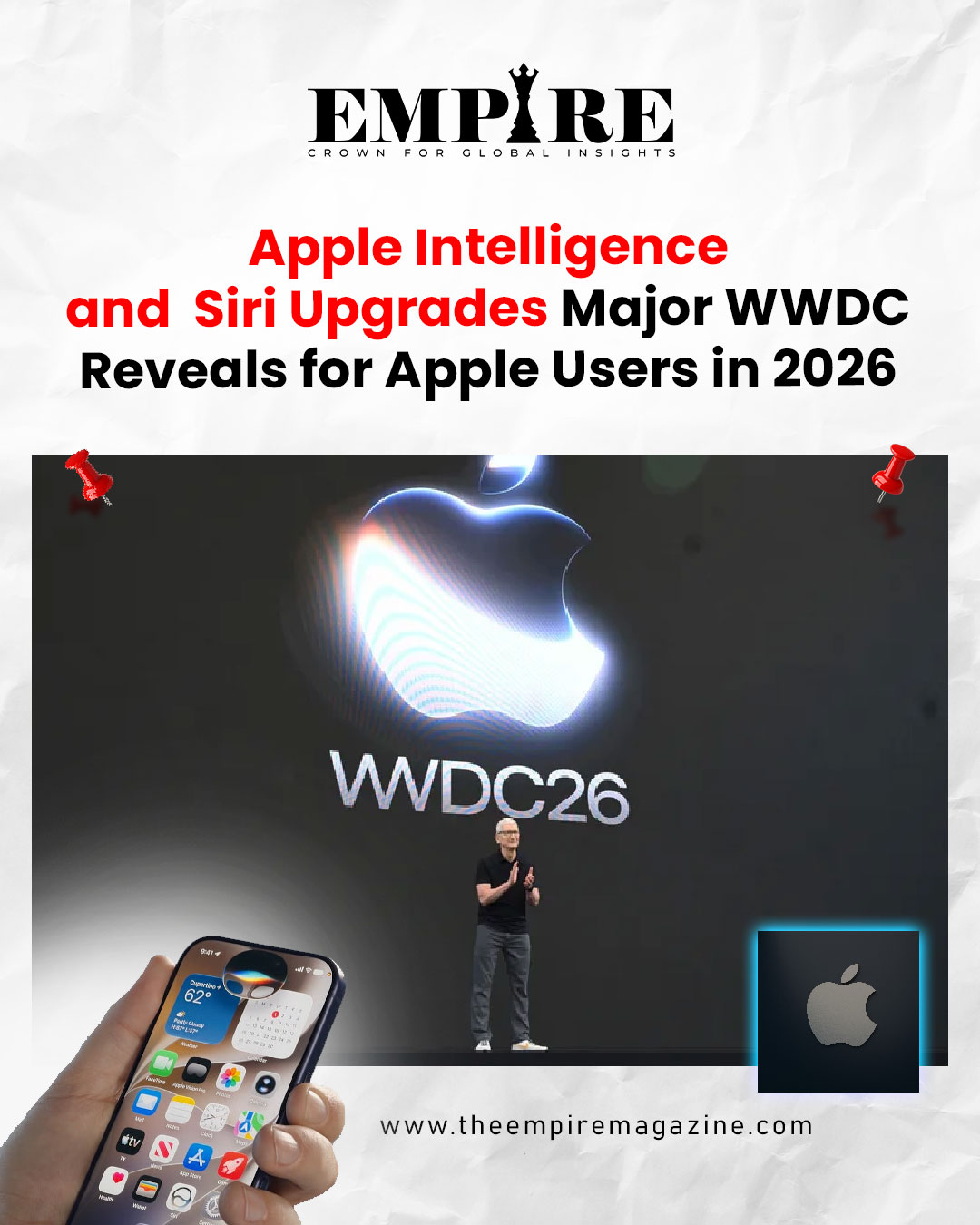
Apple Intelligence and Siri upgrades have become one of the biggest stories from Apple’s recent WWDC reveals. For years, Apple built its reputation around hardware, privacy, design, and ecosystem control. Now, artificial intelligence is becoming a deeper part of the iPhone, iPad, Mac, Apple Watch, and Apple Vision Pro experience.
Apple introduced Apple Intelligence as a personal intelligence system designed for iPhone, iPad, and Mac. Unlike many AI tools that feel separate from the operating system, Apple’s approach is built directly into apps, device features, and user workflows. The company is focusing on personal context, privacy, on-device processing, and useful daily tasks instead of only chatbot-style interaction.
Siri is also central to this strategy. Apple has been working to make Siri more natural, more context-aware, and more useful across devices. The goal is to transform Siri from a basic voice assistant into a smarter personal assistant that can understand language, take action inside apps, and respond with better awareness of what the user is doing.
At WWDC, Apple’s AI updates showed that the company is not only adding new features. It is rebuilding the way users interact with devices. Apple Intelligence and Siri upgrades are now part of a larger software direction that connects productivity, communication, creativity, accessibility, privacy, and app development.
Apple Intelligence and Siri Upgrades Bring AI Into Daily Use
Apple Intelligence and Siri upgrades are designed to make AI useful inside everyday tasks. Apple’s system can help users write, summarize, search, create images, manage notifications, and understand personal information across apps.
One of the most important parts of Apple Intelligence is its focus on personal context. Apple wants AI to understand the user’s information in a useful way, such as messages, calendar events, emails, photos, notes, and files. This can help users complete tasks faster without manually searching through multiple apps.
For example, Apple Intelligence can help summarize long emails, rewrite text in different tones, prioritize notifications, generate images, and support smarter search. These features are important because they bring AI into familiar Apple apps instead of forcing users to open a separate tool.
Apple Intelligence and Siri Upgrades Make Siri More Personal
Apple Intelligence and Siri upgrades are especially important for Siri. Siri has been part of Apple devices for many years, but users often expected more from it. Apple’s latest direction aims to make Siri more conversational, more flexible, and more capable.
A stronger Siri can better understand natural language. That means users can speak more normally instead of giving short robotic commands. Siri can also become better at handling follow-up questions, correcting mistakes, and understanding the context of what appears on screen.
This matters because voice assistants are most useful when they feel easy and natural. If Siri can understand what a user means, what they are looking at, and what app they are using, it can become a more powerful part of the Apple ecosystem.
Apple Intelligence and Siri Upgrades Focus on Privacy
Apple Intelligence and Siri upgrades are built around Apple’s privacy-first message. Apple has repeatedly positioned privacy as a core part of its brand, and that continues with its AI strategy.
Many AI systems depend heavily on cloud processing. Apple is taking a mixed approach. Some tasks can run directly on the device, while more complex requests can use Private Cloud Compute. Apple says this system is designed so that user data is not stored or exposed in the same way as traditional cloud services.
This privacy focus is important because AI systems often need access to sensitive personal information. If an assistant is going to understand messages, photos, emails, calendar events, and documents, users need confidence that their data is protected.
Apple Intelligence and Siri Upgrades Use On-Device Processing
Apple Intelligence and Siri upgrades benefit from Apple’s control over hardware and software. Apple designs its own chips, operating systems, and core apps. This gives the company an advantage when building AI features that can run efficiently on devices.
On-device processing helps improve speed and privacy. It means many AI tasks can happen directly on the iPhone, iPad, or Mac without sending everything to external servers. This is especially important for personal information.
Apple’s approach also supports a smoother user experience. Because Apple controls the ecosystem, it can integrate AI into apps such as Mail, Messages, Notes, Photos, Safari, and system settings in a more consistent way.
Apple Intelligence and Siri Upgrades Across Apple Devices
Apple Intelligence and Siri upgrades are not limited to one device. Apple is building AI across iPhone, iPad, Mac, Apple Watch, and Apple Vision Pro. This cross-device approach is important because Apple’s ecosystem is one of its biggest strengths.
Users often move between devices during the day. They may start a task on iPhone, continue it on Mac, reply from Apple Watch, and use iPad for work or creativity. Apple Intelligence can become more valuable when it works across this connected system.
At WWDC, Apple also highlighted developer tools and platform updates that help app creators build smarter experiences. This is important because AI will not only come from Apple’s own apps. Third-party developers will also play a major role in bringing AI-powered features to users.
Apple Intelligence and Siri Upgrades Help Developers
Apple Intelligence and Siri upgrades are also important for developers. Apple introduced tools such as the Foundation Models framework, which gives developers access to Apple’s on-device intelligence features. This can help apps add AI-powered experiences while staying within Apple’s privacy and performance model.
For developers, this is a major opportunity. Apps can become more intelligent without always needing to build expensive AI infrastructure from scratch. Developers can use Apple’s system to support smarter search, text generation, summarization, task automation, and personal app experiences.
This can also strengthen the App Store ecosystem. If developers build useful AI features inside apps, users get more value from Apple devices, and Apple’s platform becomes more competitive.
Apple Intelligence and Siri Upgrades in Communication
Apple Intelligence and Siri upgrades are changing communication features across Apple devices. Writing Tools can help users rewrite, proofread, and summarize text. This can be useful in emails, messages, notes, documents, and many other writing situations.
Smart summaries are also important. Users receive large amounts of information every day through messages, notifications, emails, and apps. Apple Intelligence can help reduce overload by highlighting what matters most.
Live Translation is another major feature connected to Apple Intelligence. It helps users translate conversations and communication in real time across supported Apple experiences. This shows how Apple is applying AI to practical everyday problems instead of only creative or entertainment tasks.
Apple Intelligence and Siri Upgrades Support Productivity
Apple Intelligence and Siri upgrades can improve productivity by saving time. Instead of manually searching, rewriting, summarizing, or organizing, users can ask Apple Intelligence to help.
For business users, students, creators, and professionals, these features can be valuable. A user can summarize a long email thread, clean up writing, search for information, or ask Siri to complete a task across apps.
The productivity value becomes stronger when Siri can take action. A smarter Siri is not only about answering questions. It is about helping users do things faster inside the Apple ecosystem.
Apple Intelligence and Siri Upgrades in Visual Intelligence
Apple Intelligence and Siri upgrades also include Visual Intelligence features. Visual Intelligence helps users understand information from images, objects, text, and what appears on the screen. This can make the iPhone camera and screen more useful for search, learning, shopping, and productivity.
Visual Intelligence is important because AI is moving beyond text. Users now expect devices to understand images, speech, context, and real-world information. Apple’s AI strategy is becoming multimodal, meaning it can work across different types of input.
This also connects to Apple Vision Pro and spatial computing. As Apple continues to develop immersive computing, AI can help users navigate visual information in more natural ways.
Apple Intelligence and Siri Upgrades Improve Accessibility
Apple Intelligence and Siri upgrades also support accessibility. Apple has announced new accessibility features using Apple Intelligence, including more detailed descriptions and natural language navigation for tools such as VoiceOver and Magnifier.
This is an important part of Apple’s AI strategy because accessibility features often show the practical value of technology. AI can help users understand visual content, navigate devices, communicate more easily, and access information more independently.
Apple has long promoted accessibility as a core design value. By adding Apple Intelligence to accessibility tools, the company is making AI more useful for people with different needs.
Apple Intelligence and Siri Upgrades and the Competitive AI Race
Apple Intelligence and Siri upgrades come at a time when the global technology industry is competing heavily in AI. Other companies have launched chatbots, AI search tools, productivity assistants, and developer platforms. Apple’s challenge is to show that AI can feel personal, private, and deeply integrated.
Apple is not trying to win only by offering the loudest AI features. Its strategy is more focused on system-level usefulness. The company wants AI to work quietly inside the device, helping users complete tasks without making the experience feel complicated.
This approach fits Apple’s brand. Apple often enters technology categories after others, but tries to make the product easier, more polished, and more mainstream. Apple Intelligence and Siri upgrades follow that pattern.
Apple Intelligence and Siri Upgrades Could Strengthen the Apple Ecosystem
Apple Intelligence and Siri upgrades could make Apple’s ecosystem more valuable. If Siri becomes more useful and Apple Intelligence improves daily workflows, users may become more attached to Apple devices and services.
AI can also support hardware sales. New AI features often require newer chips, stronger neural engines, and updated software. This can encourage users to upgrade devices over time.
For Apple, the bigger opportunity is long-term ecosystem control. If Apple Intelligence becomes a trusted personal AI layer across devices, it can become as important as iCloud, the App Store, or Apple services.
Apple Intelligence and Siri Upgrades Show Apple’s Next Platform Direction
Apple Intelligence and Siri upgrades show that Apple’s next major platform direction is intelligence built into the operating system. The company is moving from simple device features to more personal, context-aware computing.
Siri’s role is especially important. A better Siri can become the front door to Apple Intelligence. Instead of opening apps manually, users may increasingly ask Siri to find information, complete actions, summarize content, create text, or manage tasks.
This shift is not only about AI hype. It is about changing how people use devices. Apple wants users to interact with technology in a more natural way, through language, context, and intelligent assistance.
For more technology and business insights, read more on The Empire Magazine.
Follow The Empire Magazine on Facebook and Instagram.
– The Empire Magazine
Crown For Global Insights