
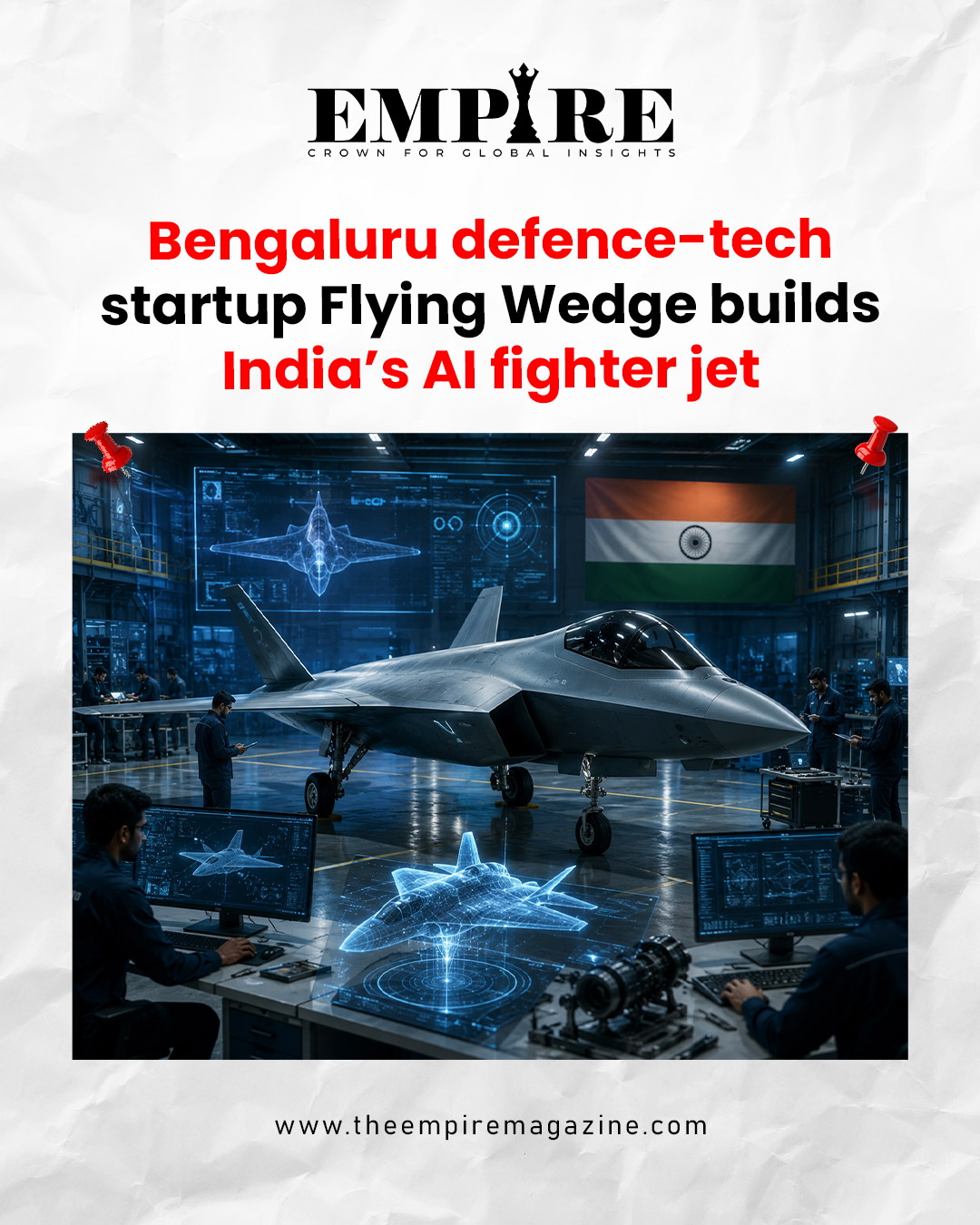
Discover how Bengaluru startup Flying Wedge is developing India’s AI fighter jet, transforming autonomous defence technology, military aviation, and aerospace innovation. Flying Wedge AI Fighter Jet is positioning India at the forefront of autonomous defence technology. The Bengaluru-based startup is developing an AI-powered combat aircraft designed for future warfare, supporting India’s self-reliance in defence manufacturing while strengthening indigenous aerospace innovation through artificial intelligence, autonomous flight systems, and advanced military technology.
Flying Wedge AI Fighter Jet: Bengaluru Startup Building India’s Future of Autonomous Air Combat
India’s defence technology ecosystem is entering a new era where artificial intelligence is no longer confined to software or surveillance systems. It is now becoming an integral part of next-generation military aircraft. At the centre of this transformation is Bengaluru-based defence-tech startup Flying Wedge, which is developing what could become India’s first indigenous AI fighter jet. While established aerospace companies have traditionally dominated military aviation, a new generation of startups is proving that innovation can emerge from smaller, agile teams focused on advanced technologies. Flying Wedge represents this new wave by combining artificial intelligence, autonomous flight systems, and indigenous engineering to create combat aircraft designed for modern warfare. As nations across the world race to integrate AI into defence platforms, India’s investment in homegrown autonomous aviation reflects both strategic necessity and technological ambition. The Flying Wedge AI Fighter Jet project is therefore not merely another defence startup story, it represents India’s broader vision of achieving self-reliance in military technology while preparing its armed forces for future battlefields shaped increasingly by intelligent machines.
Flying Wedge AI Fighter Jet Signals India’s Defence Shift
The emergence of Flying Wedge highlights how India’s defence innovation ecosystem has evolved dramatically over the past few years. Bengaluru has already earned recognition as India’s technology capital, housing hundreds of aerospace firms, artificial intelligence companies, and deep-tech startups. Defence technology has naturally become one of the fastest-growing sectors as government initiatives such as iDEX (Innovations for Defence Excellence), Startup India, and the Atmanirbhar Bharat mission encourage indigenous development instead of dependence on foreign suppliers. Flying Wedge has positioned itself within this ecosystem by focusing on autonomous combat aircraft capable of operating with minimal human intervention while maintaining high operational efficiency. Unlike traditional fighter aircraft that rely heavily on continuous pilot decision-making, AI-enabled combat systems can analyse battlefield conditions in real time, process vast amounts of sensor data within milliseconds, and recommend or execute tactical responses significantly faster than humans. This capability could redefine aerial warfare where reaction time often determines mission success. Rather than replacing human pilots immediately, the Flying Wedge AI Fighter Jet is expected to function alongside conventional military assets, enabling collaborative missions where artificial intelligence enhances situational awareness, surveillance, precision targeting, and mission planning. Such developments demonstrate how India’s defence priorities are shifting from simply purchasing advanced equipment to creating technologies capable of competing globally.
Flying Wedge AI Fighter Jet and Autonomous Combat
Artificial intelligence is rapidly transforming military aviation around the world, and Flying Wedge is aiming to ensure India remains part of that technological revolution. Modern AI-powered combat aircraft integrate machine learning algorithms, advanced navigation systems, computer vision, predictive maintenance, autonomous mission planning, and secure communication networks into a single platform capable of making informed operational decisions during flight. Instead of depending entirely on remote operators, autonomous fighter aircraft can independently navigate complex environments, identify threats, avoid obstacles, and coordinate with multiple unmanned systems simultaneously. This dramatically reduces pilot workload while improving mission effectiveness in high-risk environments. Flying Wedge’s engineering approach reportedly focuses on designing an aircraft architecture that can adapt continuously through software updates rather than requiring extensive hardware modifications each time new capabilities are introduced. Such software-defined defence platforms have become increasingly attractive because they allow armed forces to respond more rapidly to evolving battlefield requirements. Moreover, AI-powered aircraft generate and process enormous amounts of operational data, allowing defence organisations to improve mission planning, logistics, predictive maintenance, and long-term fleet management. As warfare becomes increasingly data-driven, the Flying Wedge AI Fighter Jet reflects the broader convergence of aerospace engineering, artificial intelligence, cybersecurity, and autonomous systems into a single strategic capability.
Why India Needs the Flying Wedge AI Fighter Jet
India’s geopolitical environment makes indigenous defence innovation increasingly important. The country shares borders with nuclear-armed neighbours while also protecting extensive maritime interests across the Indian Ocean region. Modern military operations demand faster intelligence gathering, persistent surveillance, precision strikes, and reduced risks to personnel. AI-enabled fighter aircraft address many of these operational requirements by undertaking dangerous reconnaissance missions, electronic warfare operations, and high-risk combat scenarios without exposing pilots to immediate danger. The Flying Wedge AI Fighter Jet aligns closely with India’s long-term objective of reducing dependence on imported military equipment while strengthening domestic manufacturing capabilities under the Make in India initiative. Indigenous development also offers strategic advantages beyond cost savings. Locally developed aircraft allow complete control over software architecture, cybersecurity measures, maintenance schedules, upgrades, and intellectual property without relying on external governments or foreign defence contractors. Furthermore, domestic manufacturing strengthens India’s industrial ecosystem by creating employment opportunities for aerospace engineers, AI researchers, robotics specialists, avionics experts, cybersecurity professionals, and advanced manufacturing companies. Every successful indigenous defence project contributes to building technological expertise that can eventually support civilian aviation, disaster management, logistics, and advanced research. Flying Wedge therefore represents not only a defence startup but also a catalyst for broader technological development across India’s innovation landscape.
Flying Wedge AI Fighter Jet Faces Global Competition
The global race to develop AI-powered military aircraft has accelerated considerably as countries recognise that artificial intelligence may define the next generation of aerial warfare. The United States continues investing heavily in collaborative combat aircraft, autonomous drones, and AI-assisted fighter systems through major defence programmes. China has similarly prioritised intelligent warfare technologies by integrating AI into unmanned aerial systems and next-generation military platforms. European defence companies are also embedding artificial intelligence into future combat aircraft projects designed for multinational defence cooperation. Against this backdrop, Flying Wedge enters a highly competitive environment where technological innovation, regulatory approvals, military testing, cybersecurity resilience, and operational reliability determine long-term success. For an Indian startup, competing globally requires balancing rapid innovation with stringent defence standards that demand exceptional reliability under extreme operating conditions. Every autonomous decision made by an AI-powered fighter aircraft must remain secure, explainable, and resilient against cyber threats or electronic warfare attacks. Consequently, extensive testing, simulation, validation, and collaboration with defence agencies become essential before operational deployment. Yet India’s rapidly growing startup ecosystem has repeatedly demonstrated its ability to solve complex engineering challenges through agile development models, making Flying Wedge an example of how smaller technology companies can complement established defence manufacturers rather than compete directly with them.
Flying Wedge AI Fighter Jet Could Transform Defence
The future of military aviation will likely depend less on individual aircraft performance and more on intelligent networks where multiple autonomous systems collaborate seamlessly during complex operations. Flying Wedge appears to be building toward this future by developing technologies that can integrate artificial intelligence, autonomous navigation, advanced sensing, and mission adaptability into a scalable defence platform. As AI capabilities continue improving, autonomous fighter aircraft may eventually perform intelligence gathering, electronic warfare, border surveillance, disaster response, maritime security, and tactical support missions alongside conventional fighter fleets. Beyond defence, innovations emerging from such programmes often generate commercial applications across aerospace manufacturing, robotics, autonomous logistics, aviation safety, and advanced software engineering. This broader impact reinforces why investments in indigenous defence startups matter far beyond military objectives alone. The Flying Wedge AI Fighter Jet symbolises a new generation of Indian innovation where ambitious entrepreneurs are addressing national security challenges through cutting-edge technology developed within the country. Although significant technical milestones, regulatory evaluations, and operational testing remain ahead, the startup’s progress demonstrates India’s growing confidence in designing sophisticated defence systems capable of competing internationally. If Flying Wedge successfully delivers on its vision, it may become one of the defining examples of how India’s startup ecosystem is reshaping the future of defence technology while contributing meaningfully to the country’s long-term strategic autonomy, technological leadership, and global aerospace ambitions.
For more business and retail insights, read more on The Empire Magazine
Previous article: https://theempiremagazine.com/groq-nvidia-agreement/
Magazine Feautures | Podcasts: Empire Global Talks
Follow The Empire Magazine on Facebook | Instagram | LinkedIn | YouTube
The Empire Magazine | Crown for Global Insights