
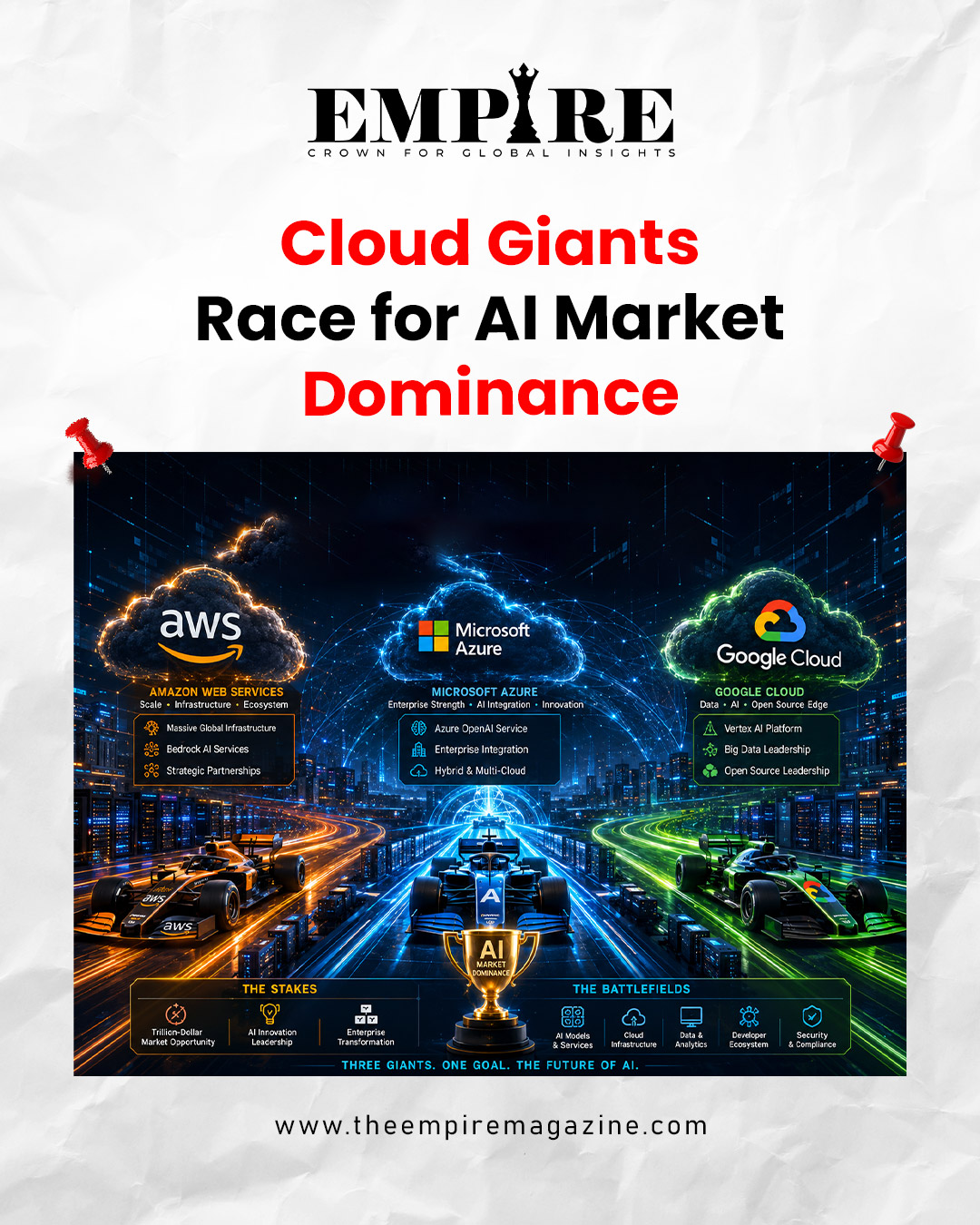
The global cloud market has entered a decisive phase where artificial intelligence defines competitive advantage. Microsoft, Amazon Web Services, and Google Cloud are investing aggressively in AI infrastructure, foundational models, and enterprise integration, shifting the industry from traditional cloud computing toward intelligence-driven platforms that shape enterprise workflows and digital economies.
A New Frontline in the Cloud Economy
The balance of power in global cloud computing is undergoing a structural shift, driven almost entirely by artificial intelligence. What was once a battle for uptime, storage efficiency, and global data center coverage has transformed into a contest for control over enterprise intelligence itself.
Across Seattle, Redmond, and Mountain View, hyperscalers are committing unprecedented capital to AI infrastructure. The shift is not incremental. It is foundational. Cloud platforms are no longer selling computing capacity alone, they are selling decision-making capability, embedded into enterprise systems.
The implications are already visible in earnings reports, infrastructure spending cycles, and long-term partnership strategies. AI is no longer a feature layered onto cloud services. It is becoming the operating logic of the entire industry.
When Compute Became Strategy, Not Utility
The cloud industry’s original promise was simplicity: scalable computing on demand. That promise still exists, but it is no longer the differentiator. Artificial intelligence has redefined what enterprises expect from infrastructure providers.
Demand is increasingly concentrated around AI training workloads, inference engines, and real-time data processing systems. These workloads require not just scale but architectural specialization. As a result, hyperscalers are redesigning entire data center topologies to optimize for GPU density, memory bandwidth, and interconnect speed.
Capital expenditure reflects this pivot. Across the industry, spending is now disproportionately allocated toward AI-optimized infrastructure rather than traditional server expansion. The cloud is no longer expanding outward; it is intensifying inward.
Microsoft’s Embedded Intelligence Strategy
Microsoft has positioned itself at the center of enterprise AI adoption through deep integration between Azure and advanced AI systems developed in partnership with leading model providers.
Rather than treating AI as a standalone product, Microsoft has embedded it across its enterprise ecosystem, spanning productivity tools, developer environments, and business applications. This integration strategy has created a closed-loop system where usage naturally reinforces platform dependence.
Enterprise clients adopting AI copilots are not simply upgrading software; they are restructuring workflows. This shift significantly increases switching costs and strengthens long-term retention across Microsoft’s cloud stack.
Yet the strategy carries operational pressure. Rapid adoption has strained capacity in several regions, forcing accelerated expansion of data center footprints and GPU procurement agreements at scale.
AWS and the Architecture of Scale
Amazon Web Services remains the largest cloud provider globally, but its position is being tested by the structural demands of AI workloads.
AWS is responding by expanding its model-agnostic strategy, allowing enterprises to deploy multiple foundation models across a unified infrastructure layer. This approach positions AWS as a neutral backbone for AI deployment rather than a single-model ecosystem.
The company’s focus is increasingly on infrastructure depth, custom silicon development, distributed computing optimization, and long-term chip partnerships. These investments reflect a broader belief that control over infrastructure, not models alone, will determine long-term dominance.
At the same time, AWS is strengthening its AI services portfolio to ensure it does not lose enterprise momentum to more vertically integrated competitors.
Google Cloud’s AI-Native Reinvention
Google Cloud enters the AI era with a distinct advantage: years of internal research leadership in machine learning and neural network architecture.
Unlike its competitors, Google’s strategy is not centered solely on infrastructure scale. Instead, it is tightly aligned with model development, data intelligence systems, and search-driven AI applications.
This positions Google Cloud as an AI-native platform, where infrastructure and intelligence evolve in parallel. Its strength lies in combining proprietary models with large-scale data systems, particularly in analytics and enterprise search.
However, monetization remains a key challenge. While technical capabilities are strong, converting research leadership into consistent enterprise revenue continues to define Google’s strategic focus.
The Global Scramble for AI Compute Power
Behind every major cloud strategy lies a single constraint: compute availability.
Advanced GPUs and AI accelerators have become the most contested resources in the technology sector. Supply remains limited, and demand continues to outpace manufacturing capacity. This imbalance has elevated semiconductor manufacturers into central actors in the cloud ecosystem.
As a result, hyperscalers are entering long-term procurement agreements, co-developing hardware solutions, and securing priority access to next-generation chips. In many cases, infrastructure planning is now dictated by hardware availability rather than market demand.
Energy consumption has also emerged as a limiting factor. AI-optimized data centers require significantly higher power density, forcing providers to rethink geographic expansion strategies based on grid capacity and regulatory frameworks.
Monetization Pressure and Enterprise Lock-In
The transition to AI-driven cloud services is reshaping revenue structures across the industry. AI workloads generate significantly higher revenue per compute unit compared to traditional cloud services, but they also introduce new cost pressures.
Enterprises adopting AI at scale are embedding cloud providers deeper into operational workflows. This integration reduces flexibility but increases efficiency, creating a trade-off that strongly favors long-term platform lock-in.
Once data pipelines, models, and decision systems are embedded into enterprise operations, migration becomes economically and technically complex. This dynamic is quietly reshaping competitive barriers across the industry.
A Market Moving Toward Convergence
Despite differences in strategy, major hyperscalers are converging toward a similar end state: full-stack AI platforms that integrate infrastructure, models, and enterprise applications into unified ecosystems.
Microsoft leads in enterprise integration, AWS in infrastructure scale, and Google in AI-native development. Yet the boundaries between these approaches are increasingly blurred.
The competitive battlefield is no longer defined by isolated capabilities but by ecosystem depth. Control over developers, enterprise workflows, and data pipelines now matters as much as raw compute power.
Why the Stakes Extend Beyond Technology
The implications of this transition extend far beyond the technology sector. AI-driven cloud platforms are becoming foundational to national competitiveness, industrial productivity, and digital sovereignty.
Countries and corporations without access to scalable AI infrastructure risk falling behind in automation capability and innovation velocity. In this context, cloud providers are no longer service vendors, they are strategic infrastructure partners shaping economic trajectories.
Strategic Signals from the C-Suite
Executives across the industry increasingly describe this moment as a capital-intensive inflection point. Unlike previous cloud cycles driven by software migration or storage demand, the AI era requires sustained infrastructure investment at unprecedented scale.
Analysts consistently highlight three determinants of success: infrastructure ownership, model ecosystem strength, and enterprise distribution channels. Companies that fail to balance these pillars risk long-term erosion of market position.
The Next Phase of Cloud Evolution
Over the coming years, cloud platforms are expected to evolve into orchestration layers for autonomous systems. AI agents, domain-specific models, and automated decision frameworks will increasingly define enterprise software architecture.
This shift will further blur the line between infrastructure and application layers. Cloud providers will not only host intelligence systems, they will actively shape how intelligence is deployed and governed within enterprises.
The industry is moving toward a model where cloud platforms function as continuous intelligence networks rather than static computing environments.
For more business and retail insights, read more on The Empire Magazine
Previous articles: Luxury Hospitality | Zoho Tech
Magazine Edits: Magazines
Podcasts: Empire Global Talks
Follow The Empire Magazine on Facebook | Instagram | LinkedIn
The Empire Magazine | Crown for Global Insights