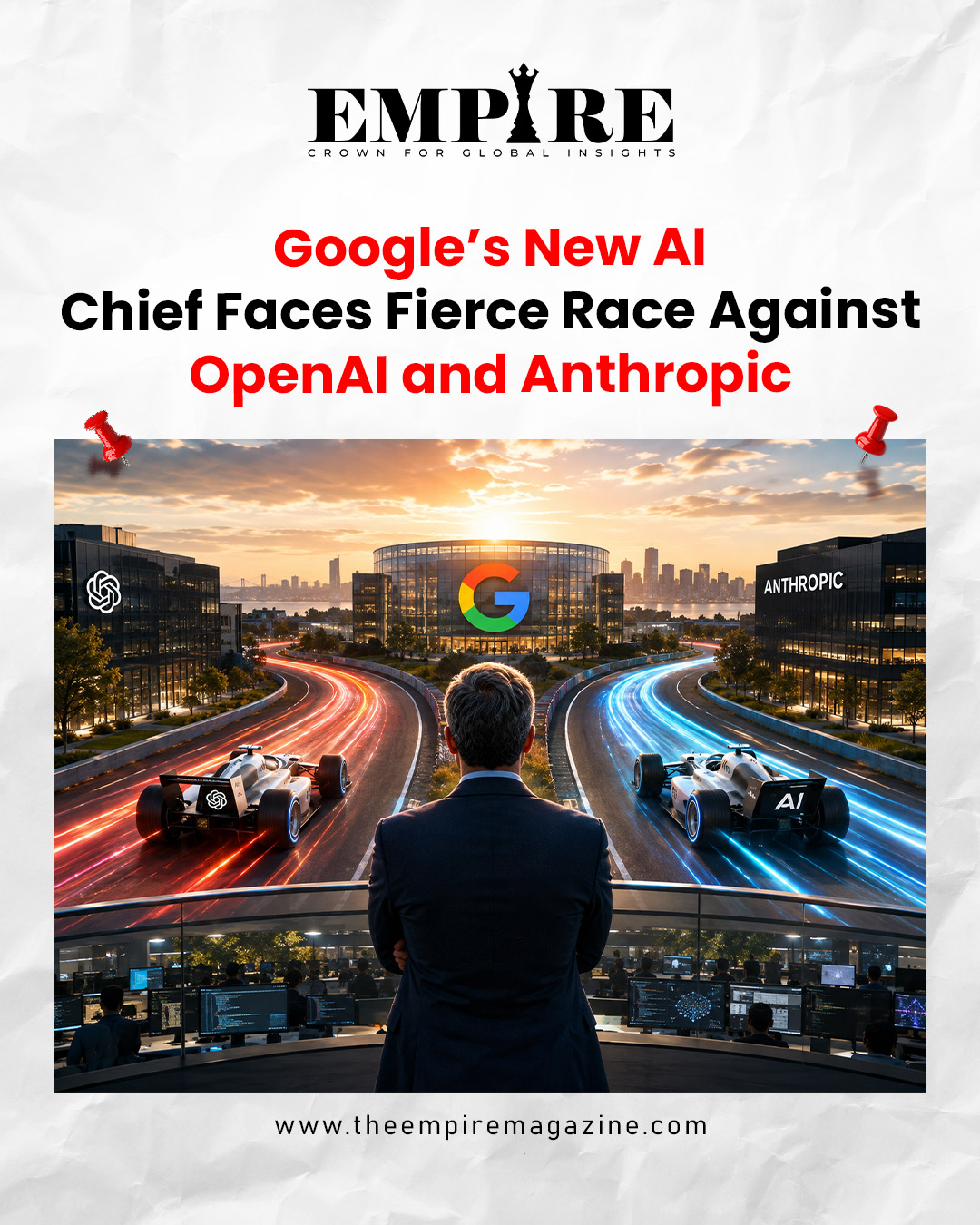
Google’s new AI chief Koray Kavukcuoglu faces a fierce race against OpenAI and Anthropic as Gemini battles to regain the AI leadership.
Google AI Chief and a Major Leadership Shift
The artificial intelligence race has entered a new phase at Google. The company has reorganised its Google DeepMind leadership, placing Koray Kavukcuoglu at the centre of Gemini development while Demis Hassabis moves into the role of chair. The change comes at a moment when Google is under growing pressure from OpenAI and Anthropic, two companies that have moved quickly to challenge its position in advanced AI. Reuters reported that Kavukcuoglu will have the final say on major DeepMind decisions, giving him an increasingly powerful role in determining where Google’s AI strategy goes next.
The leadership change is more than a routine corporate reshuffle. It reflects a clear message from Google: the company wants to move faster, commercialise AI more aggressively and reduce the internal friction that can slow model development. Hassabis will continue to focus on long-term AI and scientific questions, while Kavukcuoglu takes a stronger operational role. For Google, the challenge is no longer proving that it has exceptional AI research. The harder task is turning that research strength into products that can consistently compete with the fastest-moving rivals.
Why the Google AI Chief Must Move Faster
Google has never lacked the ingredients needed to compete in artificial intelligence. It has world-class researchers, custom AI chips, enormous computing infrastructure, a massive cloud business and consumer products used by billions of people. Gemini has also been integrated across Search, the Gemini app, Cloud and other Google services. When Gemini 3 launched in November 2025, Google described it as its most intelligent model, highlighting stronger reasoning, multimodal abilities and agentic capabilities.
Yet scale does not automatically produce speed. Reuters reported that Google delayed its next flagship Gemini version by two months after internal testing showed that it was still behind rivals in areas including coding. Sources also pointed to computing constraints, disagreements among project leaders and a bureaucratic structure that could make Google slower than smaller competitors. That is the environment the Google AI chief now inherits. The challenge is to take a sprawling AI organisation and make it act with the urgency of a startup without losing the research depth that made DeepMind one of the world’s most respected AI labs.
Google AI Chief Faces OpenAI Pressure
OpenAI remains one of the strongest forces in the global AI race because it has built a powerful combination of frontier models, consumer adoption and rapid product development. Its GPT-5.6 family, launched in July 2026, includes multiple models designed for different levels of capability, speed and cost, with OpenAI positioning the technology for demanding work such as coding, research, science, cybersecurity and computer use.
For the Google AI chief, OpenAI represents a difficult competitor because it moves quickly from research breakthroughs to widely used products. Google has an enormous distribution advantage, but OpenAI has shown that consumers and businesses will adopt AI products outside traditional search and software ecosystems. This creates pressure on Gemini to become not merely an impressive model but a platform people actively choose for daily work. Google can put Gemini inside Search, Android and Workspace, but the real test will be whether users see it as the most capable and useful AI assistant rather than simply the AI that comes bundled with Google’s services.
Anthropic Raises the AI Race Even Further to Google AI
Anthropic has changed the competitive picture in another important way. While OpenAI has pushed broad consumer and enterprise adoption, Anthropic has developed a reputation for strong performance in complex knowledge work, coding and AI safety. In June, Anthropic introduced Claude Fable 5 and Claude Mythos 5, describing Fable 5 as a state-of-the-art system across areas including software engineering, knowledge work, vision and scientific research. Mythos 5 has been positioned for specialised cybersecurity and biological research, initially with limited access to vetted partners.
That matters because the AI race is no longer about one benchmark or one chatbot. Competitors are increasingly separating themselves through specialised strengths. Anthropic is pushing into high-value professional workloads, while OpenAI is expanding its reach across reasoning and agentic work. Google must therefore make Gemini competitive across a much wider field, from consumer assistants to software development, enterprise AI and scientific applications. The Google AI chief is entering a contest where improvements are measured not only by model intelligence but also by reliability, speed, price, distribution and the ability to turn AI into useful work.
Google AI Must Close the Performance Gap; Gemini
The biggest immediate test for Google will be Gemini. Google has already demonstrated that it can produce major AI breakthroughs, but maintaining the lead is much harder than achieving it once. Reuters reported that Gemini briefly overtook competitors in late 2025 before newer updates from OpenAI and Anthropic pushed Google back into catch-up mode. The company’s new structure is designed in part to address this problem by bringing clearer decision-making and stronger commercial focus to Gemini development.
There is also a deeper strategic question. Google has historically balanced long-term research with the demands of a huge commercial organisation. That model produced extraordinary achievements, but the generative AI market now rewards companies that can release, test and improve products at remarkable speed. Kavukcuoglu’s background makes him particularly important here. Google appointed him as chief AI architect in 2025 with responsibility for helping integrate Gemini across the company’s products, and he has increasingly become a central figure in shaping Gemini’s direction.
Google’s Biggest AI Advantages
Despite the current pressure, it would be a mistake to count Google out of the AI race. The company still possesses advantages that OpenAI and Anthropic cannot easily replicate. Google controls a vast ecosystem spanning Search, Android, YouTube, Chrome, Cloud and Workspace. It also designs its own AI infrastructure, including Tensor Processing Units, giving the company a degree of control over the hardware needed to train and deploy advanced models. Reuters reported that leaders hope the new structure may also reduce tensions around the allocation of Google’s limited TPU capacity.
Google’s reach is already enormous. When Gemini 3 launched, Google said AI Overviews were reaching 2 billion users each month and the Gemini app had surpassed 650 million monthly users, while more than 70% of Google Cloud customers were using its AI. Those numbers show why the Google AI chief is operating with an extraordinary advantage: the infrastructure and audience for rapid AI distribution are already in place. The question is whether Google can organise those advantages quickly enough to turn scale into sustained leadership.
What the Google AI Chief Must Deliver Next
The new Google AI chief faces a simple but difficult mission: make Google faster without making it reckless. That means improving Gemini’s performance, accelerating product launches, strengthening coding and agentic capabilities, managing computing resources more efficiently and ensuring that research teams can work with enough freedom to produce the next breakthrough. It also means turning Gemini from a collection of impressive tools into a coherent AI ecosystem that works naturally across Google’s products.
The timing could hardly be more important. OpenAI is pushing frontier reasoning with GPT-5.6, while Anthropic is expanding Claude into increasingly sophisticated coding, research and cybersecurity tasks. At the same time, Google co-founder Sergey Brin has reportedly been urging AI teams to move faster and focus resources on areas such as recursive self-improvement.
For users, developers and businesses, the rivalry could bring faster innovation, lower costs and more capable AI tools. For Google, however, the stakes are larger. The company that once defined how the internet found information is now fighting to define how people interact with intelligent machines.
The AI race is therefore no longer simply OpenAI versus Google versus Anthropic. It is a contest over speed, intelligence, infrastructure, trust and everyday usefulness. The new Google AI chief has the resources to compete. What comes next will show whether Google can turn those resources into momentum before the next breakthrough belongs to someone else.
Previous article: https://theempiremagazine.com/meta-tiktok/
Magazine Feautures | Podcasts: Empire Global Talks
Follow The Empire Magazine on Facebook | Instagram | LinkedIn | YouTube
The Empire Magazine | Crown for Global Insights