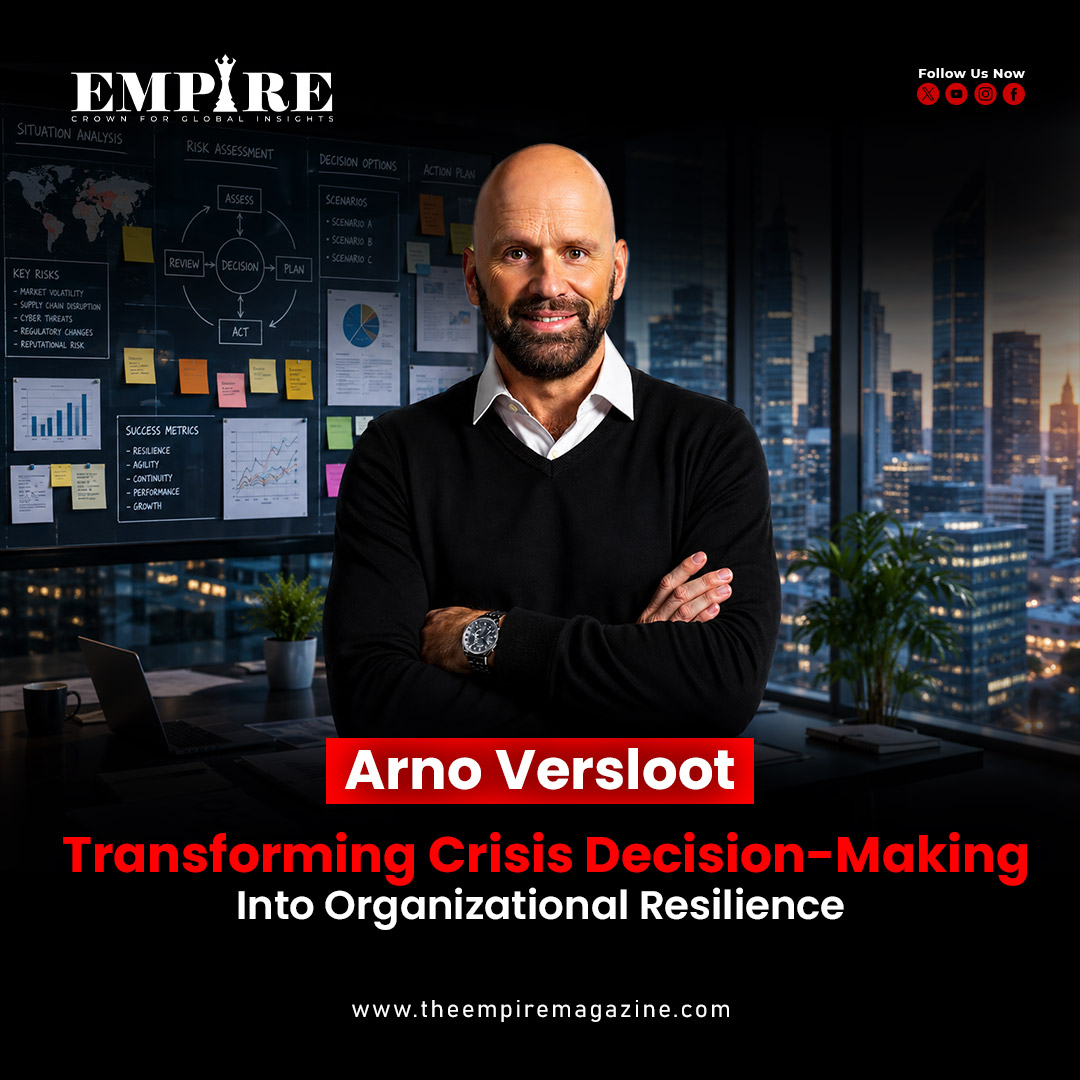
Arno Versloot transforms crisis decision-making through tactical training, risk assessment, team resilience and real-world incident response.
Arno Versloot: Transforming Crisis Decision-Making Into Organizational Resilience
When a crisis unfolds, there is rarely time to stop and develop a perfect plan. Decisions must be made quickly, teams must communicate clearly and everyone involved needs to understand what is happening before taking action. For Arno Versloot, this kind of pressure is not theoretical. His professional career was built inside environments where poor decisions could have serious consequences. After serving in the Royal Marine Corps and Air Mobile Brigade, completing three foreign deployments and spending 16 years in a specialist unit working in counter-terrorism and high-risk situations, Arno Versloot developed an intimate understanding of how people and teams respond when pressure becomes real. Today, through CeBeReN Incompany Training and Education, he applies that experience to crisis management, incident response and tactical decision-making training. His approach is built around a simple but powerful idea: organizations should not wait for a crisis to discover whether their people can work together. They should create realistic opportunities to prepare, test, learn and improve before the pressure arrives.
Arno Versloot Brings Tactical Experience Into Crisis Management Training
The professional journey of Arno Versloot has given him a perspective on crisis management that is difficult to replicate through classroom theory alone. He joined the Royal Marine Corps at the age of 18 before moving through the Air Mobile Brigade and completing three foreign deployments. He subsequently spent 16 years with the Department of Special Interventions, a specialist tactical unit where police and military personnel worked together during counter-terrorism operations and high-risk arrests. His responsibilities included precision shooting and CBRN specialization, covering chemical, biological, radiological and nuclear scenarios. These experiences placed Arno in situations where communication, preparation and decision-making had direct consequences. Over the years, he observed how teams behaved under pressure, where communication broke down and how assumptions could affect outcomes. Those experiences eventually shaped his understanding of effective crisis decision-making. Rather than keeping that expertise within the tactical world, Arno Versloot decided to translate it into practical organizational training, helping teams understand how preparation, structure and communication can determine performance when circumstances become unpredictable.
Arno Versloot Starts Crisis Preparedness Before the Crisis Begins
A defining principle of Arno Versloot’s crisis management approach is that effective preparation begins long before an emergency occurs. When he enters an organization, he does not immediately introduce a new procedure or impose a predetermined framework. His first step is understanding what the team is actually responsible for accomplishing. This initial conversation establishes clarity around the team’s core task and creates a shared understanding before further changes are introduced. Arno then observes how the team operates in its normal environment, identifying existing strengths as well as small obstacles that may interfere with performance. Rather than attempting to transform everything simultaneously, he looks for practical improvements that can demonstrate early value and build confidence in the process. Larger changes, including procedures and organizational structures, are then developed over approximately three to four months. The final stage involves realistic scenarios conducted within the team’s own environment, sometimes without advance notice. This allows Arno Versloot to see how preparation translates into actual behavior when people are confronted with uncertainty and pressure. The objective is not to create a perfect theoretical plan, but to make effective responses more instinctive when they are genuinely needed.
Arno Versloot Uses the BOB Model for Strategic Crisis Decision-Making
At the heart of Arno Versloot’s strategic crisis decision-making framework is the BOB model. The Dutch model can be understood through three central stages: Image or View, Judgment and Decision. Its strength comes from forcing teams to establish a shared understanding before immediately attempting to solve a problem. During a crisis, different people naturally notice different details. One person may focus on the physical environment, another on the people involved, while someone else may already be considering potential outcomes. Arno Versloot’s approach first brings those perspectives together by asking the team to establish what is actually happening. Where is the incident occurring? What is the context? What actions are already underway? Which other teams are involved? Once a common picture has been established, the team moves into judgment. Risks are identified and assessed according to likelihood and potential impact, using low, medium and high ratings. The team then develops scenarios around the most likely outcome, worst-case situation and alternative “what-if” possibilities. Any dilemma that emerges must be resolved or assigned to someone for immediate ownership. Only after these steps does the team move toward the final decision.
Why Arno Versloot Teaches Teams to Pause Before Acting
One of the most interesting outcomes of Arno Versloot’s decision-making training is that teams often become faster by initially slowing down. Under pressure, people naturally want to act immediately. Each individual forms an interpretation of what is happening and begins responding according to that interpretation. The problem arises when several people are operating from different assumptions. A team may then move quickly in different directions, only to discover that someone misunderstood the situation. Correcting that misunderstanding consumes more time than the brief pause required to establish a shared picture in the first place. Arno Versloot’s framework introduces that pause at the beginning of the decision-making process. Teams first communicate what they are seeing, establish a common understanding and then determine what needs to happen. Once that foundation exists, decisions can move much more quickly because people are no longer constantly correcting conflicting assumptions. Conversations become shorter, responsibilities become clearer and team members understand how their actions connect with those of their colleagues. For Arno, effective crisis response is therefore not about rushing. It is about creating enough clarity at the beginning that the entire team can move forward together.
Arno Versloot Addresses the Gap Between Crisis Plans and Real Action
A major gap identified by Arno Versloot exists between having a crisis plan and knowing how to use it under pressure. Organizations frequently invest substantial time and resources into developing crisis plans and Incident Response Plans. Consultants may create detailed documents covering procedures, responsibilities and possible scenarios. Yet a plan sitting on paper does not automatically become effective behavior when a real incident occurs. Teams still need to understand how to translate those plans into decisions on the working floor. This is the space where Arno Versloot has built his professional niche. His experience in tactical environments gives him firsthand knowledge of what happens when a carefully prepared plan meets an unpredictable situation. Instead of simply reviewing documents, he works with teams inside their own operational environments and helps them practice applying their procedures. The process turns theoretical preparedness into practical capability. Arno also believes that decision-making is not exclusively a skill for police officers, military personnel or emergency responders. People make decisions under pressure every day, including in businesses and ordinary working environments. This realization has allowed his training philosophy to expand beyond specialist units and into organizations seeking stronger decision-making and resilience.
Arno Versloot Creates Training Environments Where Mistakes Become Learning
For Arno Versloot, realistic training requires people to experience uncertainty without fearing the consequences of making a mistake. He deliberately creates environments where participants can get things wrong, say the wrong thing, overlook something or discover that an assumption was incorrect. The purpose is not to embarrass anyone. It is to create a safe environment where weaknesses can be identified before they become dangerous in an actual crisis. Arno believes that whatever happens during the training should remain within the room and become material for honest reflection. This approach changes the relationship between training and failure. Instead of treating mistakes as evidence that someone is incapable, the training treats them as information about what the team needs to improve. That philosophy is particularly relevant for organizations working in high-pressure environments because no team can predict every possible situation. What they can do is develop the ability to recognize problems, communicate them and adapt their response. By allowing participants to experience pressure in a controlled setting, Arno Versloot helps teams identify how they actually behave rather than how they assume they will behave.
Arno Versloot Builds Leadership Through Learning and Observation
The leadership philosophy of Arno Versloot has also been shaped by his willingness to learn from people around him. Throughout his career, he deliberately observed experienced colleagues and sought to understand what they knew that he did not. Moving between different units gave him opportunities to encounter people with different skills, experiences and perspectives. Rather than seeing those differences as obstacles, he used them as opportunities for professional development. Teaching eventually became another part of that learning process. By instructing others, Arno could test ideas, observe how people responded and refine his own approach. This experience also changed how he views training itself. He learned that delivering information and creating genuine learning are two very different things. A trainer can have excellent slides and extensive knowledge, yet still fail to connect with the people in the room. Arno Versloot therefore pays close attention to participant engagement, adjusting his training according to what is happening in front of him. His approach is highly personalized, allowing the people being trained to become active participants rather than passive recipients of information.
Arno Versloot Uses Realistic Scenarios to Strengthen Team Resilience
The training methods developed by Arno Versloot have evolved considerably throughout his career. Earlier in his professional life, training involved substantially more teaching and presentation. Today, his sessions are overwhelmingly focused on practical training. He recognizes that many of the professionals in the room already possess significant experience. The challenge is often not giving them more information, but creating an environment where their existing knowledge can be combined effectively. To achieve this, Arno uses tools such as virtual reality, game-based exercises and live scenarios. These methods allow participants to experience situations instead of simply discussing them. He can also deliberately place people from different parts of an organization together, creating opportunities for them to discover how their roles connect. A CEO might work alongside someone from another operational department, revealing strengths and dependencies that are difficult to see during normal routines. Training can take place in a conference room, outdoors, on a factory floor or directly inside a specialist operational environment. The location changes according to the organization, but the principle remains consistent: people learn most effectively when they are placed in realistic situations and given the opportunity to solve problems together.
Arno Versloot Helps Police Teams Improve Tactical Decision-Making
The experience of the Dutch police provides a strong example of how Arno Versloot’s tactical decision-making training can influence team behavior over time. His work with Dutch police has continued for three to four years, involving multiple training sessions each year. Police officers regularly face situations involving public disorder, unpredictable behavior and rapidly changing circumstances. Historically, individuals could respond according to their own interpretation of what they were seeing. While individual speed can sometimes be valuable, it can become a weakness when multiple officers are responding to different interpretations of the same situation. Arno’s approach encourages officers to take a brief pause, communicate what they are observing and establish a shared understanding before acting. That pause may last only two or three minutes, but it can significantly change how the team subsequently operates. Instead of five people acting according to five different assessments, the group moves forward with a coordinated understanding. For Arno Versloot, the value of this approach extends beyond the immediate outcome. When a team can look back at an incident and recognize that everyone understood their role, communicated effectively and contributed to a successful response, the experience reinforces confidence and strengthens the team’s ability to work together during future incidents.
Arno Versloot Brings CBRN Expertise to High-Risk Decision-Making
Arno Versloot’s CBRN expertise adds another important dimension to his crisis management work. CBRN refers to chemical, biological, radiological and nuclear scenarios, where decision-making becomes particularly demanding because environmental conditions can directly affect the safety and survival of responders. Protective equipment, gas masks, limited visibility, physical discomfort and uncertainty can all increase cognitive pressure. In such circumstances, the ability to communicate and make structured decisions becomes even more important. Arno also works with anti-terror units and understands these environments from direct professional experience. His background allows him to adapt training to the specific realities faced by specialist teams rather than applying a generic program. One recent assignment took him to Luxembourg to work with a close protection unit responsible for ministry VIPs. Following the introduction of new CBRN first responder equipment, Arno spent two days putting the team through practical scenarios involving potential contamination incidents. The exercises considered situations such as a contaminated drone cloud affecting a VIP outdoors or an incident occurring inside a building. The decision-making model was integrated into each scenario, helping the team develop procedures that could later be documented and used for future training.
Arno Versloot Is Taking Crisis Decision-Making Beyond the Netherlands
Although much of Arno Versloot’s work has been based in the Netherlands, his expertise in crisis decision-making and CBRN response has international relevance. The challenges associated with social behavior, emergency response, tactical coordination and high-risk decision-making are not limited to one country. Arno’s approach is deliberately designed around the organization and environment he is working with. Rather than operating from a fixed training center and expecting participants to adapt to a standard environment, he travels to the teams themselves. He trains people during their actual working hours and within the environments where they are expected to perform. This approach allows training to reflect real operational conditions, organizational structures and team dynamics. It also means that lessons can be translated into practical procedures that remain within the organization after the training concludes. Arno Versloot’s ambition is to extend this model into more countries and more specialist units while continuing to maintain the practical character that defines his work. His long-term objective is not simply to deliver individual training sessions, but to transfer decades of experience into organizations so that better crisis decision-making becomes part of their institutional capability.
Arno Versloot Is Turning Tactical Expertise Into Organizational Resilience
The professional journey of Arno Versloot demonstrates how experience gained in some of the most demanding operational environments can be translated into broader organizational resilience. His work goes beyond traditional crisis management because it focuses on what happens between preparation and action. A plan needs to become behavior. A team needs to transform individual observations into a shared picture. Risks need to be identified before decisions are made. Responsibilities need to be clear. And people need opportunities to experience pressure before they face it in reality. Through CeBeReN Incompany Training and Education, Arno Versloot is building that bridge between theoretical preparedness and practical response. His approach combines tactical experience, structured decision-making, realistic scenarios, emotional reflection and team learning. The central lesson is simple but powerful: organizations cannot choose when a crisis arrives, but they can choose how prepared their people are when it does. By teaching teams to pause, assess, communicate and decide together, Arno is helping transform crisis response from an instinctive reaction into a practiced organizational capability. His vision is not simply to help teams survive pressure, but to help them become more resilient because of how they prepare for it.
Read the complete feature here: https://theempiremagazine.com/magazine/arno-versloot-the-most-influential-leader-in-strategic-crisis-decision-making-for-2026/
Read the previous feature here: https://theempiremagazine.com/magazine/dr-andrey-rogachev-the-most-influential-leader-driving-innovation-in-global-finance-and-risk-management-in-2026/
Read Previous Article here: https://theempiremagazine.com/anna-kai/
Magazine Feautures | Podcasts: Empire Global Talks
Follow The Empire Magazine on Facebook | Instagram | LinkedIn | YouTube
The Empire Magazine | Crown for Global Insights