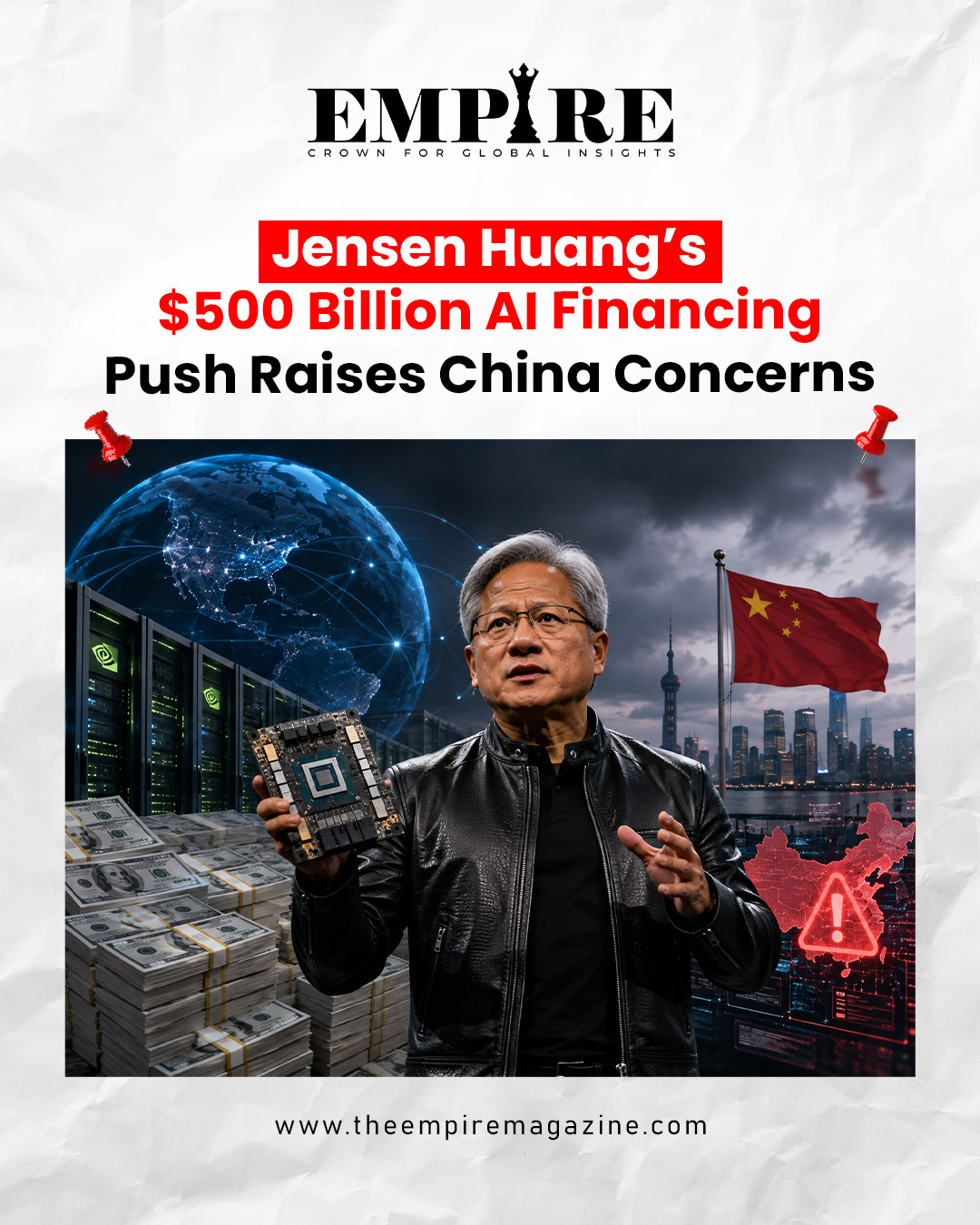
Jensen Huang’s $500 Billion AI Financing Push is changing the way the artificial intelligence industry could fund its next phase of growth. With Nvidia working alongside major Wall Street firms to mobilize more than $500 billion for AI infrastructure, the strategy is creating new opportunities while raising concerns about China, chip values, financial risks and global AI competition.
Jensen Huang’s $500 Billion AI Financing Push is Nvidia’s plan with major financial institutions to mobilize more than $500 billion in third-party capital for AI computing infrastructure. The strategy aims to finance data centers and GPU deployments while raising questions about China, GPU values, AI demand, technology depreciation and financial risk.
Jensen Huang’s $500 Billion AI Financing Push
Jensen Huang’s $500 Billion AI Financing Push represents a major expansion of Nvidia’s role in the artificial intelligence economy. Nvidia announced partnerships with Apollo, BlackRock, Blackstone, Brookfield, Goldman Sachs and KKR to establish independent financing platforms designed to mobilize more than $500 billion of third-party capital for AI computing infrastructure.
The initiative comes at a time when the AI industry is moving beyond software development and entering an infrastructure-heavy phase. Artificial intelligence companies need enormous amounts of computing power, advanced GPUs, data centers, networking equipment and electricity to train and operate increasingly sophisticated AI models.
For Jensen Huang, the challenge is therefore no longer simply producing powerful chips. Nvidia is now helping create the financial infrastructure required to deploy those chips at unprecedented scale. The strategy could allow technology companies to access computing capacity without carrying the entire cost of infrastructure on their own balance sheets.
At the same time, the size of the financing push has attracted scrutiny. Investors are questioning how quickly AI infrastructure will generate returns, how long advanced GPUs can retain value and whether China’s rapidly developing semiconductor industry could affect the economics behind the financing model.
The Vision Behind Jensen Huang’s AI Financing
Jensen Huang’s AI financing strategy reflects a broader vision for Nvidia. Under Huang’s leadership, Nvidia has moved from being primarily known for graphics processors to becoming a central supplier of the computing infrastructure powering generative AI, cloud computing and advanced data centers.
The latest financing initiative takes that transformation another step forward. Instead of relying entirely on customers to find billions of dollars to purchase or deploy AI computing capacity, Nvidia is connecting those customers with major institutional investors.
The objective is to make AI infrastructure easier to finance and expand. Nvidia says its partners are establishing independent platforms that can support financing for computing infrastructure, while the capital will largely come from third-party investors.
This approach is significant because the AI industry increasingly resembles other capital-intensive sectors. Just as infrastructure projects require long-term financing, large-scale AI systems require sustained investment in computing, energy and physical facilities.
Huang is effectively betting that computing power will become one of the defining infrastructure assets of the digital economy.
AI Infrastructure and Jensen Huang’s Financing Strategy
The rapid growth of artificial intelligence has created a huge demand for AI infrastructure. Training advanced models requires thousands of high-performance processors operating together, while commercial AI services require data centers capable of handling enormous volumes of user requests.
That demand has pushed technology companies into a race to secure GPUs, electricity and data-center capacity. Nvidia’s financing strategy is designed to address the capital requirement behind that expansion.
Major Wall Street firms are participating because the scale of AI infrastructure creates a potential new market for private credit, asset financing and other investment structures. Reuters reported that Nvidia’s partnerships are intended to create financing platforms capable of supporting more than $500 billion of capital.
The significance goes beyond Nvidia. If the model works, smaller AI companies and infrastructure operators could gain access to capital that would otherwise be difficult to obtain.
This could accelerate the development of AI data centers and computing clusters while strengthening Nvidia’s position within the global AI ecosystem.
Jensen Huang’s New AI Asset Class
One of the most important ideas behind Jensen Huang’s $500 Billion AI Financing Push is the possibility of treating AI computing hardware as an investable infrastructure asset.
Huang has argued that Nvidia GPUs have characteristics that could allow them to be financed similarly to other productive assets. The concept is attracting significant attention because Wall Street traditionally evaluates technology hardware differently from long-lived infrastructure.
The challenge is depreciation. AI chips are extremely powerful, but new generations are released rapidly. Investors therefore need confidence that older GPUs will continue generating economic value long enough to support long-term financing.
Financial institutions involved in Nvidia’s strategy appear to believe that strong demand for computing power, software improvements and continued AI adoption can help preserve the economic value of the hardware.
If this model succeeds, it could create an entirely new category of AI infrastructure finance. GPUs would no longer be viewed simply as components inside computers but as productive assets capable of supporting investment structures.
That would represent a major change in the economics of artificial intelligence.
How the $500 Billion AI Financing Strategy Works
The $500 billion figure does not represent a single pool of cash sitting on Nvidia’s balance sheet. Instead, Nvidia and its financial partners are developing platforms intended to mobilize more than $500 billion in third-party capital for AI compute infrastructure.
Apollo, BlackRock, Blackstone, Brookfield, Goldman Sachs and KKR bring substantial experience in private credit, infrastructure investment and asset management. Their involvement gives the AI financing strategy access to institutional capital that could support large projects.
The structure is important for Nvidia because it can shift much of the financing requirement toward external investors. Nvidia can continue focusing on designing and supplying advanced computing platforms while financial partners help fund their deployment.
However, the arrangement also creates questions about risk. If AI demand remains strong, financed infrastructure could generate attractive returns. If demand slows or computing technology changes faster than expected, investors could face losses.
The success of Jensen Huang’s financing strategy will therefore depend on whether AI computing can behave like durable infrastructure rather than rapidly depreciating technology.
China and Jensen Huang’s AI Financing Challenge
China represents one of the biggest uncertainties surrounding Jensen Huang’s $500 Billion AI Financing Push. The United States and China remain locked in a strategic competition over advanced semiconductors, artificial intelligence and computing power.
Nvidia has historically viewed China as an important market, but U.S. export restrictions have limited the company’s ability to sell some advanced AI processors there. At the same time, Chinese technology companies are investing heavily in domestic AI chips and computing systems.
This creates a potential long-term challenge for Nvidia. If Chinese companies successfully develop competitive alternatives, demand for Nvidia hardware could face additional pressure in one of the world’s largest technology markets.
Recent analysis has specifically highlighted China as a major variable in the value of GPUs used as collateral in Nvidia-linked financing structures. If cheaper or more competitive Chinese chips reduce demand for Nvidia GPUs, the residual value of existing hardware could become an important concern for investors.
For Huang, therefore, China is not simply a sales-market issue. It is increasingly connected to the financial assumptions behind the global AI infrastructure business.
Nvidia’s China Challenge
Nvidia’s China challenge has become closely linked to U.S. semiconductor policy. Export controls have restricted access to some advanced Nvidia processors, forcing the company to navigate an increasingly complicated regulatory environment.
The restrictions have also encouraged Chinese technology companies to accelerate domestic semiconductor development. That could eventually create a stronger competitive ecosystem inside China.
Huang has continued to argue for maintaining a meaningful presence in the Chinese market and has spoken publicly about the importance of allowing access to technology and open-source AI models. His position reflects Nvidia’s commercial interest in remaining part of a major global technology market.
However, national-security concerns have made the issue far more complicated. Washington wants to protect America’s lead in advanced computing, while Beijing wants to reduce its dependence on foreign semiconductor technology.
The result is a technology competition in which Nvidia sits at the center of commercial, financial and geopolitical pressures.
For Jensen Huang, maintaining Nvidia’s global leadership will require navigating all three simultaneously.
AI Financing Risks and Market Concerns
The biggest concern surrounding Jensen Huang’s $500 Billion AI Financing Push is whether the rapid expansion of AI infrastructure could create excessive financial exposure.
AI companies are investing heavily in data centers and computing capacity because they expect demand for AI services to continue growing. Financing allows that expansion to happen faster, but it also creates obligations that must eventually be supported by real revenue.
There are concerns about what could happen if AI demand grows more slowly than expected. Investors could then be left holding infrastructure or hardware that produces lower returns than originally projected.
Another concern is circular financing. Critics have pointed to financial relationships across the AI ecosystem in which companies invest in one another and then purchase each other’s technology. Such arrangements can accelerate growth, but they can also make it harder to determine the true level of independent demand.
Nvidia’s involvement with major financial institutions is intended to bring third-party capital into the ecosystem, but scrutiny remains. Recent market commentary has questioned whether rapidly evolving AI processors are suitable collateral for long-duration financing.
The opportunity is enormous, but so is the financial responsibility.
Global Impact of Jensen Huang’s AI Strategy
Jensen Huang’s AI strategy could influence the global technology industry far beyond Nvidia. If AI computing becomes easier to finance, more companies could build data centers and acquire high-performance computing systems.
This could accelerate the development of generative AI, autonomous systems, robotics, scientific computing and other emerging technologies.
It could also intensify competition among technology giants. Companies developing their own AI chips may seek to reduce dependence on Nvidia, while cloud providers compete to offer increasingly powerful AI infrastructure.
For investors, the emergence of AI infrastructure financing could create a new investment category. For governments, it could make computing capacity an increasingly important part of national economic and technological strategy.
The geopolitical dimension is equally important. The United States is attempting to maintain its leadership in advanced semiconductors, while China is investing in domestic alternatives. Europe, the Middle East and other regions are also seeking to expand their AI infrastructure.
Jensen Huang’s financing strategy therefore arrives at a moment when computing power is becoming both an economic resource and a strategic asset.
The Future of AI Financing
The future of AI financing will depend on one fundamental question: can artificial intelligence generate enough sustainable economic value to justify the enormous infrastructure investment now taking place?
Nvidia and its financial partners clearly believe the answer is yes. The company’s strategy assumes that AI adoption will continue expanding across industries and that demand for computing power will remain strong.
The recent move to finance AI infrastructure through major financial institutions suggests that the industry is entering a new phase. Technology companies are no longer funding AI growth only through venture capital and corporate cash flows. Private credit, infrastructure funds and institutional investors are increasingly becoming part of the equation.
For Nvidia, this could strengthen its ecosystem and create additional demand for its GPUs and networking platforms.
But the risks will remain. Rapid technological change, higher financing costs, overbuilding, geopolitical restrictions and competition from alternative chips could all influence future returns.
The $500 billion opportunity is therefore both a powerful growth strategy and a major test of confidence in the long-term AI economy.
Lessons from Jensen Huang’s Leadership
Jensen Huang’s $500 Billion AI Financing Push reflects the leadership philosophy that has helped Nvidia become one of the most influential technology companies in the world: anticipate the next transformation before it becomes obvious to everyone else.
Huang did not stop at building faster GPUs. He recognized that AI would require an entire ecosystem of computing, software, networking, energy and infrastructure.
Now he is addressing another barrier — capital.
The strategy demonstrates how technology leadership increasingly depends on understanding finance, infrastructure and geopolitics alongside engineering. Nvidia’s future will not be determined only by whether it produces the fastest AI chip. It will also depend on whether the company can help build an ecosystem capable of deploying those chips at global scale.
At the same time, Huang’s strategy carries an important lesson about ambition and risk. Large opportunities require large investments, but sustainable leadership requires ensuring that growth is supported by real demand and durable economic value.
Jensen Huang’s $500 Billion AI Financing Push could ultimately become one of the defining financial developments of the AI era. Its success will depend on Nvidia’s technology, investor confidence, global AI demand and the outcome of the growing semiconductor competition between the United States and China.
If Huang succeeds, Nvidia may not simply remain the company supplying the AI revolution. It could become one of the companies helping finance the infrastructure on which that revolution is built.
Previous article: https://theempiremagazine.com/google-ai/
Magazine Feautures | Podcasts: Empire Global Talks
Follow The Empire Magazine on Facebook | Instagram | LinkedIn | YouTube
The Empire Magazine | Crown for Global Insights