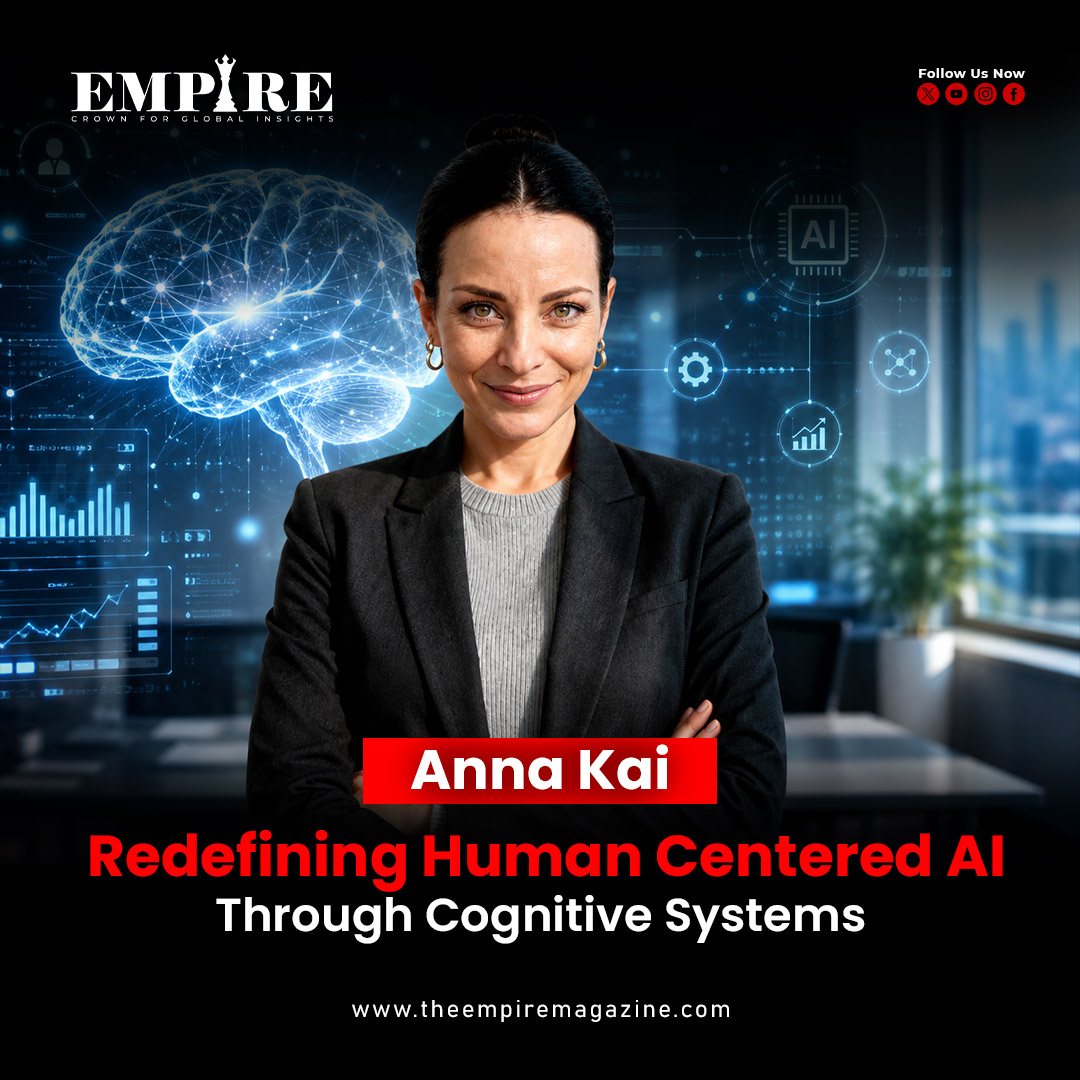
Discover how Anna Kai is redefining human-centered AI through cognitive systems, contextual intelligence, KaiSpace, Python Zero and responsible AI innovation.
Anna Kai Is Building the Missing Layer of Artificial Intelligence
Artificial intelligence is advancing at an extraordinary pace. Large language models can generate sophisticated text, analyze information, write code and support increasingly complex workflows. Yet Anna Kai believes that the biggest challenge facing AI is not simply making machines more intelligent. It is helping them understand the human context in which intelligence is actually used. As the Founder and Director of FreeIntelligence.Institute, Anna Kai is developing a distinctly human-centered approach to artificial intelligence, combining cognitive systems, psychology, systems thinking, emotional intelligence and human development. Her work challenges the conventional idea that AI should primarily automate tasks. Instead, she is exploring how artificial intelligence can preserve context, support continuity, strengthen decision-making and help people navigate complexity. Through initiatives including KaiSpace and Python Zero, Anna Kai is working toward cognitive environments where humans and AI can collaborate over time rather than interact through disconnected prompts. Her central philosophy is clear: the future of AI should not be measured only by how much information a system can process, but by how effectively it can operate within the realities of human life.
Anna Kai’s Journey From Corporate Leadership to AI Innovation
Unlike many artificial intelligence innovators whose careers began directly in engineering or computer science, Anna Kai developed her perspective through more than two decades of experience working with businesses, organizations and people. Her professional journey exposed her to business development, leadership, organizational growth, coaching, psychology and human transformation. Across these experiences, one question continued to influence her thinking: why do people make the decisions they make? That curiosity gradually expanded beyond conventional business performance into the deeper structures that influence human behavior, motivation, learning and wellbeing. When AI became increasingly practical as a business technology, Anna initially approached it as a way to automate processes and create greater independence. However, sustained experimentation revealed a deeper limitation. AI could produce impressive answers, but those answers often lacked continuity, memory and an understanding of the user’s broader objectives. This realization became a turning point. Rather than accepting those limitations, Anna Kai began developing new cognitive architectures designed around human experience. Her transition into AI therefore did not represent a departure from her earlier work; it became an extension of her long-standing interest in human behavior, structured thinking and meaningful transformation.
Anna Kai Says Context Is the Missing Ingredient in AI
One of the most important ideas in Anna Kai’s human-centered AI philosophy is that context is more important than simply increasing computational power. Modern AI systems are remarkably capable of recognizing patterns and generating language, but Anna argues that convincing output should not automatically be confused with genuine understanding. Human beings interpret information through memories, relationships, emotions, experiences and changing circumstances. The same sentence can have entirely different meanings depending on the person, environment and history surrounding it. Without that context, an AI system may generate an answer that appears correct while still being inappropriate or irrelevant to the real situation. This distinction becomes especially important in healthcare, education, leadership, business strategy and human development, where decisions often have consequences that extend far beyond a single interaction. Anna Kai therefore believes that memory, continuity, emotional awareness and contextual intelligence should not be treated as optional features added to AI systems. They should be part of the underlying architecture. Her work challenges the industry to move beyond the question of how AI can produce better answers and toward a more fundamental question: how can AI understand the environment in which those answers actually matter?
Anna Kai Is Redefining AI Through Cognitive Architecture
The work of Anna Kai represents a shift from artificial intelligence as a collection of tools toward AI as a continuous cognitive environment. Conventional AI interactions are generally transactional: a user enters a prompt, receives an answer and begins another interaction. This model can be effective for individual tasks, but it becomes increasingly limited when people are working on long-term projects, businesses, research, learning or personal development. Human thinking does not operate through isolated questions. People develop ideas through stories, experiences, relationships and processes that unfold over time. Anna Kai’s cognitive architecture responds to this limitation by focusing on continuity. Her flagship initiative, KaiSpace, is designed around maintaining memory and context so that interaction can develop rather than repeatedly restart. This approach changes the role of AI from a system that simply produces outputs into an environment capable of supporting ongoing human thought. Instead of asking users to constantly reconstruct their goals and previous decisions, a contextual cognitive system can preserve relevant information and support cumulative progress. For Anna Kai, this is a critical step toward meaningful human-AI collaboration because the value of intelligence increases when it can operate within an evolving process rather than a disconnected moment.
KaiSpace Reflects Anna Kai’s Vision for Human-AI Collaboration
KaiSpace, one of the key initiatives associated with Anna Kai, reflects her belief that the next stage of artificial intelligence should focus on collaboration rather than simple task completion. The platform was developed around the principle of continuity, allowing interactions, projects, ideas and objectives to remain connected over time. This approach addresses one of the frustrations of conventional AI: users often need to repeat their background, intentions and previous decisions whenever they begin a new interaction. For Anna Kai, this does not reflect the way humans naturally think or work. A person developing a business idea does not erase yesterday’s thinking before beginning today’s work. A researcher does not forget previous findings each time a new question emerges. A leader does not make strategic decisions without considering the history of an organization. Cognitive systems should therefore support the same kind of continuity. KaiSpace seeks to create an environment where humans can work with AI through ongoing processes rather than disconnected prompts. As users evolve, their objectives change and their understanding develops, the system can potentially become more useful by retaining the contextual relationships that shape those changes. This vision positions AI as a cognitive partner that supports human growth instead of merely executing instructions.
Anna Kai Is Making Advanced AI More Accessible With Python Zero
Another important dimension of Anna Kai’s AI innovation is accessibility. As artificial intelligence becomes more sophisticated, interacting effectively with advanced systems can also become more technically demanding. Programming knowledge, complex interfaces and prompt engineering can create barriers for people who could otherwise benefit from powerful cognitive technologies. Anna Kai’s Python Zero initiative seeks to reduce that friction by creating more intuitive ways for people to interact with sophisticated AI capabilities. The underlying philosophy is straightforward: users should not have to become programmers simply to access advanced intelligence. By simplifying the relationship between humans and machines, Python Zero supports Anna’s broader objective of making cognitive technology more accessible to people beyond traditional technical communities. This has implications for entrepreneurs, educators, researchers, business leaders and professionals who increasingly need to work with AI but may not possess advanced technical skills. Accessibility is therefore not simply a usability issue in Anna Kai’s vision. It is part of the democratization of intelligence. If AI is going to influence how society learns, works and makes decisions, access to these systems should not be restricted to a small group of highly technical users. Human-centered AI must also be human-accessible AI.
Anna Kai Believes AI Should Strengthen Human Intelligence
The philosophy of Anna Kai becomes particularly distinctive when she discusses the relationship between human intelligence and artificial intelligence. Much of the current AI conversation focuses on automation and whether machines will eventually replace human workers. Anna takes a different approach. She argues that the more valuable opportunity lies in creating systems that strengthen human capability. Artificial intelligence can process large quantities of information, recognize patterns and help people explore alternatives, but it does not experience consequences in the same way humans do. It does not possess human responsibility, lived experience or personal meaning. For that reason, Anna advocates responsible augmentation rather than removing people from important decisions. AI should help individuals understand complexity, evaluate possibilities and identify risks while humans retain accountability for the choices they make. This philosophy is especially important in areas such as healthcare, leadership, education and governance, where decisions can directly affect people’s lives. The goal is therefore not to create technology that thinks instead of people. It is to create technology that helps people think more clearly. In Anna Kai’s vision, the most successful AI systems will not make humans less important; they will make human judgment more informed, structured and capable.
Anna Kai Brings Emotional Intelligence Into Cognitive Systems
For Anna Kai, intelligence cannot be separated from emotion and lived experience. Human beings rarely make decisions using facts and logic alone. Memories, relationships, personal experiences, fear, confidence, trust and emotional associations all influence how information is interpreted. This creates an important challenge for artificial intelligence systems that primarily rely on statistical patterns. A word that represents safety to one individual could represent loss or trauma to another. Without understanding the circumstances surrounding communication, even a technically accurate AI response may fail to address what a person actually needs. Anna Kai therefore considers emotional context an important component of human-centered cognitive systems. This becomes particularly significant in sensitive environments such as healthcare, wellbeing, education, leadership and crisis communication. Emotional intelligence can also expand the creative potential of AI. Music, storytelling, visual communication and other creative disciplines depend heavily on meaning and emotional interpretation rather than factual accuracy alone. Anna’s approach suggests that future AI systems will need to move beyond recognizing language and toward understanding the human significance behind language. In this model, context and emotion are not distractions from intelligence. They are essential elements of intelligence when technology operates inside real human environments.
Anna Kai Uses Systems Thinking to Improve Decision-Making
A recurring theme throughout Anna Kai’s work is the importance of structure. Modern organizations and individuals have access to unprecedented amounts of information, yet more information does not automatically lead to better decisions. Anna believes many failures occur because people cannot see how individual decisions connect to broader systems and long-term consequences. Under pressure, humans naturally simplify complicated situations, prioritize immediate solutions and overlook effects that may only become visible months or years later. Systems thinking provides a way to examine these relationships more clearly. Anna Kai’s work on AI T360 reflects this approach by supporting structured decision-making and helping users understand how different elements within complex situations interact. The objective is not to replace judgment but to strengthen it by making relationships and consequences more visible. This philosophy also challenges the assumption that organizations should immediately automate every process. Automation can increase speed, but if the underlying structure is poorly understood, greater speed can simply amplify existing problems. Anna’s approach therefore places structure before optimization. Before organizations ask how technology can make a process faster, they should first understand whether the process itself is designed effectively.
Anna Kai Is Moving Artificial Intelligence From Prompts to Processes
The limitations of prompt-based AI have become another important area of Anna Kai’s innovation. Prompts are useful when someone needs a quick answer, summary or isolated task. However, complex activities such as building a company, conducting research, developing a product or managing a long-term strategy require continuity. People need to remember what has already happened, understand why previous decisions were made and adjust their thinking as circumstances change. Reconstructing that context repeatedly creates unnecessary friction. Anna Kai therefore believes AI needs to move from prompt-based interactions toward continuous processes. In this model, AI can preserve relevant memory, maintain project states and support iterative development over time. Voice interaction is also important because people naturally communicate through conversation, reflection and evolving ideas rather than perfectly engineered prompts. Combining conversational interfaces with memory and contextual awareness could make human-AI collaboration more natural and useful. The result would be an AI environment where progress accumulates rather than disappearing between conversations. For organizations, this could eventually mean moving beyond fragmented AI tools toward integrated cognitive systems that support long-term strategic thinking, organizational learning and decision-making.
Anna Kai’s Vision for the Future of Human-Centered AI
Looking toward the future, Anna Kai is focused on a question that goes beyond technological performance: what kind of intelligence should humanity build? Her work through FreeIntelligence.Institute and initiatives such as KaiSpace, Python Zero and AI T360 explores how cognitive systems can support human growth, learning, wellbeing, decision-making and responsible innovation. She believes the next generation of AI will require interdisciplinary thinking that combines artificial intelligence with psychology, systems theory, neuroscience, business, ethics, mathematics and human development. This broader perspective is important because AI does not exist in isolation. It operates inside workplaces, families, healthcare systems, educational institutions and communities where human values and consequences matter. Anna also emphasizes persistence as an essential quality for innovators because genuinely new ideas may not immediately fit existing structures. Her philosophy suggests that meaningful innovation requires experimentation, patience and the willingness to continue developing an idea before the wider world fully understands it. In an industry increasingly focused on automation, Anna Kai offers a different vision: AI should not make humanity less important. It should create systems that help people understand themselves, navigate complexity and make better decisions.
Anna Kai Is Shaping a More Human Future for Artificial Intelligence
The journey of Anna Kai represents a broader shift in how the future of artificial intelligence is being imagined. Instead of defining progress only through larger models, faster processing and greater automation, her work focuses on context, continuity, emotional intelligence, cognitive architecture and human responsibility. Through FreeIntelligence.Institute and her developing ecosystem of cognitive systems, Anna is exploring how technology can become more deeply aligned with the way people actually think, learn and evolve. Her central message is particularly relevant as AI becomes increasingly embedded in everyday life: intelligence without context can produce information, but intelligence with context can support understanding. The future of AI may therefore depend not simply on building machines that can answer more questions, but on creating systems that can understand the processes, experiences and environments in which those questions arise. Anna Kai’s human-centered approach places people back at the center of the AI conversation. Her vision is not a future where machines replace human intelligence, but one where carefully designed cognitive systems help humans become more thoughtful, informed and capable. The next chapter of artificial intelligence may ultimately be defined not by how human machines become, but by how much better technology helps humans understand, decide and grow.
Read the complete feature here: https://theempiremagazine.com/magazine/anna-kai-the-most-visionary-human-centered-ai-cognitive-systems-leader-to-watch-in-2026/
Read the previous feature here: https://theempiremagazine.com/magazine/dr-andrey-rogachev-the-most-influential-leader-driving-innovation-in-global-finance-and-risk-management-in-2026/
Magazine Feautures | Podcasts: Empire Global Talks
Follow The Empire Magazine on Facebook | Instagram | LinkedIn | YouTube
The Empire Magazine | Crown for Global Insights