
Taiwan | Global Markets, Technology & Business
Information checked on 9 October 2026.
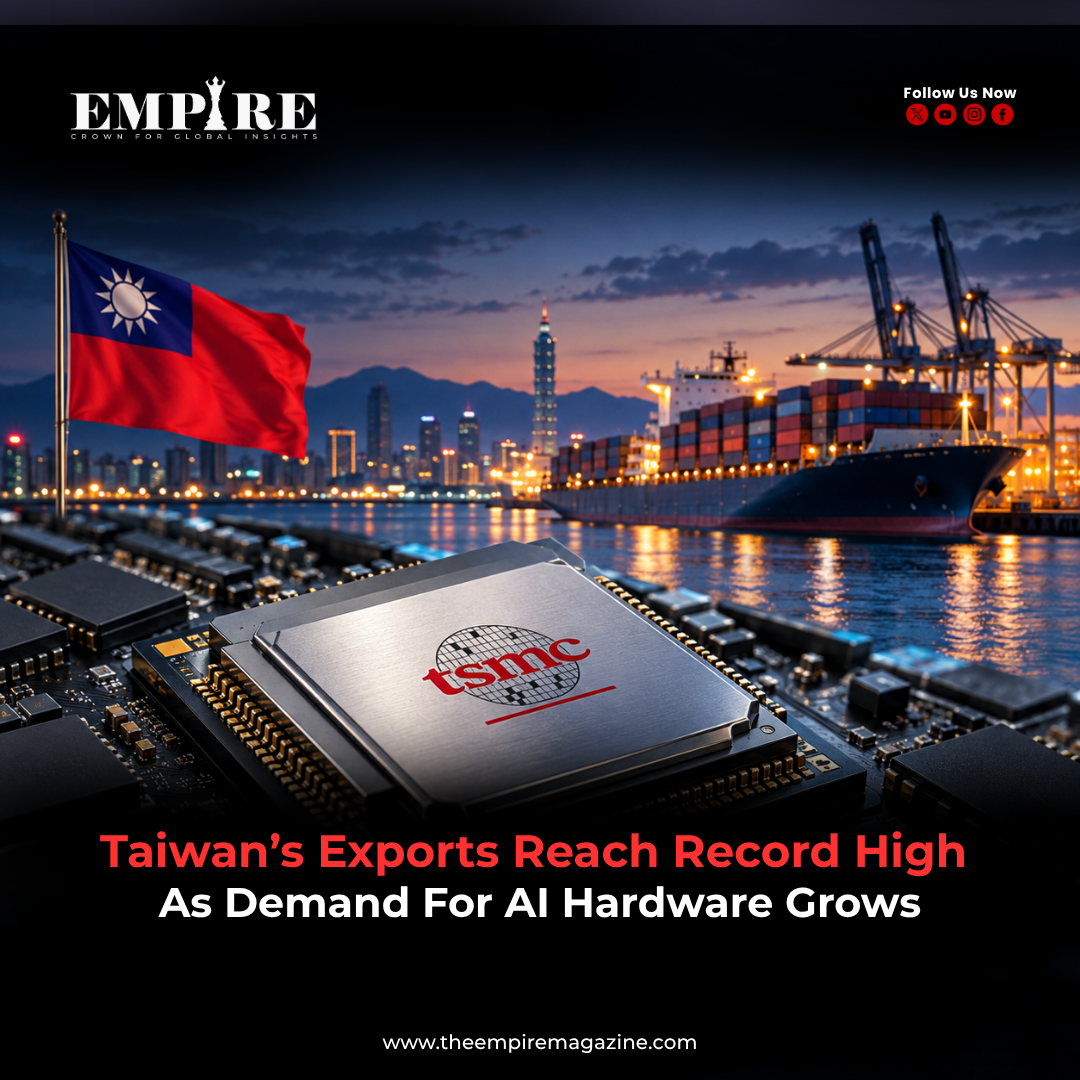
Taiwan exports reached a record US$87.22 billion in September 2026, rising 60.9% from a year earlier, as demand for AI hardware and other technology products strengthened.
Figures released by Taiwan’s Ministry of Finance on 8 October show how spending on computing infrastructure is translating into shipments of physical equipment. Servers, electronic components and related products remain central to the expansion.
September exceeded August’s record of US$82.4 billion and marked the 35th consecutive month of year-on-year export growth.
The result reflects several forces working together. Alongside AI investment, the ministry identified preparations for consumer electronics launches and higher product prices as contributors to the increase.
Taiwan Exports in September 2026: Key Figures
The latest customs data show strong growth in both outward shipments and imports.
| Indicator | Reported value | Year-on-year change |
|---|---|---|
| September exports | US$87.22 billion | +60.9% |
| September imports | US$63.59 billion | +51.7% |
| September trade surplus | US$23.63 billion | +92.2% |
| January–September exports | US$661.55 billion | +46.2% |
Source: Taiwan Ministry of Finance. Values are rounded.
These figures measure the value of goods traded. They do not show how many individual products were shipped or establish that every exporting industry expanded at the same pace.
For businesses assessing Taiwan exports, the distinction matters. Export receipts can rise because manufacturers sell more units, ship more expensive products or receive higher prices for existing products.
AI Hardware and Electronics Lead the Expansion
Two broad technology categories dominated September’s shipments.
Information, communication and audio-video products generated US$39.13 billion, an increase of 103.0% from a year earlier. Electronic components contributed US$31.13 billion, up 45.3%.
Together, these categories represented approximately 80.6% of total exports, calculated from the reported values.
That percentage measures their combined share of trade. The categories also contain products serving other markets, so it should not be presented as the proportion of exports used exclusively for AI.
The ministry’s account of the expansion included strong shipments of graphics cards, servers, storage devices, switches and routers.
This illustrates the physical requirements behind AI services. Computing systems need processors to perform calculations, storage to hold information and networking equipment to move data between machines. Investment in the surrounding infrastructure can therefore create demand across several types of hardware.
The Markets Driving Taiwan Exports
Taiwan’s September trade figures also show where shipments were going.
| Export destination | September export value | Year-on-year growth |
|---|---|---|
| United States | US$27.46 billion | 106.2% |
| Mainland China and Hong Kong | US$20.62 billion | 30.2% |
| ASEAN | US$18.88 billion | 93.4% |
Source: Taiwan Ministry of Finance. Values are rounded.
The United States accounted for 31.5% of Taiwan’s total export value during the month.
These destination figures describe where goods were shipped. They do not necessarily identify the final customer for every component. A chip may travel to another economy for assembly before becoming part of a finished product sold elsewhere.
The pattern is therefore useful for understanding trade relationships, while a complete view of end demand requires information about the production stages that follow.
How the Composition of Taiwan Exports Is Changing
A separate ministry bulletin published on 17 September provides longer-term context for the latest figures.
For January–August 2026, automatic data processing machines and their units accounted for 33.5% of exports, narrowly ahead of electronic integrated circuits at 33.1%.
The first category includes products such as servers and graphics cards. The bulletin also noted that Taiwan’s ten largest export commodity categories accounted for 80.5% of exports over that period.
These figures use a different commodity classification and reporting period from September’s broad technology categories.
They nevertheless point to an important development: Taiwan’s role in global technology supply extends across both semiconductor components and computing equipment.
For manufacturers and their suppliers, growth in these areas creates opportunities tied to engineering, production and delivery. It also increases exposure to the investment decisions of customers buying advanced technology.
TSMC Reports Strong Annual Sales Growth
Company figures offer another perspective on activity in the semiconductor industry.
Taiwan Semiconductor Manufacturing Company (TSMC) reported September consolidated revenue of NT$511.86 billion, up 54.6% year on year. Revenue was 0.6% below August, showing that strong annual growth can coexist with a small monthly decline.
For January–September, TSMC reported revenue of approximately NT$3.90 trillion, an increase of 41.1%.
These amounts are denominated in New Taiwan dollars, while the national export figures are reported in US dollars.
They also measure different things. TSMC’s consolidated sales cover its business operations; customs statistics measure goods crossing Taiwan’s borders. The two datasets should not be added together or treated as interchangeable.
Demand Is Reaching Industries Beyond Electronics
The ministry reported that exports outside electronics and information and communications products increased 25.4% year on year in September.
Exports of electrical machinery rose 29.8%, with officials pointing to demand connected to data centre construction, power grid upgrades and equipment replacement.
This suggests that the investment cycle has effects beyond the most visible AI processors and servers.
A data centre project requires several connected systems to work together. Suppliers can benefit at different stages, depending on the equipment they produce and their position in the construction or manufacturing process.
However, those opportunities vary by company. A rise in overall trade cannot establish the profitability, order visibility or production capacity of an individual supplier.
Why Prices and Inventory Timing Matter
Higher export values do not come entirely from an increase in the number of finished products sold.
According to the ministry’s explanation, tight electronics supply capacity helped keep prices elevated. Inventory building ahead of new mobile devices and other consumer electronics launches also supported September’s shipments.
These factors can affect when trade appears in the monthly data.
Manufacturers may order components before launching a product, and customers may build inventories ahead of expected demand. As a result, a strong shipment month does not provide a complete picture of eventual consumer sales.
Assessing the durability of Taiwan exports growth therefore requires attention to both the value of shipments and the conditions behind them.
What Could Shape the Next Phase of Growth
The ministry projected October exports of US$85.2 billion to US$87.7 billion, implying year-on-year growth of 40% to 44%.
That range is a forecast. It would keep shipments near September’s level, although a new monthly record is not assured.
The outlook remains linked to continued investment in AI infrastructure and seasonal demand for electronics. Officials also identified changes in trade policy and geopolitical tensions as risks.
For suppliers, the practical questions concern delivery schedules, customer commitments and the ability to sustain production as demand changes.
Taiwan’s next official monthly trade release is scheduled for 9 November 2026. It will provide another measure of whether the latest pace of expansion is continuing.
Explore more global business, technology and innovation coverage in The Empire Magazine’s article archive.
Read our related AI hardware coverage: chatprd-claire-vo-ai-agents/
Follow The Empire Magazine:
Facebook | Instagram
The Empire Magazine | Crown For Global Insights