France & United States | Business, Technology & Artificial Intelligence
Information checked on 6 October 2026.
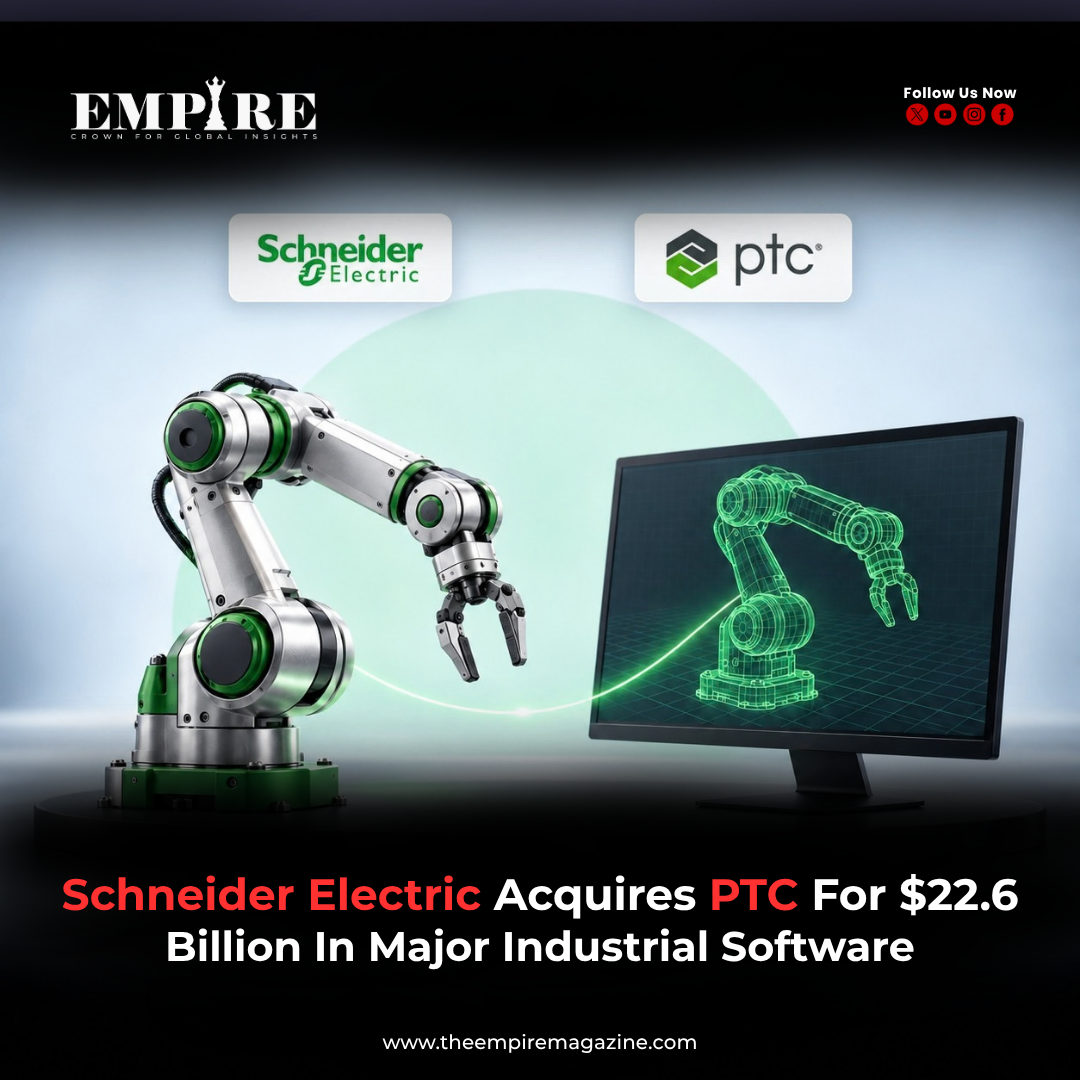
Schneider Electric has agreed to acquire US industrial software company PTC in an all-cash transaction valuing its equity at approximately $22.6 billion. Announced on 5 October 2026, the agreement would expand the French group’s capabilities in product design, engineering and industrial data management.
The transaction has not closed. Completion remains subject to shareholder and regulatory approvals and other customary conditions.
The proposed Schneider Electric PTC acquisition reflects a broader business ambition: connecting the information used to design a product with the systems used to manufacture, operate and maintain it.
Key Terms of the Schneider Electric PTC Acquisition
| Deal element | Announced terms |
|---|---|
| Payment to PTC shareholders | $205 per share in cash |
| Equity value | Approximately $22.6 billion |
| Enterprise value | Approximately $23.7 billion |
| Premium to PTC’s last closing price | 42.3% |
| Expected completion | By the third quarter of 2027 |
| Board approval | Unanimous approval from both companies’ boards |
Equity value describes the value assigned to shareholders’ ownership. Enterprise value also accounts for net debt and related adjustments, which explains why reports may use different headline figures for the same transaction.
The announced premium is a comparison with a historical share price. It does not measure the financial benefits Schneider will ultimately achieve from owning PTC.
What PTC Would Add to Schneider Electric
Boston-based PTC develops software used across the lifecycle of manufactured products. Its portfolio covers the creation of engineering designs, management of product information, development of software-intensive products and support for equipment in service.
Several established products illustrate that range:
| Product | Main role |
|---|---|
| Creo | Computer-aided design for physical products |
| Windchill | Product lifecycle management |
| Codebeamer | Application lifecycle management |
| Onshape | Cloud-based design and product data management |
| ServiceMax | Field service management |
| Servigistics | Service parts planning and optimisation |
PTC’s customers operate in industries including automotive, aerospace, medical technology, electronics and industrial manufacturing.
For these businesses, engineering information remains useful long after a product leaves the drawing board. A maintenance team may need the exact configuration of a machine, while a product engineer may need to understand why a component failed after installation.
Connecting those records can help teams investigate problems and make better-informed changes.
Why Industrial AI Depends on Connected Data
Schneider’s stated rationale centres on combining PTC’s engineering information with its own operational and energy expertise. The company describes the intended result as a unified digital thread.
In practical terms, a digital thread connects information across stages of a product or asset’s life.
Consider an industrial pump that consumes more electricity than expected. Understanding the problem might require its design specifications, installed components, operating conditions and maintenance history. Each record answers a different part of the question.
From a product-development perspective, bringing those records together could make an AI assistant more useful. It would have a clearer basis for identifying relevant information and supporting an engineer’s investigation.
The value would still depend on accurate records, appropriate access controls and traceable answers. Connecting databases alone does not establish that an AI system can reliably interpret every engineering situation.
PTC’s Financial Results Show the Business Behind the Deal
For its fiscal year ended 30 September 2025, PTC reported approximately $2.739 billion in revenue, up 19%, alongside $868 million in operating cash flow.
It also reported $857 million in free cash flow, a non-GAAP measure, and 8.5% growth in annual recurring revenue at constant currency.
These are historical results for PTC’s business at that time. The company subsequently divested ThingWorx and Kepware to Velotic in March 2026, so comparisons with later periods need to account for the changed portfolio.
That distinction matters when evaluating an acquisition. Historical revenue, current operations and forecasts for the combined business describe different things.
How AVEVA and Cognite Fit the Strategy
Schneider’s software expansion predates the PTC agreement.
AVEVA became wholly owned by Schneider Electric in January 2023. Its software supports industrial engineering, operations and maintenance, providing an established foundation for Schneider’s industrial software activities.
On 30 June 2026, Schneider also announced an agreement to acquire Cognite for $3.1 billion. Cognite develops industrial data and AI software, including tools that connect engineering, operational and enterprise information.
The October PTC announcement continued to identify Cognite’s acquisition as subject to closing conditions.
Taken together, the businesses address related parts of an industrial workflow: product engineering, plant operations and the organisation of data used across those activities.
Schneider estimates that software and services would represent approximately 24% of group revenue on a pro forma basis including PTC and Cognite. This is an estimate for the combined portfolio.
PTC Was Already Expanding Its AI Capabilities
PTC’s own development programme provides further context.
At its PTC NEXT event in June 2026, the company introduced PTC Orbit and PTC Jetstream, alongside new AI agents, integrations and updates across its products.
PTC describes Orbit as a way to connect information from multiple enterprise systems into a unified asset record. Jetstream supports sharing, reviewing and recording feedback on product information across teams.
The company also previewed an AI platform intended to support capabilities across its portfolio.
These announcements show that the acquisition would bring an existing AI development programme into Schneider’s broader strategy.
For customers, the practical test will be whether these capabilities improve specific tasks: finding the correct document, understanding a design change or preparing a service intervention. Product announcements establish the direction of development; customer outcomes establish its usefulness.
How Schneider Plans to Finance the Purchase
Schneider expects to finance the transaction through approximately €5 billion to €6 billion in new equity and €16 billion to €17 billion in new debt, supported by committed bridge financing.
The all-cash description therefore refers to what PTC shareholders would receive. Schneider’s funding plan involves raising capital from investors and lenders.
Management also expects to pause share buybacks in 2027 and 2028, while retaining its overall buyback commitment through 2030.
These choices make the financing an important part of the deal’s assessment. New shares change the ownership base, while borrowing creates interest and repayment obligations that future cash generation must support.
The Savings and Revenue Targets Remain Forecasts
Schneider targets €250 million in annual cost savings by the third year after closing and approximately €800 million in revenue synergies.
During its investor call, management also identified approximately €250 million in one-time implementation costs associated with the cost-savings programme.
Cost savings and additional revenue need separate assessment. Savings may come from procurement or shared infrastructure. Revenue gains depend on customers purchasing additional products and services, with associated selling and delivery costs.
Management expects the transaction’s return on capital employed to exceed its cost of capital by the fifth year after closing, including the full expected synergies.
These projections describe the financial case for the acquisition. They are not results already delivered.
What Will Determine the Deal’s Long-Term Value
The immediate milestones are the required approvals and completion of the transaction.
Beyond closing, customers will need clear product plans, dependable support and workable connections between systems. Many manufacturers have substantial investments in existing software, making compatibility and continuity important.
Commercial progress would be demonstrated by sustained customer adoption, stronger cash generation and evidence that the combined tools reduce meaningful costs or improve industrial performance.
Schneider’s proposed purchase creates an opportunity to connect product engineering more closely with factory operations and energy management. Its long-term value will depend on how effectively that connection works for customers.
Explore more global business, technology and innovation coverage in The Empire Magazine’s article archive.
Read our related coverage: eliseai-property-management-healthcare/
Follow The Empire Magazine:
Facebook | Instagram
The Empire Magazine | Crown For Global Insights