United States | Technology & Corporate Leadership
November 13, 2026
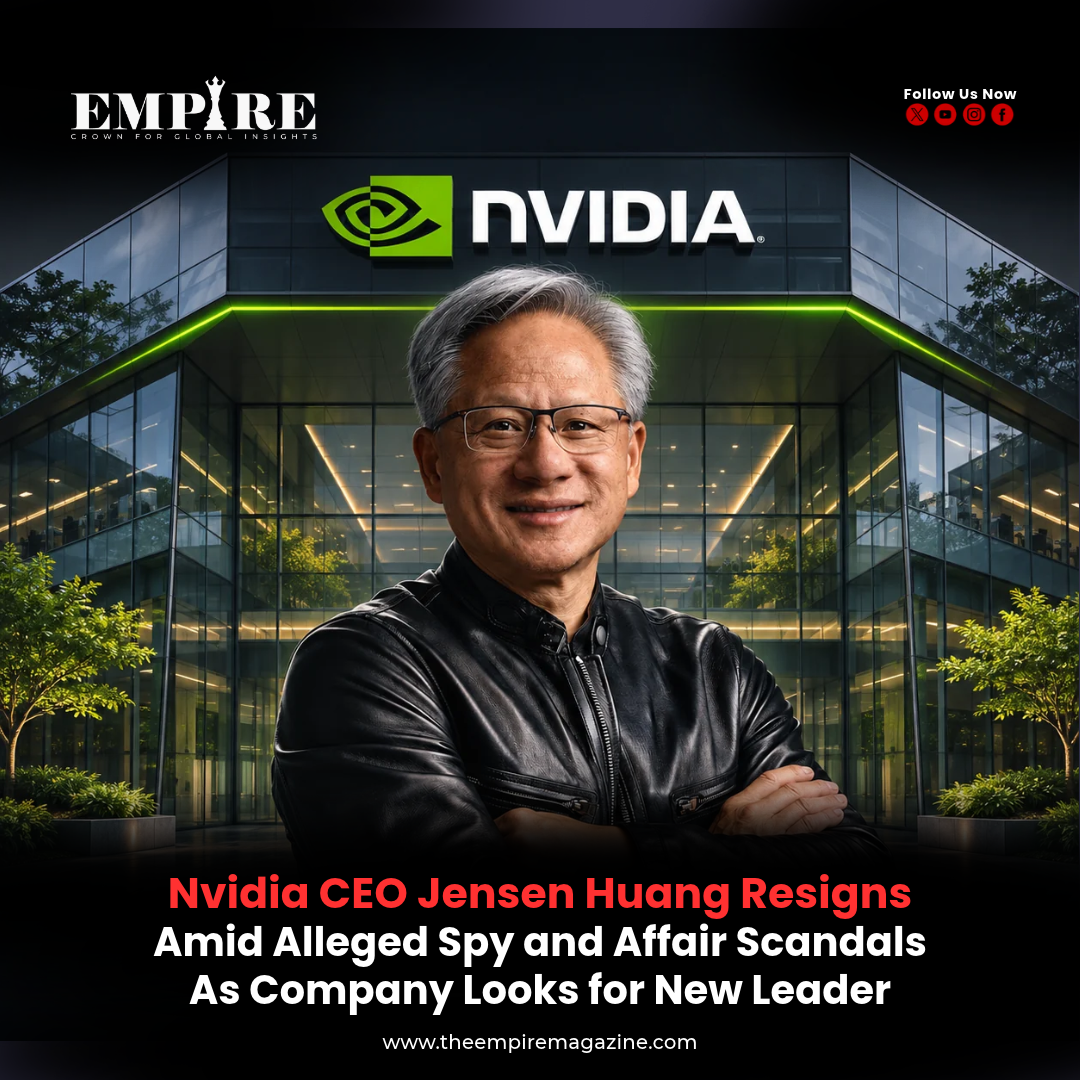
Jensen Huang resigns as Nvidia CEO amid scrutiny of his personal conduct and an independent investigation into reports that he was targeted by a foreign intelligence operation.
The company announced the leadership change on November 12, 2026. Its regulatory filing provides a more precise timeline: the board accepted Jensen Huang is resignation as president, chief executive and director on November 11, effective immediately.
Chief Financial Officer Colette Kress has become interim CEO while retaining her existing responsibilities. The transition ends Jensen Huang is leadership of the business he helped establish more than three decades ago.
Jensen Huang Resigns Following Affair Reports
Huang publicly acknowledged infidelity in a November 8 message to Nvidia employees. He apologised to his wife and family, accepted responsibility for his conduct and said he had fallen short of the trust placed in him by colleagues, directors, partners and shareholders.
He also pledged to cooperate with the board’s investigation into the national security concerns raised by news reports. His statement expressed support for protecting Nvidia and US national security.
That admission did not identify a partner or establish the espionage claims.
Reuters reported that the controversy included a relationship with a Chinese businesswoman whom US authorities suspected of spying for Beijing, alongside reports of relationships with Nvidia employees. Reuters also reported that Beijing denied the spying allegation and that the US Justice Department had not reached a conclusion about it as of November 12.
These distinctions matter: an admission about personal conduct does not establish that confidential information was disclosed or that anyone acted for a foreign intelligence service.
What Nvidia’s Independent Investigation Covers
On November 8, Nvidia’s board announced an investigation following reporting that Jensen Huang had been targeted by a foreign intelligence effort.
The board placed oversight with a committee of independent directors, supported by outside legal counsel. It identified US national and economic security as central concerns for the company and its shareholders.
On November 10, the independent directors named former acting US Attorney Joon H. Kim and the law firm Wachtell, Lipton, Rosen & Katz to conduct the inquiry.
Those announcements identify the investigation’s leadership and the concerns that prompted it. They do not publish conclusions about espionage, compromised information or responsibility for any security breach.
Huang’s resignation changes the company’s leadership, but it does not itself answer the questions being investigated. Any assessment of the allegations must depend on evidence and subsequent findings.
Who Is Interim Nvidia CEO Colette Kress?
Kress joined Nvidia in September 2013 as executive vice president and chief financial officer. Her background includes extensive experience overseeing financial planning and operations at large technology companies.
Before Nvidia, she spent three years in a senior finance role at Cisco. Earlier, she worked at Microsoft for 13 years, including four years as chief financial officer of its Server and Tools division. She also held finance positions at Texas Instruments.
Her experience gives the interim leadership team familiarity with Nvidia’s finances and operating structure. The practical challenge will be coordinating the business through a sudden transition while employees, customers and shareholders seek clarity about its direction.
Nvidia Begins Its Search for a Permanent CEO
Nvidia says its board will consider candidates from both inside and outside the company. Its announcement does not name a permanent successor or provide a deadline for completing the search.
Harvey C. Jones has been appointed board chair. A director since 1993, Jones brings experience as a technology executive and investor.
The board says it expects Nvidia’s operations, customer commitments and product development plans to continue without interruption. That is the company’s stated expectation during the transition; it is not a guarantee about future business performance.
The succession process will require the board to assess who can lead Nvidia’s technical organisation, manage major commercial relationships and maintain confidence in its governance.
Why the Leadership Change Matters for Artificial Intelligence
Huang co-founded Nvidia in 1993 with Chris Malachowsky and Curtis Priem. The company initially focused on bringing advanced graphics to gaming and multimedia.
Its role expanded as graphics processors became useful for scientific and other demanding computing tasks. Nvidia introduced CUDA in 2006, opening its GPUs to a wider range of applications. Its hardware later helped power the breakthrough AlexNet neural network in 2012.
That history explains why the departure has significance beyond a single executive position. Nvidia’s business connects semiconductor design, software development and the computing infrastructure used for artificial intelligence.
From a business perspective, the central challenge is continuity: preserving technical execution and customer relationships while leadership accountability and the investigation receive sustained attention.
Explore more global business, technology and innovation coverage in The Empire Magazine’s article archive.
Read our related coverage: us-consumer-prices-october-2026-inflation/
Follow The Empire Magazine:
Facebook | Instagram
The Empire Magazine | Crown For Global Insights