
Anthropic’s latest releases target demanding technical work, combining reported performance improvements with lower standard API prices and different access requirements.
The Empire Magazine | Artificial Intelligence and Technology
Information checked: 11 November 2026
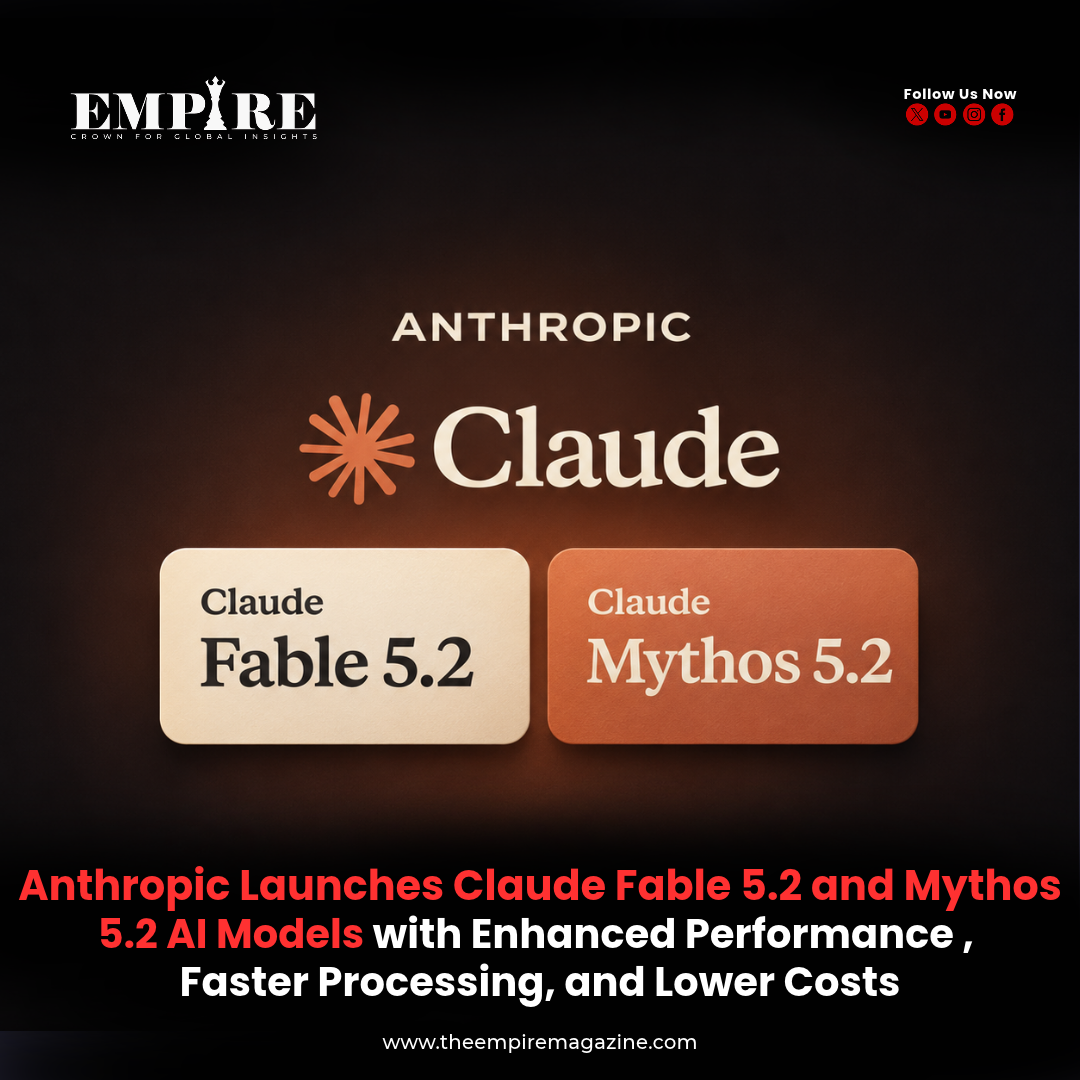
Anthropic has launched Claude Fable 5.2 and Claude Mythos 5.2, introducing upgrades aimed at complex software development, reasoning, visual analysis and extended AI workflows.
Released on 9 November 2026, the models carry standard API prices of $8 per million input tokens and $40 per million output tokens. Both rates are 20% lower than those of their respective 5.1 predecessors.
Anthropic also says the models generate outputs up to 30% faster. Access differs: Fable 5.2 is broadly available, while Mythos 5.2 remains restricted to organisations approved through the company’s verification programmes.
What Has Improved in Claude Fable 5.2?
Anthropic reports improvements in coding, reasoning and vision, alongside clearer communication.
Its published evaluations show gains over Fable 5.1 on several technical tasks. Selected coding results include:
| Evaluation | Claude Fable 5.1 | Claude Fable 5.2 |
|---|---|---|
| FrontierCode 2.0, extra-high effort | 32.4% | 49.1% |
| FrontierSWE v2 | 56.3% | 69.9% |
These are company-reported results under Anthropic’s stated evaluation conditions. Performance in a particular business or development environment will depend on the task, settings and surrounding tools.
For software teams, the practical question is whether stronger results translate into usable code, fewer corrections and less time spent reviewing unsuccessful attempts.
How Claude Fable 5.2 and Mythos 5.2 Differ
Anthropic says Fable and Mythos share the same underlying model.
Fable includes cybersecurity and biology safeguards that support broader deployment. Mythos is offered through verification programmes for organisations pursuing approved work in areas such as cybersecurity and life sciences.
The distinction therefore concerns access and safeguards. The two releases share their published core specifications and standard token prices.
This matters for organisations evaluating the launch. Mythos access requires approval; it is not automatically included simply because a customer can use Fable.
Standard API Prices Fall by 20%
Anthropic’s documentation lists the following changes from the 5.1 releases:
| Standard API charge | Fable/Mythos 5.1 | Fable/Mythos 5.2 | Reduction |
|---|---|---|---|
| Input, per million tokens | $10 | $8 | 20% |
| Output, per million tokens | $50 | $40 | 20% |
Input tokens represent material supplied to the model. Output tokens represent material it generates.
For illustration, a workload billed for one million standard input tokens and 100,000 output tokens would cost $12 at the new rates, compared with $15 previously. This example excludes caching, tool charges and other pricing adjustments.
The reduction applies to those unit prices. The total cost of completing a task will also depend on token consumption, reasoning effort, repeated attempts and any additional services used.
For businesses running substantial workloads, measuring cost per successfully completed task will provide a more useful comparison than looking at token rates alone.
Faster Output and Optional Fast Mode
Anthropic’s claim of up to 30% faster output compares the new releases with their 5.1 predecessors.
Output generation is one part of a workflow. Research, external tool calls, software execution and human review can also affect how long a task takes.
The company separately offers an optional fast mode, described as providing up to 2.5 times higher output-token throughput.
Published fast-mode rates for both models are:
- $16 per million input tokens
- $80 per million output tokens
Fast mode therefore carries twice the standard token prices. It offers a speed–cost trade-off for supported deployments.
A team using AI interactively may value shorter waits, while a workload running in the background may place greater weight on cost. The appropriate choice depends on whether faster generation materially improves the overall process.
Large Context Capacity for Complex Work
The API documentation lists a one-million-token context window and a maximum output of 128,000 tokens for both models.
They accept text and images as inputs and generate text outputs. Adaptive thinking is enabled, with reasoning effort adjustable through the API.
A large context window can help users supply extensive project material, such as documents, code and supporting evidence, within a request. It does not by itself establish that every detail will be interpreted correctly.
For document-heavy work, the useful test is whether the model can identify relevant information, maintain consistency and produce an answer that can be checked against the supplied material.
Anthropic positions Fable 5.2 for demanding reasoning and extended tasks, including research and work carried through to a finished document, spreadsheet or presentation.
Where the Models Are Available
Claude Fable 5.2 is available through the Claude API and supported services across Amazon Web Services, Google Cloud and Microsoft Foundry.
Access within Claude products depends on the relevant plan and its usage allowances.
Claude Mythos 5.2 requires organisational verification. Anthropic identifies cybersecurity and life-sciences programmes as routes through which eligible organisations can apply.
Availability through a cloud platform does not remove Mythos verification requirements. Customers also need to distinguish standard model availability from support for optional features such as fast mode.
What the Launch Means for Businesses
The combination of lower unit prices and reported capability gains could make some demanding AI workflows more economical.
The largest benefit would come where improved performance reduces repeated attempts or helps complete work that previously required substantial manual intervention.
Teams comparing the releases can assess three practical measures: the quality of the finished result, the total time required and the complete cost of producing it.
Existing API users should also review the migration documentation. Anthropic identifies compatibility changes that may affect custom integrations moving from earlier models.
Testing on representative work will help establish whether the new releases improve the tasks a business actually needs to complete.
Explore more global business, technology and innovation coverage in The Empire Magazine’s article archive.
Read our related coverage: tesla-project-crystal-sun-solar-factory/
Follow The Empire Magazine:
Facebook | Instagram
The Empire Magazine | Crown For Global Insights