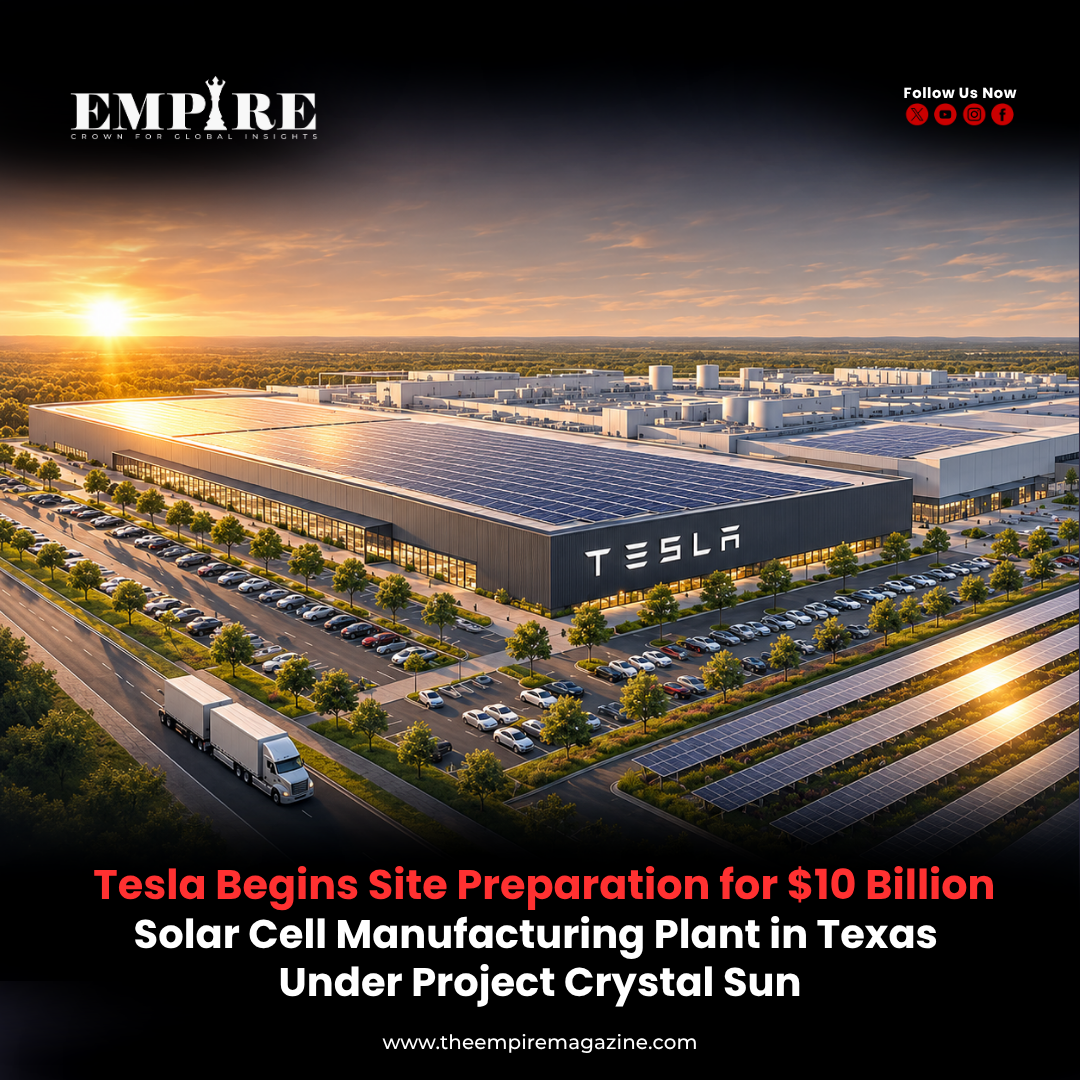
Reported site preparation in Fort Bend County brings fresh attention to Tesla’s proposed $10.1 billion solar manufacturing project, with commercial operations targeted for early 2029.
The Empire Magazine | Energy and Manufacturing
Updated: 10 November 2026
Tesla’s Project Crystal Sun is drawing renewed attention after reports of site preparation at its proposed solar manufacturing location in Fort Bend County, Texas.
The development concerns a planned investment of approximately $10.1 billion, according to Tesla’s application filed with the Texas Comptroller. The proposal includes manufacturing photovoltaic solar cells and potentially assembled solar modules.
The latest activity represents an early physical milestone. Production, the full investment programme and thousands of projected permanent jobs remain future objectives.
What the Latest Site Reports Show
Tesla North reported on 9 November that videographer S. E. Robinson Jr. had documented site preparation in a drone video dated 8 November.
The proposed location covers roughly 3,000 acres near Needville, close to FM 762 and FM 1994 in Fort Bend County.
Elon Musk also brought attention to the development by sharing a related post on X with the words “Project Crystal Sun.” His brief response did not include an updated construction timetable or manufacturing capacity.
These reports indicate activity at the proposed location, although they do not establish how much of the overall factory programme has been completed.
What Tesla Plans to Manufacture
Tesla’s application describes a facility intended to produce photovoltaic cells and/or assembled modules for solar installations.
The proposed equipment includes machinery for making ingots and wafers, applying coatings, processing cells and checking product quality. Supporting facilities would include production buildings, utilities, storage areas and material-handling systems.
Taken together, that equipment list suggests a manufacturing operation covering several stages of solar production. The final configuration and output would depend on the equipment installed and the production lines brought into service.
The application identifies potential uses for the finished products across utility-scale, commercial and distributed solar installations.
Project Crystal Sun Investment and Timeline
The financial proposal places most of the planned investment in equipment and other personal property.
| Project component | Proposed amount or target |
|---|---|
| Total capital investment | Approximately $10.1 billion |
| Real property investment | Approximately $1.5 billion |
| Equipment and other personal property | Approximately $8.6 billion |
| Commercial operations | First quarter of 2029 |
These figures describe the project’s planned scale. They are not a statement that Tesla has already spent the entire amount.
The equipment-heavy budget also highlights the work required after land preparation. Buildings, utility connections, machinery installation and production testing would all need to progress before the facility could operate commercially.
For readers following construction updates, the most useful distinction is between preparing the site and demonstrating that manufacturing systems are ready to produce saleable products.
Nearly 9,700 Permanent Jobs Projected
Lamar Consolidated Independent School District’s summary of Tesla’s application projects approximately 9,712 permanent full-time positions by 2033.
The proposal also anticipates about 1,147 temporary construction jobs at peak activity. Construction employment and permanent factory employment are separate categories.
The hiring forecast describes a phased expansion over several years. It should not be interpreted as an announcement that thousands of positions are currently open.
If the project reaches its proposed scale, it could generate demand for manufacturing skills, maintenance services, logistics and local suppliers. Those wider opportunities would depend on actual construction, purchasing and recruitment decisions.
For the surrounding community, the timing of employment growth will matter alongside the headline job total. Training providers and businesses would need to match their preparations to confirmed hiring schedules.
Local Incentive Decisions Support the Proposal
Project Crystal Sun has already moved through significant local incentive discussions.
On 15 September, Lamar CISD trustees approved a resolution to proceed with a taxable-value limitation agreement under the Texas Jobs, Energy, Technology and Innovation programme, known as JETI.
Fort Bend County subsequently approved a property-tax incentive package in October. The Houston Chronicle reported that commissioners approved the agreement by a 4–0 vote, with one abstention.
These decisions concern the project’s financial arrangements. The school district has explained that its role in the JETI process does not determine whether Tesla may purchase or develop private property.
The district also states that qualifying property remains fully taxable for the school-tax component used to repay bonds.
Why the Factory Could Matter for Solar Manufacturing
If completed and brought into sustained production, Project Crystal Sun could expand domestic manufacturing options for solar components.
One potential advantage of bringing multiple production stages together is closer coordination between processes. However, the practical benefit would depend on reliable equipment, consistent materials, trained employees and satisfactory production yields.
The project’s commercial significance will therefore depend on more than its investment figure. Output, product quality, manufacturing costs and customer demand will determine how effectively the plant competes.
The documents reviewed do not establish a site-specific annual production capacity. Assigning the factory a gigawatt figure would require a clearer disclosure from Tesla.
The Next Milestones to Watch
Future updates will be more informative if they show progress beyond earthworks.
Factory construction, utility installation, equipment deliveries and commissioning would provide stronger evidence of movement toward commercial operations. Updated company disclosures could also clarify the final manufacturing scope and production schedule.
For local businesses and potential employees, confirmed procurement opportunities and recruitment announcements would be more actionable than broad forecasts.
The first-quarter 2029 operating target remains the central date in the application. Any revised timetable should be assessed against the physical progress of the facility and Tesla’s subsequent disclosures.
Explore more global business, technology and innovation coverage in The Empire Magazine’s article archive.
Read our related coverage: nvidia-jensen-huang-probe/
Follow The Empire Magazine:
Facebook | Instagram
The Empire Magazine | Crown For Global Insights