Thousands protested during the G7 Summit over global capitalism, wealth inequality, climate justice, and militarization. Clashes with police reignite debate over global governance.
G7 Summit Protests Turn Violent as Thousands Rally Against Global Capitalism and Inequality
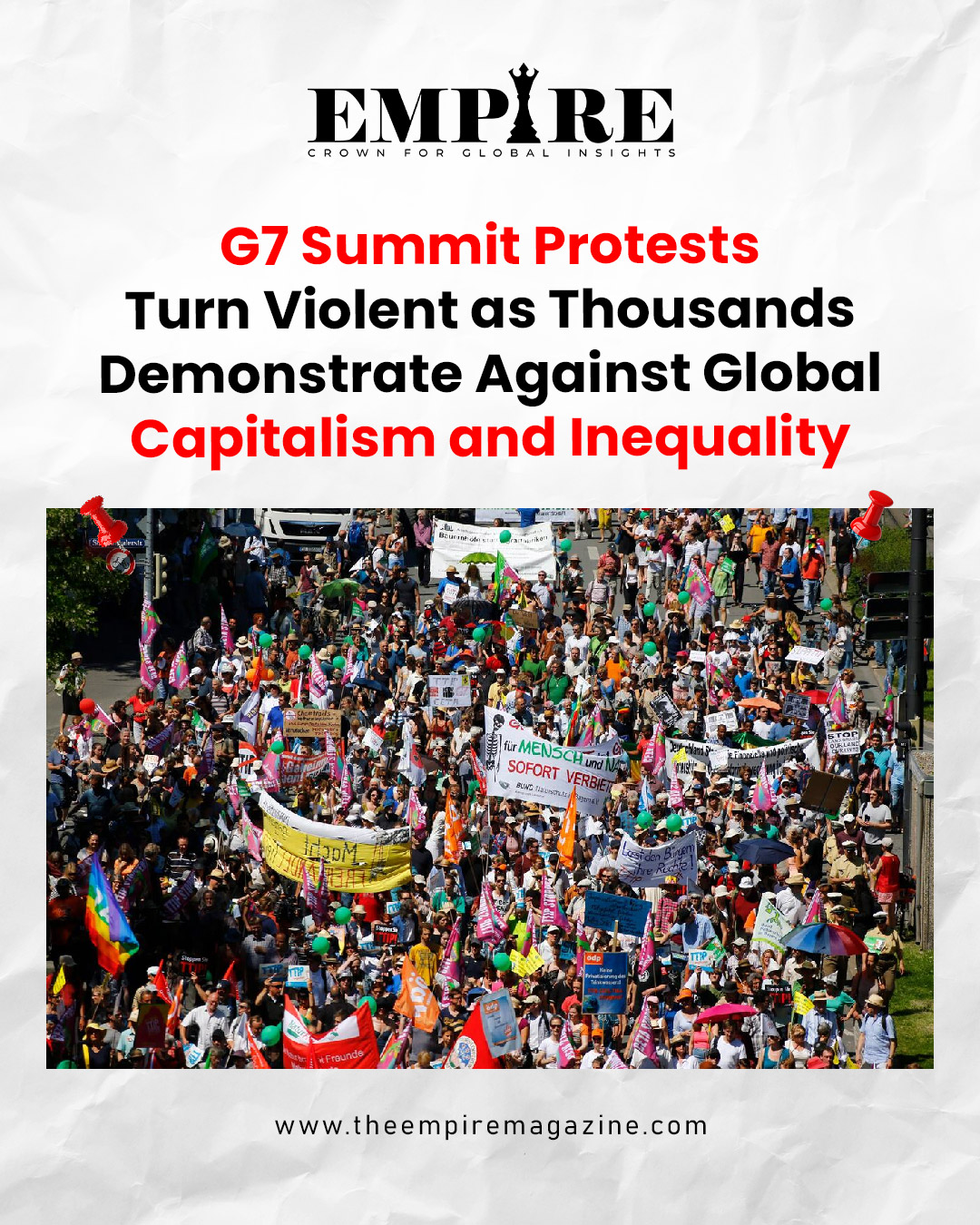
As leaders of the world’s most advanced economies gathered for the 2026 G7 Summit in Evian-les-Bains, France, thousands of demonstrators took to the streets of neighboring Geneva to voice their frustration over rising inequality, corporate influence, climate inaction, and global economic policies.
The protests, which attracted nearly 20,000 participants, reflected growing public dissatisfaction with widening wealth gaps and the concentration of economic and political power among the world’s richest nations. While organizers described the demonstrations as largely peaceful, tensions escalated after a smaller group of protesters vandalized property, set a Tesla vehicle on fire, and clashed with police, prompting authorities to deploy tear gas to restore order. Reuters reported that protesters also damaged bank branches and broke windows at a United Nations office during the unrest.
The demonstrations have once again brought attention to longstanding debates surrounding globalization, social justice, and the legitimacy of international institutions that shape the global economy.
Why the G7 Summit Protests Began
Every G7 Summit attracts demonstrations, but this year’s protests were driven by a combination of economic, environmental, and geopolitical concerns.
Activists argued that the world’s largest industrialized democracies continue to promote policies that disproportionately benefit multinational corporations and wealthy economies while leaving developing nations to struggle with debt, inflation, climate impacts, and unequal access to resources.
Many protesters described the G7 as a symbol of global economic inequality, arguing that decisions affecting billions of people are often made by a small group of powerful nations.
Issues raised during the demonstrations included:
- Rising global wealth inequality
- Corporate influence over public policy
- Climate justice
- Military spending
- International debt
- Workers’ rights
- Cost-of-living pressures
- Global tax fairness
According to Reuters, several demonstrators described the summit as “a meeting of the rich,” reflecting broader concerns about economic exclusion and unequal representation in global decision-making.
Geneva Became the Center of Global Demonstrations at G7
Although the summit itself was held in Evian-les-Bains, much of the public protest activity occurred across the border in Geneva, Switzerland.
Geneva has long served as a focal point for international activism due to its role as headquarters for numerous global organizations, including the United Nations, the World Health Organization, and the World Trade Organization.
Thousands of activists from across Europe gathered in the city carrying banners demanding climate action, economic justice, and democratic reforms to international institutions.
The march initially proceeded peacefully through central Geneva under heavy police supervision.
However, as evening approached, a smaller group separated from the main procession and began attacking symbols they associated with global capitalism, including luxury storefronts, financial institutions, and corporate property.
Reuters reported that protesters also smashed windows at a United Nations building and ignited a Tesla vehicle before police intervened.
Violence Overshadowed an Otherwise Peaceful Protest at G7
Authorities emphasized that the vast majority of demonstrators participated peacefully.
The violence was attributed to a relatively small number of masked individuals who engaged in vandalism and confrontations with law enforcement.
Police responded after protesters threw bottles, stones, and other objects at officers.
To disperse the crowd, security forces deployed tear gas and crowd-control measures while making several arrests.
The clashes dominated international headlines despite representing only a fraction of the overall demonstration.
This distinction remains important because protest organizers continued to stress that their primary objective was to raise awareness of inequality and climate concerns rather than promote violence.
Nevertheless, images of burning vehicles and damaged buildings became symbolic of the tensions surrounding the summit.
Massive Security Operation Protected the G7 Summit
The demonstrations unfolded under one of the largest security operations seen in the region in years.
French and Swiss authorities deployed thousands of police officers and military personnel to safeguard summit venues, transportation corridors, and border crossings.
Temporary border checks were introduced between France and Switzerland, while airspace restrictions were implemented around the summit location.
According to AP News, security planning was heavily influenced by memories of the violent 2003 G8 Summit protests in nearby Evian, which resulted in widespread clashes between demonstrators and police.
This year’s preparations aimed to prevent similar disruptions while allowing peaceful demonstrations to proceed under controlled conditions.
Global Capitalism Became the Main Target of Protesters at G7
A recurring theme throughout the demonstrations was opposition to what activists described as an increasingly unequal global economic system.
Protesters argued that multinational corporations continue to accumulate record profits while millions of people struggle with inflation, housing costs, stagnant wages, and limited economic opportunities.
Climate activists also criticized wealthy nations for failing to provide sufficient financial support to developing countries facing the impacts of climate change.
Others called for reforms to international financial institutions, fairer taxation of multinational corporations, stronger labor protections, and greater accountability from global leaders.
The protests reflected a broader resurgence of anti-globalization movements that have gained renewed momentum following the pandemic, rising living costs, and growing geopolitical uncertainty.
Wealth Inequality Remains a Growing Global Concern
One of the strongest messages emerging from the demonstrations was concern over widening wealth inequality.
Recent reports from international organizations have highlighted growing disparities between high-income and low-income countries, as well as increasing concentration of wealth among the world’s richest individuals.
Protesters argued that these inequalities have been intensified by inflation, higher borrowing costs, unequal access to technology, and uneven economic recovery following recent global crises.
For many participants, the G7 Summit represented an opportunity to pressure world leaders to adopt policies that prioritize inclusive growth, fair taxation, sustainable development, and stronger social protections.
Rather than focusing solely on national issues, demonstrators framed inequality as a global challenge requiring coordinated international action.
For more business and retail insights, read more on The Empire Magazine
Previous article: https://theempiremagazine.com/uk-sport-event/
Magazine Feautures | Podcasts: Empire Global Talks
Follow The Empire Magazine on Facebook | Instagram | LinkedIn
The Empire Magazine | Crown for Global Insights