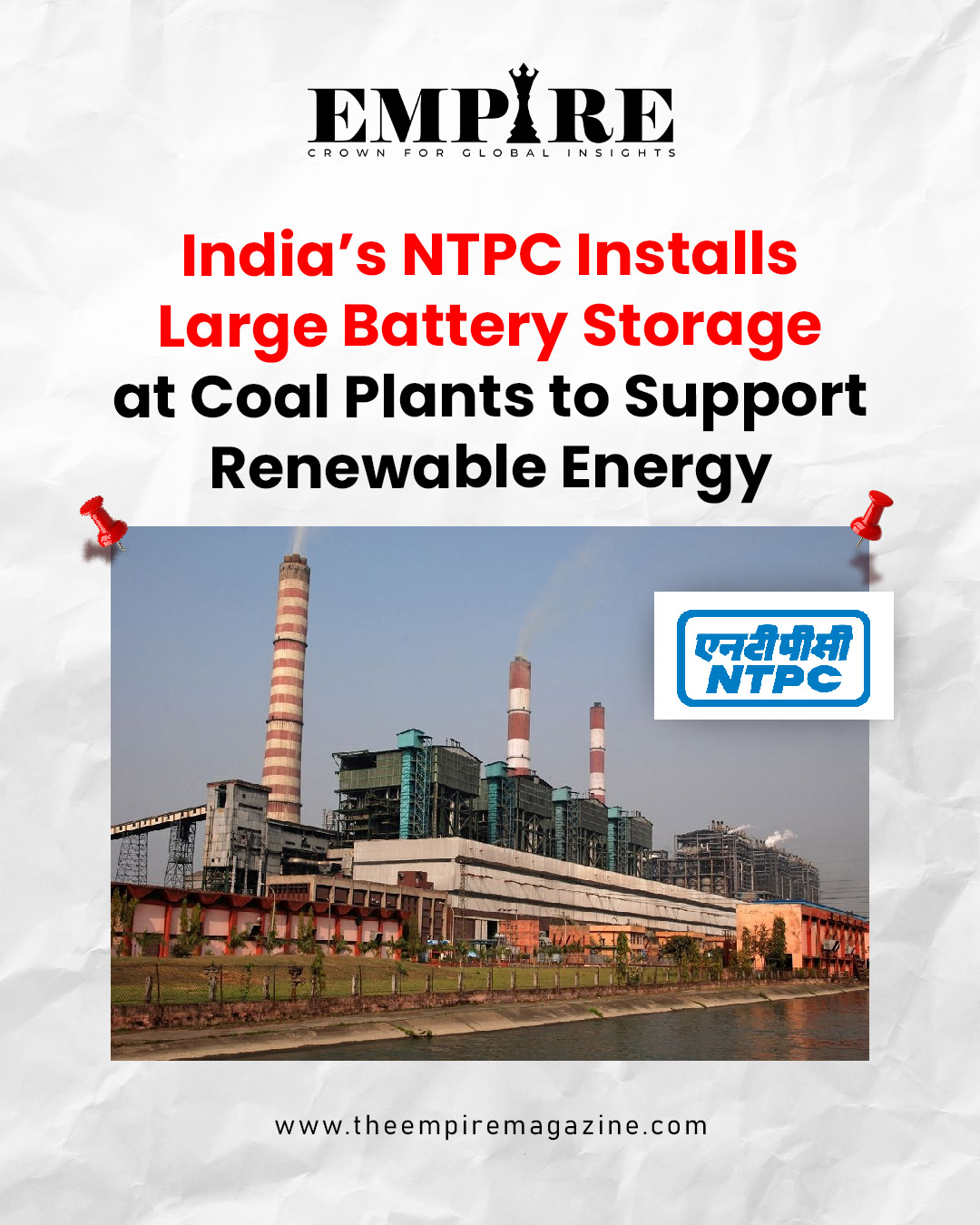
NTPC is installing 5 GWh of battery storage at coal plants to reduce renewable energy curtailment, improve grid stability, and accelerate India’s clean energy transition.
NTPC Battery Storage Project Signals a New Era for India’s Renewable Energy Transition
India’s journey toward becoming a global clean energy leader is entering a new phase. While the country has made remarkable progress in expanding solar and wind power capacity, one major challenge continues to limit the full potential of renewable energy efficiently storing electricity when generation exceeds demand.
To address this challenge, NTPC Limited, India’s largest power producer, has launched one of the country’s most ambitious energy storage initiatives by installing nearly 5 gigawatt-hours (GWh) of Battery Energy Storage Systems (BESS) across several coal-fired power stations. The project, valued at approximately ₹5,000 crore, represents a significant shift in how traditional thermal power plants can complement renewable energy instead of competing with it.
Rather than replacing coal plants overnight, NTPC is transforming them into flexible energy hubs capable of storing surplus electricity generated from solar and wind projects. This innovative approach allows renewable energy to be utilized even after sunset or during periods of low wind, making India’s electricity grid more reliable and efficient.
As India works toward achieving 500 GW of non-fossil fuel power capacity by 2030, battery storage is emerging as one of the most important technologies supporting the country’s clean energy ambitions.
NTPC Battery Storage to Transform Coal Plants into Energy Storage Hubs
Traditionally, coal-fired power stations have been designed to generate electricity continuously. However, renewable energy behaves differently.
Solar power peaks during daylight hours, while wind generation fluctuates depending on weather conditions. During periods of high renewable generation and lower electricity demand, a significant amount of clean power often goes unused—a phenomenon known as renewable energy curtailment.
NTPC’s Battery Energy Storage Systems are designed to solve this problem.
The batteries will store surplus electricity generated by nearby solar and wind projects before releasing it back into the grid when demand rises, particularly during evening peak hours when solar generation declines.
According to industry reports, NTPC plans to install approximately 5 GWh of storage capacity, making it one of India’s largest battery storage deployments linked to conventional thermal power infrastructure. The project demonstrates how existing coal plant infrastructure can be repurposed to support renewable energy integration instead of functioning solely as baseload generation assets.
Why Battery Energy Storage Is Critical for India’s Renewable Energy Future
India has become one of the world’s fastest-growing renewable energy markets.
The country has already installed more than 250 GW of renewable energy capacity, including solar, wind, hydroelectric, and other clean energy sources. However, renewable generation alone cannot guarantee uninterrupted electricity supply.
Electricity demand continues throughout the day, while renewable generation depends on sunlight and weather conditions.
Battery Energy Storage Systems bridge this gap by storing electricity when renewable generation is abundant and supplying it when renewable output declines.
This provides several important advantages:
- Reduced renewable energy curtailment
- Improved grid reliability
- Lower dependence on expensive peak-hour power generation
- Better utilization of renewable assets
- Faster response during fluctuations in electricity demand
Unlike conventional power plants that require time to increase generation, battery systems can respond within seconds, making them particularly valuable for maintaining grid frequency and system stability.
As India’s renewable energy capacity expands further, storage solutions will become increasingly essential for balancing electricity supply and demand.
How NTPC’s Battery Energy Storage System Works
Battery Energy Storage Systems, commonly known as BESS, function similarly to large rechargeable batteries connected directly to the electricity grid.
During periods of excess solar or wind generation, electricity charges the batteries instead of being wasted.
When electricity demand increases—or renewable generation falls—the stored energy is discharged into the grid.
This process enables renewable electricity to remain available even after sunset, improving the overall efficiency of India’s power system.
NTPC plans to integrate these battery systems alongside existing thermal power stations because these sites already possess transmission infrastructure, substations, grid connectivity, and operational expertise.
Using existing coal plant infrastructure also reduces project costs compared to developing entirely new storage facilities.
The initiative highlights how conventional power plants can continue contributing to India’s energy security while supporting renewable energy expansion.
Reducing Renewable Energy Curtailment Through Smart Storage
One of the biggest challenges facing India’s clean energy sector is renewable energy curtailment.
Curtailment occurs when electricity generated by solar and wind farms cannot be absorbed by the grid due to limited demand or transmission constraints.
In such situations, renewable generators are instructed to reduce production despite available sunshine or strong winds.
This results in lost clean electricity and reduced financial returns for renewable energy developers.
Battery storage changes this equation.
Instead of wasting surplus electricity, excess generation can now be stored for later use during evening demand peaks.
Industry experts believe this approach will significantly improve renewable energy utilization rates while reducing reliance on fossil-fuel peaking plants.
For investors, higher renewable utilization also strengthens project economics, encouraging additional investments in India’s rapidly expanding clean energy sector.
NTPC’s Strategy Aligns with India’s Clean Energy Goals
India has committed to achieving ambitious climate and energy targets over the coming decade.
These include expanding renewable generation, improving energy efficiency, reducing emissions intensity, and strengthening electricity infrastructure.
Battery storage has emerged as one of the government’s priority technologies because it enables larger amounts of renewable energy to be integrated without compromising grid stability.
NTPC’s investment aligns closely with these national objectives.
Instead of viewing thermal and renewable generation as competing technologies, the company is developing an integrated energy system where coal plants, battery storage, and renewable energy operate together.
This approach reflects a broader shift occurring across global electricity markets, where flexibility is becoming just as valuable as generation capacity.
Grid Stability Will Become More Important Than Ever
India’s electricity demand continues to grow rapidly due to industrial expansion, urbanization, electric vehicles, and the emergence of AI-powered data centres.
The Ministry of Power estimates that peak electricity demand could approach 300 GW in the coming years, placing additional pressure on the national grid.
Battery storage provides grid operators with valuable flexibility by responding instantly to fluctuations in demand and renewable generation.
Instead of relying solely on conventional power plants to balance the grid, utilities can increasingly depend on stored renewable electricity to maintain reliability while reducing emissions.
NTPC Battery Storage Will Strengthen India’s Energy Security
Beyond supporting renewable energy, NTPC’s battery storage initiative is expected to play a crucial role in strengthening India’s long-term energy security.
India’s electricity demand has been growing steadily due to rapid industrialization, urbanization, expanding digital infrastructure, electric vehicles, and increasing household consumption. At the same time, renewable energy generation remains weather-dependent, making grid balancing more complex.
Battery Energy Storage Systems (BESS) provide utilities with the flexibility to store electricity when renewable generation exceeds demand and dispatch it almost instantly during peak consumption periods.
Unlike conventional coal plants, which may require several hours to ramp up generation, battery systems can respond within milliseconds. This rapid response capability improves grid frequency, reduces voltage fluctuations, and minimizes the risk of power outages.
As India continues to modernize its electricity infrastructure, battery storage is expected to become a critical pillar of the country’s energy resilience.
Battery Energy Storage Will Reduce Dependence on Fossil Fuels
One of the biggest advantages of large-scale battery deployment is its ability to reduce dependence on fossil-fuel-based peaking power plants.
Traditionally, coal and gas plants have been used to meet sudden spikes in electricity demand. However, operating these plants for short periods is both expensive and carbon-intensive.
By storing surplus renewable electricity during periods of high generation and releasing it during evening demand peaks, Battery Energy Storage Systems can replace a significant portion of fossil-fuel peaking capacity.
This not only lowers greenhouse gas emissions but also improves the efficiency of existing thermal plants, allowing them to operate at more stable output levels instead of frequently ramping production up and down.
For India, this represents an important step toward balancing energy security with climate commitments.
India’s Battery Energy Storage Market Is Expanding Rapidly
India’s battery storage sector is experiencing unprecedented growth.
Government agencies estimate that the country will require hundreds of gigawatt-hours of energy storage over the next decade to support renewable energy integration and ensure uninterrupted electricity supply.
Several public and private companies have already announced major investments in battery storage projects.
Industry experts believe India could emerge as one of the world’s fastest-growing Battery Energy Storage markets as falling battery costs, supportive government policies, and rising renewable capacity drive demand.
The growing market is also expected to attract investments in battery manufacturing, recycling, software development, and grid management technologies, creating thousands of skilled jobs across the clean energy ecosystem.
For investors, battery storage is increasingly viewed as one of the most promising segments within India’s energy transition.
NTPC Initiative Coal Plants Are Evolving Into Flexible Energy Assets
For decades, coal-fired power plants have served as India’s primary source of electricity.
However, the country’s energy transition is changing their role.
Instead of functioning solely as electricity generators, coal plants are gradually evolving into integrated energy hubs capable of supporting renewable energy through advanced storage technologies.
NTPC’s initiative demonstrates this transformation.
By combining Battery Energy Storage Systems with existing thermal infrastructure, the company can leverage established transmission lines, substations, land availability, and operational expertise while reducing the need for entirely new infrastructure.
This hybrid model allows coal plants to complement renewable energy rather than compete with it.
It also extends the economic usefulness of existing assets while supporting India’s long-term decarbonization strategy.
Government Policies Are Accelerating Battery Storage Deployment
India’s clean energy transition is being supported by an increasingly favorable policy environment.
The government has introduced several initiatives aimed at encouraging Battery Energy Storage deployment, including viability gap funding, competitive bidding mechanisms, renewable energy incentives, and transmission infrastructure upgrades.
Policy support has significantly improved investor confidence, leading to increased participation from domestic and international companies.
Battery storage is also expected to become an essential component of future renewable energy tenders, ensuring that new solar and wind projects include storage capacity capable of providing reliable round-the-clock electricity.
As regulations continue evolving, battery deployment is likely to accelerate further over the coming years.
Challenges Facing Large-Scale Battery Energy Storage
Despite its enormous potential, Battery Energy Storage deployment still faces several challenges.
The first is cost.
Although battery prices have declined substantially over the past decade, large-scale installations still require significant upfront investment.
Supply chain dependence presents another concern.
Many battery components, including lithium, nickel, cobalt, and graphite, rely on global supply chains that remain vulnerable to geopolitical disruptions and price volatility.
Battery recycling and end-of-life management also require continued policy development to ensure environmental sustainability.
Additionally, integrating thousands of megawatt-hours of storage into existing electricity networks demands sophisticated grid management software and advanced forecasting capabilities.
Addressing these challenges will require collaboration between government agencies, utilities, technology providers, and private investors.
NTPC Battery Storage Reflects a Global Energy Transition
India is not alone in embracing battery storage.
Countries including the United States, China, Australia, Germany, and the United Kingdom are rapidly expanding Battery Energy Storage capacity to support renewable electricity generation.
China currently leads the world in battery manufacturing and utility-scale storage deployment, while the United States has seen record investments in grid-scale batteries alongside solar power.
India’s approach, however, is distinctive.
Rather than building entirely separate storage facilities, NTPC is integrating Battery Energy Storage Systems directly with existing coal-fired power plants.
This strategy maximizes infrastructure utilization while minimizing additional capital expenditure, offering a practical model for other emerging economies undergoing similar energy transitions.
As global electricity systems become increasingly renewable, hybrid power plants combining conventional generation with energy storage may become a standard industry practice.
What NTPC’s Battery Storage Means for India’s Net Zero Journey
India has pledged to achieve Net Zero emissions by 2070 while significantly expanding renewable energy capacity by 2030.
Achieving these targets will require more than installing additional solar panels and wind turbines.
Reliable storage solutions are equally important because they enable renewable electricity to remain available even when weather conditions change.
NTPC’s battery storage initiative represents a significant milestone in this transition.
By reducing renewable energy curtailment, improving grid flexibility, and maximizing clean energy utilization, the project strengthens India’s ability to meet its climate commitments without compromising electricity reliability.
The initiative also demonstrates that traditional utilities can play a central role in the clean energy transition by modernizing existing infrastructure instead of abandoning it entirely.
Future Outlook for NTPC Battery Storage and Renewable Energy
Looking ahead, battery storage is expected to become an integral part of India’s electricity system.
As battery technology continues improving and costs decline, utilities will increasingly deploy storage alongside renewable energy projects, transmission infrastructure, and conventional power stations.
Artificial intelligence, digital grid management, and predictive analytics are also expected to enhance battery performance by optimizing charging and discharging cycles based on electricity demand and weather forecasts.
For NTPC, the current project could serve as a blueprint for future hybrid power plants capable of delivering reliable, low-carbon electricity at scale.
If successful, similar models may be replicated across India’s energy sector, accelerating the country’s transition toward a cleaner, smarter, and more resilient electricity grid.
NTPC Battery Storage
NTPC Battery Storage marks a defining moment in India’s renewable energy journey. By investing approximately 5 GWh of Battery Energy Storage Systems (BESS) across coal-fired power plants, NTPC is demonstrating how conventional energy infrastructure can be transformed to support the next generation of clean power.
Rather than viewing coal and renewable energy as competing resources, the initiative integrates both into a more flexible and resilient electricity system capable of storing surplus solar and wind power, improving grid stability, and reducing renewable energy curtailment.
As India’s electricity demand continues to rise, battery storage will play an increasingly critical role in ensuring energy security, supporting economic growth, and achieving the country’s ambitious climate goals. NTPC’s strategy highlights how innovation, infrastructure modernization, and smart energy management can work together to create a sustainable power sector for the decades ahead.
For India, this is more than a technology upgrade it is a blueprint for the future of energy.
For more business and retail insights, read more on The Empire Magazine
Previous article: https://theempiremagazine.com/prada-nasa-space/
Magazine Feautures | Podcasts: Empire Global Talks
Follow The Empire Magazine on Facebook | Instagram | LinkedIn
The Empire Magazine | Crown for Global Insights