South Korea is testing a new Arctic shipping route from Busan to Europe, opening a shorter Asia-Europe trade link while raising geopolitical and climate concerns.
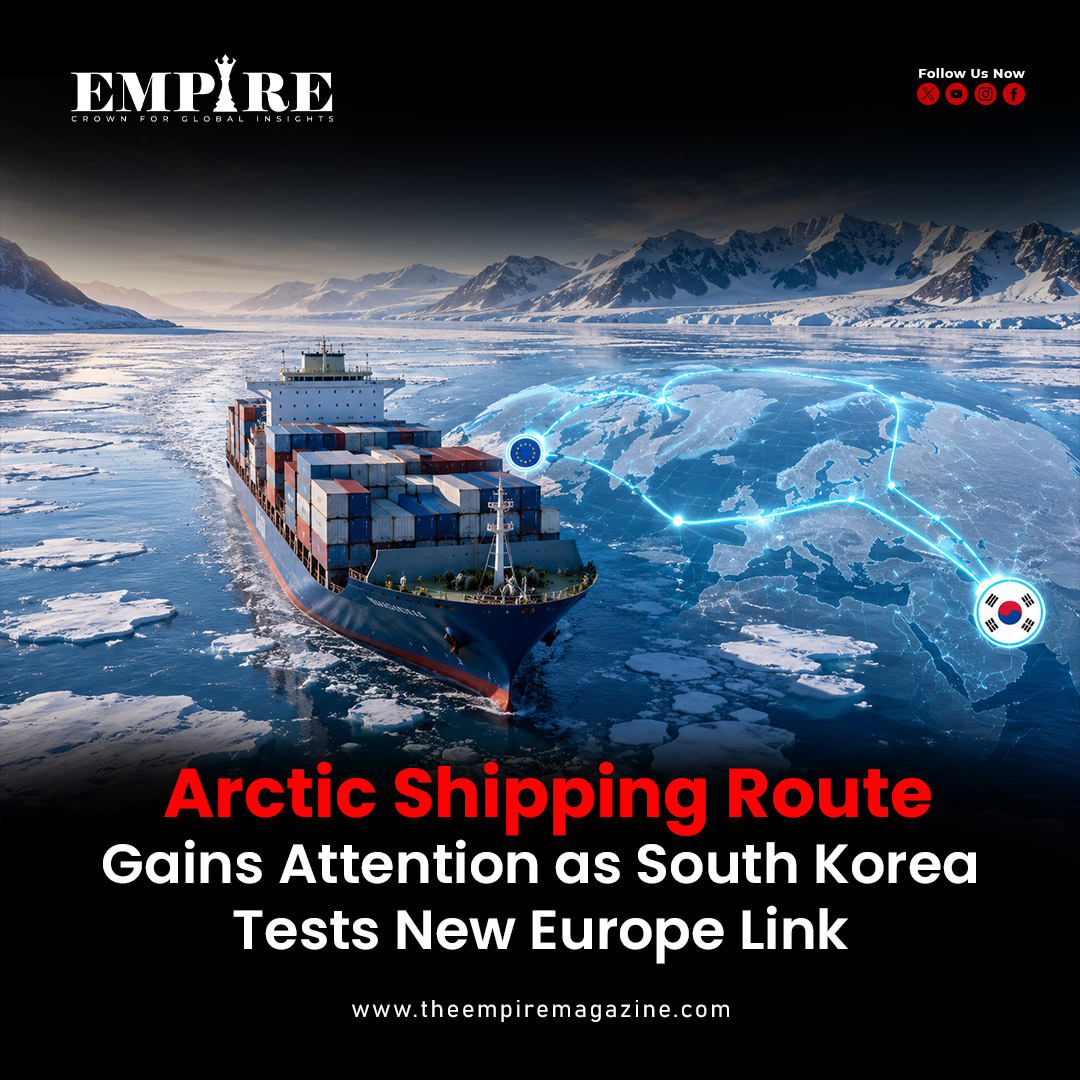
South Korea is testing an Arctic shipping route connecting Busan with Europe through the Northern Sea Route. The trial voyage is scheduled to begin on August 22, 2026, as Seoul explores a shorter Asia-Europe trade corridor and aims to establish a regular Arctic shipping service by 2030.
South Korea’s Arctic Shipping Route Trial
The Arctic Shipping Route is moving from long-term possibility to a real commercial experiment as South Korea prepares to send a container ship from Busan toward Europe through the Arctic. The first Korean trial voyage is scheduled to depart Busan on August 22, 2026, marking a significant step in Seoul’s effort to develop a new Asia-Europe maritime corridor. PanStar has been preparing the voyage with government and industry support, while its official materials now promote an Arctic route connecting Europe with Korea, China and Japan through Busan.
The development is significant because the Arctic has traditionally been viewed as a difficult and highly seasonal maritime environment rather than a mainstream trade corridor. Yet changing ice conditions, pressure on established shipping lanes and growing interest in faster supply chains are altering that calculation. South Korea’s government has already set a broader objective of establishing a regular Korea-Europe Arctic shipping service by 2030.
Why the Arctic Shipping Route Matters
The attraction of the Arctic Shipping Route is straightforward: geography can offer a shorter connection between Northeast Asia and Northern Europe than traditional southern routes. The Northern Sea Route follows Russia’s Arctic coastline, linking the Pacific and Atlantic sides of Eurasia. Recent commercial experiments have demonstrated how much transit time can potentially be saved when vessels navigate the Arctic during suitable seasonal conditions.
For South Korea, the opportunity is larger than simply reducing sailing days. The country is one of the world’s leading shipbuilding and trading economies, while Busan is already a major global port. A successful Arctic corridor could therefore strengthen Korea’s position in international logistics while giving European and Asian businesses another option for moving goods. It also reflects a wider shift in global trade: companies increasingly value alternative routes that can reduce exposure to congestion, geopolitical disruption and unpredictable freight costs.
Busan Emerges as an Arctic Shipping Hub
The South Korea Arctic shipping route is closely connected to Seoul’s ambition to transform Busan and the surrounding southeastern region into a maritime powerhouse. The Ministry of Oceans and Fisheries has identified the Arctic route as one of the pillars of its broader plan for developing a southern maritime capital, alongside logistics, manufacturing, energy and artificial intelligence capabilities.
Busan’s location gives the project a natural starting point. Instead of treating the Arctic as an isolated shipping experiment, South Korea wants to integrate it into a wider logistics network connecting ports, manufacturers and supply chains. The government is also studying how logistics networks could connect the Arctic corridor with Northern European ports. That suggests the ambition goes beyond a single voyage: Seoul is exploring whether the Arctic can eventually become part of a dependable commercial system.
Arctic Shipping Route Could Cut Travel Time
One of the strongest arguments for the Arctic trade route is speed. South Korean and industry reports indicate that an Arctic voyage could substantially reduce the distance and transit time compared with established routes through the Suez Canal. A Korean container ship’s planned trial is expected to demonstrate whether these theoretical advantages can translate into practical commercial performance.
The potential savings could matter enormously for time-sensitive cargo. Faster transportation can reduce inventory costs, improve supply-chain responsiveness and make certain Asian-European trade flows more competitive. However, speed alone will not determine the route’s future. Shipping companies must also consider insurance, ice conditions, port infrastructure, vessel specifications, permits and the availability of support services. The trial is therefore important precisely because it will test the complete logistics equation rather than simply the sailing distance.
Russia Remains Central to the Route
The Northern Sea Route presents South Korea with a complicated geopolitical reality. Much of the commercially navigable corridor runs through waters and infrastructure under Russian jurisdiction, meaning international vessels require Russian permissions and, in certain circumstances, access to icebreaker support. South Korea has acknowledged the need for consultations with Moscow as part of its Arctic shipping preparations.
This dependence creates a major question for the future of the route. European governments and other Western countries have imposed extensive sanctions on Russia following the war in Ukraine, making any trade corridor involving Russian infrastructure politically sensitive. Recent reporting on South Korea’s planned voyage has highlighted precisely this tension. The economic attraction of a shorter route exists alongside the diplomatic and regulatory complications of operating through Russian-controlled waters.
Climate Change Is Reshaping Arctic Shipping
The rise of Arctic shipping 2026 is inseparable from one of the defining transformations of the planet: the rapid warming of the Arctic. Declining sea ice has increased the seasonal accessibility of waters that were once considerably more difficult for commercial vessels to navigate. This does not mean the Arctic has suddenly become an ordinary shipping environment, but it has changed the economic conversation around the region.
There is an uncomfortable contradiction at the heart of the Arctic shipping story. The same climate change that is making parts of the route more accessible is also damaging the Arctic ecosystem. Greater maritime activity can bring risks from fuel spills, underwater noise, emissions and accidents in an environment where emergency response is particularly challenging. The commercial opening of the Arctic therefore raises a fundamental question: how can a route created partly by environmental change be developed without accelerating further environmental damage?
The Economic Opportunity for South Korea
For South Korea, the Arctic Shipping Route represents an opportunity to combine several existing national strengths. The country has world-class shipbuilders, major container ports, advanced logistics companies and a powerful export-oriented industrial base. Developing vessels and infrastructure capable of operating in polar conditions could create additional demand for specialised maritime technology and engineering.
The Korean government is also planning to expand its national icebreaker capabilities, train polar specialists and develop environmentally friendly fuel infrastructure as part of its longer-term Arctic strategy. These investments indicate that Seoul views the route as an industrial project rather than merely a transportation experiment.
If successful, Busan could become an important gateway between Asian manufacturers and Northern European markets. PanStar itself describes its Arctic service as a network connecting Europe with Korea, China and Japan through Busan, illustrating how the route could eventually serve a broader regional market.
Environmental and Safety Concerns
The promise of the Arctic Shipping Route comes with significant risks. Ships operating in polar waters face ice, extreme weather, limited search-and-rescue infrastructure and longer emergency-response distances. Even when seasonal ice conditions improve, Arctic navigation cannot simply be treated as equivalent to sailing through established commercial corridors.
Environmental concerns are equally serious. The Arctic ecosystem is particularly vulnerable to pollution, while an accident involving fuel or cargo could be difficult to contain because of the remoteness and harsh conditions. The expansion of Arctic shipping also raises concerns about black carbon and other emissions that can have disproportionate effects on snow and ice. For South Korea and other countries entering the route, commercial success will therefore depend on whether safety and environmental standards can keep pace with the ambition to increase traffic.
Arctic Shipping Route and Global Trade
The growing attention around the Arctic Shipping Route reflects a much larger transformation in global logistics. Shipping companies are increasingly looking for alternatives as geopolitical tensions, regional conflicts and disruptions expose the vulnerabilities of traditional maritime corridors. The Suez Canal remains a vital artery, but recent disruptions have demonstrated how quickly global supply chains can be affected when a major route becomes more expensive or unreliable.
China has already moved aggressively into Arctic commercial shipping, with a regular cargo service through the Northern Sea Route launched in 2026. Japan, South Korea and other Asian economies are also watching the corridor closely.
South Korea’s trial therefore carries significance beyond its own trade. It could help determine whether the Arctic becomes a competitive shipping corridor shared by multiple Asian economies or remains a limited seasonal route dominated by a small number of operators.
What Comes Next for the Arctic Route
The August 22 trial will not determine the future of the Arctic Shipping Route by itself, but it could provide valuable evidence about what commercial Arctic navigation actually requires. South Korea is targeting a regular Korea-Europe route by 2030, and its government has commissioned research into the commercial viability of such a system, including feedback from shipping companies and logistics firms.
The real test will be consistency. A successful Arctic corridor must deliver more than a shorter theoretical journey. It must offer predictable schedules, manageable insurance costs, dependable navigation support, suitable vessels, regulatory clarity and strong environmental safeguards. If those pieces come together, the Arctic could evolve from a seasonal frontier into an important component of global trade.
South Korea’s experiment is therefore worth watching closely. The voyage from Busan is not simply another shipping trial; it is a test of whether climate-driven geographical change, maritime technology and shifting global trade patterns can combine to create a new commercial route between Asia and Europe. The Arctic Shipping Route may still have many obstacles ahead, but South Korea’s decision to test it marks a clear sign that the world’s northern waters are becoming part of the next chapter in global logistics.
Previous article: https://theempiremagazine.com/coal-india/
Magazine Feautures | Podcasts: Empire Global Talks
Follow The Empire Magazine on Facebook | Instagram | LinkedIn | YouTube
The Empire Magazine | Crown for Global Insights