Oracle Cuts 21,000 Jobs as It Embraces AI | Tech Industry Analysis. Oracle cuts 21,000 jobs as it embraces AI, marking one of the biggest workforce restructurings in tech. Explore what the layoffs mean for employees, AI adoption, and the future of work.
Oracle cuts 21,000 jobs as it embraces AI
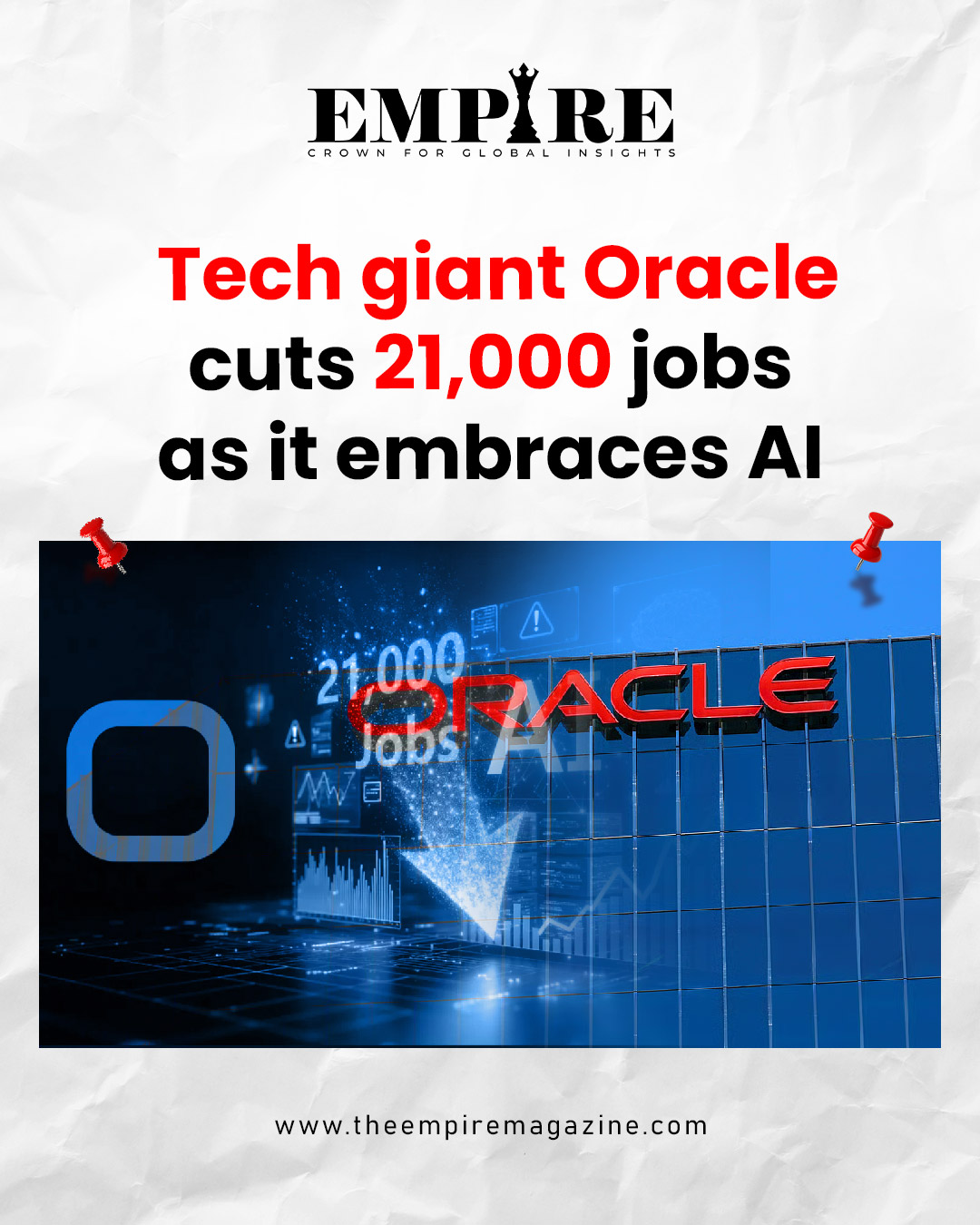
Oracle cuts 21,000 jobs as it embraces AI, making one of the most significant workforce reductions in the global technology industry this year. The software and cloud computing giant revealed in its latest annual regulatory filing that its global workforce declined from approximately 162,000 employees in 2025 to around 141,000 employees by the end of May 2026 a reduction of nearly 13%.
Unlike many technology companies that vaguely attribute layoffs to “business restructuring,” Oracle explicitly acknowledged that the deployment of artificial intelligence across its operations has contributed to workforce reductions, while also cautioning investors that additional job cuts may occur as AI adoption continues.
The announcement comes at a time when Oracle is aggressively investing billions of dollars in AI infrastructure, cloud computing, and large-scale data centers to compete with industry leaders such as Microsoft, Amazon Web Services, and Google Cloud. While these investments strengthen Oracle’s long-term AI ambitions, they also raise important questions about how artificial intelligence is reshaping employment across the technology sector.
Oracle Cuts 21,000 Jobs as It Embraces AI Amid Massive Business Restructuring
Oracle’s latest annual filing paints a clear picture of the company’s strategic transformation.
The company disclosed that its workforce stood at approximately 141,000 full-time employees as of May 31, 2026, compared with about 162,000 employees one year earlier, representing a reduction of roughly 21,000 positions worldwide. The filing further states that the company’s adoption and deployment of AI technologies “have resulted, and may continue to result, in reductions to our workforce.”
Importantly, Oracle did not attribute the layoffs solely to automation. The filing also references organizational restructuring, strategic realignment, acquisitions, product changes, and performance management as contributing factors. Nevertheless, AI remains one of the most prominent reasons officially cited by the company. The restructuring has not come cheaply.
Oracle recorded approximately $1.84 billion in severance payments and restructuring costs during fiscal 2026; almost five times higher than the previous year’s restructuring expenses. These figures highlight the scale of Oracle’s internal transformation as it reallocates resources toward AI-driven growth initiatives.
The company has simultaneously expanded hiring in high-priority AI engineering, cloud infrastructure, and data center operations, indicating that Oracle is not simply reducing headcount but reshaping the types of talent it requires for future growth.
Oracle’s Multi-Billion-Dollar AI Strategy Is Reshaping the Company
The workforce reduction comes alongside one of Oracle’s largest investment cycles in its history.
As enterprise customers increasingly demand AI-powered cloud infrastructure, Oracle has committed tens of billions of dollars toward expanding its global data center footprint. The company expects capital expenditures to rise dramatically as it builds AI computing capacity capable of supporting large language models, enterprise AI applications, and next-generation cloud services.
Oracle has secured several high-profile AI partnerships, including agreements involving OpenAI and Meta, positioning itself as a major provider of AI computing infrastructure. These partnerships require enormous investments in advanced GPUs, networking equipment, energy infrastructure, and hyperscale data centers.
However, unlike some competitors with stronger free cash flow, Oracle is financing much of this expansion through debt and equity while simultaneously reducing operating costs across the organization. Analysts view the workforce restructuring as part of a broader effort to redirect capital toward AI infrastructure rather than traditional enterprise software operations.
This reflects a growing trend across Silicon Valley, where companies are prioritizing AI investments even if doing so requires substantial organizational restructuring.
AI Is Transforming Jobs Across the Technology Industry
Oracle is far from the only technology company restructuring around artificial intelligence. Major technology firms, including Meta, Amazon, Microsoft, and Google, have all announced organizational changes, layoffs, or hiring freezes while simultaneously increasing investments in AI research and infrastructure. Industry trackers estimate that well over 100,000 technology jobs have been eliminated across multiple companies during the past year as businesses accelerate automation and AI deployment.
The nature of work itself is changing. Routine administrative functions, documentation tasks, customer support workflows, software testing, and certain coding responsibilities are increasingly being supported or partially automated through generative AI tools.
At the same time, companies continue hiring specialists in machine learning, AI infrastructure, cybersecurity, semiconductor engineering, cloud architecture, and data science.
This shift illustrates that AI is not simply eliminating jobs; it is fundamentally changing workforce composition. Demand is declining for some traditional operational roles while expanding rapidly for highly specialized AI-related positions.
Economic researchers increasingly describe this transition as a workforce redesign rather than simple automation, with organizations reorganizing both job structures and required skill sets.
Layoffs at Oracle Mean for Employees, Businesses, and Investors
For employees, Oracle’s announcement reinforces a growing reality across the technology industry: adaptability is becoming one of the most valuable professional skills.
Professionals with expertise in AI implementation, cloud computing, cybersecurity, enterprise architecture, and data engineering are likely to experience increasing demand, while repetitive knowledge-based tasks may continue to face automation pressure.
For enterprise customers, Oracle’s strategy demonstrates its determination to compete aggressively in the AI infrastructure market. Organizations relying on Oracle Cloud Infrastructure (OCI) can expect greater investments in AI services, faster computing capabilities, and expanded enterprise AI offerings over the coming years.
Investors, however, remain divided. While Oracle continues reporting strong revenue growth and a rapidly expanding AI business, concerns remain regarding the enormous capital expenditure required to compete with larger cloud providers. Building AI infrastructure requires billions of dollars in continuous investment, and markets will closely monitor whether Oracle can translate these investments into sustained profitability.
The company’s disclosure that additional workforce reductions may occur if AI deployment expands further also signals that organizational transformation is likely to continue rather than conclude with the current restructuring.
The Bigger Picture at Oracle: AI Is Changing the Economics of Work
The news that Oracle cuts 21,000 jobs as it embraces AI extends beyond a single company.
It represents one of the clearest acknowledgments from a major global technology firm that artificial intelligence is directly influencing employment decisions.
While AI promises significant productivity improvements, faster software development, smarter enterprise operations, and lower operating costs, it also raises complex questions about workforce displacement, employee reskilling, and long-term labor market stability.
Governments, businesses, and educational institutions will increasingly need to collaborate on preparing workers for an AI-driven economy. Upskilling, lifelong learning, and digital literacy are likely to become essential rather than optional as automation continues expanding across industries.
For Oracle, the restructuring reflects an ambitious bet that AI infrastructure will define the next era of enterprise technology.
For the broader technology sector, it serves as a powerful reminder that the AI revolution is no longer a future possibility it is actively reshaping business models, investment priorities, and employment worldwide.
As artificial intelligence becomes embedded into every layer of enterprise operations, the companies that successfully balance innovation with workforce transformation may emerge as the defining technology leaders of the next decade.
For more business and retail insights, read more on The Empire Magazine
Previous article: https://theempiremagazine.com/next-gen-radar-system-ai/
Magazine Feautures | Podcasts: Empire Global Talks
Follow The Empire Magazine on Facebook | Instagram | LinkedIn
The Empire Magazine | Crown for Global Insights