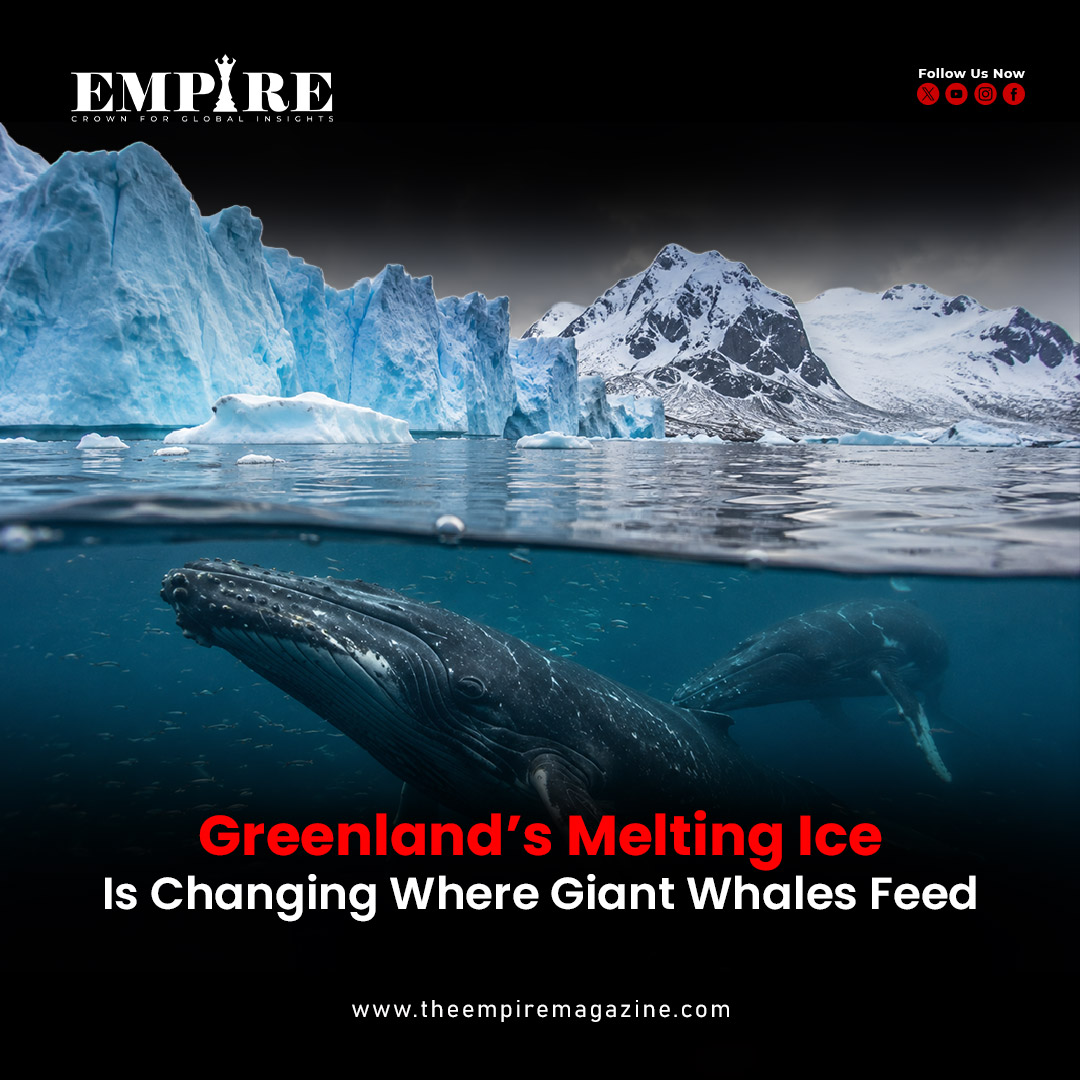
Greenland’s melting ice is reshaping whale feeding grounds as warmer seas and less sea ice bring humpback, fin and minke whales into East Greenland. Greenland’s melting ice is changing whale feeding grounds by reducing summer sea ice and warming coastal waters. A 2026 study found that humpback, fin and minke whales are now feeding regularly along East Greenland, where changing ocean conditions have opened access to capelin and krill-rich waters.
Greenland’s Melting Ice Is Reshaping the Whales Habitat
Greenland is often pictured as a vast world of glaciers, icebergs and frozen seas. But beneath that familiar image, the Arctic marine ecosystem is changing rapidly. Greenland’s melting ice is not only altering coastlines and sea-ice patterns; it is also changing where some of the world’s largest whales can find food.
A new study published in Frontiers in Marine Science has documented a striking transformation along the East Greenland coast. Fin whales, humpback whales and minke whales are now regularly feeding in coastal waters where these species were historically uncommon. Researchers say warmer sea temperatures and declining summer sea ice have helped create conditions that allow these whales to exploit newly available feeding opportunities.
The findings offer a powerful reminder that climate change does not affect one part of nature in isolation. When ice retreats, ocean temperatures change, fish move and predators follow. The result is an Arctic ecosystem that is becoming increasingly different from the one scientists and local communities knew for generations.
Whale Feeding Grounds Are Moving North
For giant baleen whales, survival depends heavily on finding dense concentrations of small prey. Humpback and fin whales can travel enormous distances, but their movements are closely linked to areas where fish and krill become concentrated.
The latest research suggests that East Greenland is becoming one such destination. Systematic surveys conducted in 2015 and 2024 estimated roughly 4,000 humpback whales, 6,000 fin whales and 4,500 minke whales in the region. Researchers found that these species were feeding as far north as 70°N and potentially farther.
That represents a significant ecological change. Historically, these more temperate or boreal whale species were only rarely observed feeding along coastal East Greenland.
Scientists describe this process as a form of “borealization” — essentially, warmer-water species are expanding into Arctic environments as physical conditions change. The whales are not necessarily moving simply because temperatures are warmer. They are responding to the animals and food resources that are moving with those changing conditions.
Warmer Seas Are Bringing More Whales
One of the most important findings concerns the relationship between ocean temperature, sea ice and whale distribution. Researchers found a clear shift in East Greenland sea-surface temperatures beginning in the late 1990s, followed by an increase of about 1°C. At the same time, the summer sea-ice regime changed significantly after 2000, reducing pack ice along the coast.
For whales that need open water to feed, this matters enormously. Less sea ice can make previously difficult or inaccessible coastal areas easier to reach. But the bigger story is what happens underneath the surface.
Warmer waters can influence the distribution of fish such as capelin, while changing ocean conditions can also alter the availability of krill and other prey. As these resources shift, predators capable of travelling long distances can follow them.
This helps explain why East Greenland is seeing more frequent feeding activity from large baleen whales. The whales are responding to a changing marine landscape rather than simply responding to temperature alone.
Why Capelin and Krill Matter; food chain beneath the whales
To understand why Greenland’s melting ice could influence whale feeding grounds, it is important to look at the food chain beneath the whales.
Capelin are small schooling fish that play an outsized role in northern marine ecosystems. They provide food for whales, seals, seabirds and larger fish. Krill are similarly important because they transfer energy from microscopic marine life to some of the largest animals on Earth.
Researchers found capelin in the stomach contents of minke whales in East Greenland and believe that both humpback and fin whales are also feeding on capelin and krill in the region. Recent observations further suggest that capelin have shifted their summer distribution from Icelandic waters toward East Greenland.
That movement creates a chain reaction. When prey becomes abundant in a new area, predators can quickly respond. For migratory whales, a productive feeding ground can become valuable enough to change seasonal movements.
The result is an Arctic ecosystem where the map of food is being redrawn — and the whales are following it.
Greenland’s Melting Ice Is Changing the Food Chain for Whales
The most important message from the research is that Greenland’s melting ice is not simply a story about disappearing white landscapes. It is also a story about ecological connections.
Sea ice influences sunlight, water mixing and the seasonal productivity of Arctic seas. When ice retreats, the timing and location of biological activity can change. Phytoplankton respond to available light and nutrients, zooplankton feed on them, fish feed on smaller organisms and whales eventually respond to concentrations of those fish and zooplankton.
This makes whales useful indicators of broader environmental change.
Earlier research has shown that Greenland’s whales already depend strongly on the seasonal relationship between sea ice, open water and prey. In West Greenland, for example, satellite-tracking research found that bowhead and humpback whales divide their use of Disko Bay according to seasonal changes in prey and ice conditions.
New research on narwhals in Northwest Greenland has also found that their activity is closely linked to sea-ice stages, with particularly high activity during partial ice cover. Scientists warn that continued sea-ice loss could alter narwhal movements and habitat use.
What the Shift Means for Arctic Wildlife
At first glance, more whales in East Greenland might sound like positive news. More animals arriving at a feeding ground can suggest that the ecosystem is becoming productive. But scientists caution against viewing every climate-driven range expansion as a conservation success.
The 2026 East Greenland study estimates that humpback, fin and minke whales collectively consume around 1 million tonnes of prey during their roughly four-month seasonal residency. Much of that consumption may involve capelin and krill.
That level of predation can influence relationships throughout the food web.
If whale numbers continue to increase while capelin and other prey remain abundant, the region could become an increasingly important feeding area. But if warming eventually reduces prey productivity, the same whales could face greater competition for food.
The changing distribution of whales may also affect fisheries, seabirds and other marine predators that depend on the same fish. What appears to be a simple shift in whale migration could therefore become part of a much larger transformation of Arctic marine life.
A Warning Beyond the Whales
The story of East Greenland is important because it shows how quickly Arctic ecosystems can respond to environmental change.
A reduction in sea ice can open new waters. Warmer seas can influence fish distribution. Fish movements can attract whales. Increased whale feeding can affect prey populations. Each change can trigger another.
Scientists studying Greenland have already documented how whales use glacier fronts, fjords and sea-ice edges as important habitats. Research on narwhals in West Greenland found that reduced summer fast ice and later autumn freeze-up likely contributed to increased use of glacial habitats.
This makes climate change in Greenland far more than a question of melting glaciers. It is a transformation of an interconnected marine system.
For communities that depend on Arctic waters, these changes may have practical consequences as well. Shifting fish distributions can affect fishing opportunities, while changing whale movements can influence monitoring, conservation and local knowledge.
The Future of Greenland’s Whales
The future of Greenland whale feeding grounds will depend on how quickly Arctic temperatures, sea ice and ocean circulation continue to change.
The recent East Greenland findings do not mean that every whale population will benefit from warming. Some species may gain temporary access to new habitats, while others could lose the ice conditions they depend upon. Narwhals, bowhead whales and belugas are particularly tied to Arctic environments where sea ice remains an important part of their seasonal ecology.
For humpback, fin and minke whales, the opening of East Greenland waters could represent an expanding seasonal opportunity. But that opportunity is ultimately dependent on prey.
If capelin and krill remain plentiful, East Greenland could become an increasingly significant feeding destination. If the underlying food web changes again, whales may have to move once more.
That uncertainty is precisely why long-term surveys matter.
Lessons From a Changing Arctic
Greenland’s whales are offering scientists a view into a rapidly changing Arctic. Their movements show that climate change is not happening only on land or at the edge of glaciers. It is also reshaping the invisible pathways that connect microscopic organisms, fish and marine giants.
The latest research shows that East Greenland has experienced warmer sea temperatures, reduced summer pack ice and a growing presence of baleen whales. Researchers estimate thousands of humpback, fin and minke whales now use the region, feeding on resources that have become more accessible as the marine environment changes.
The story is both fascinating and unsettling.
Whales are adaptable. They can travel thousands of kilometres in search of food and respond quickly when productive waters appear. But their adaptability does not make them immune to climate change.
Greenland’s melting ice is changing where giant whales feed because the Arctic food web itself is moving. And as the ice continues to retreat, the next question is not simply where the whales will go, but whether the food they follow will still be there.
Previous article: https://theempiremagazine.com/ebola-africa/
Magazine Feautures | Podcasts: Empire Global Talks
Follow The Empire Magazine on Facebook | Instagram | LinkedIn | YouTube
The Empire Magazine | Crown for Global Insights