South Korea: A Defining Political Moment
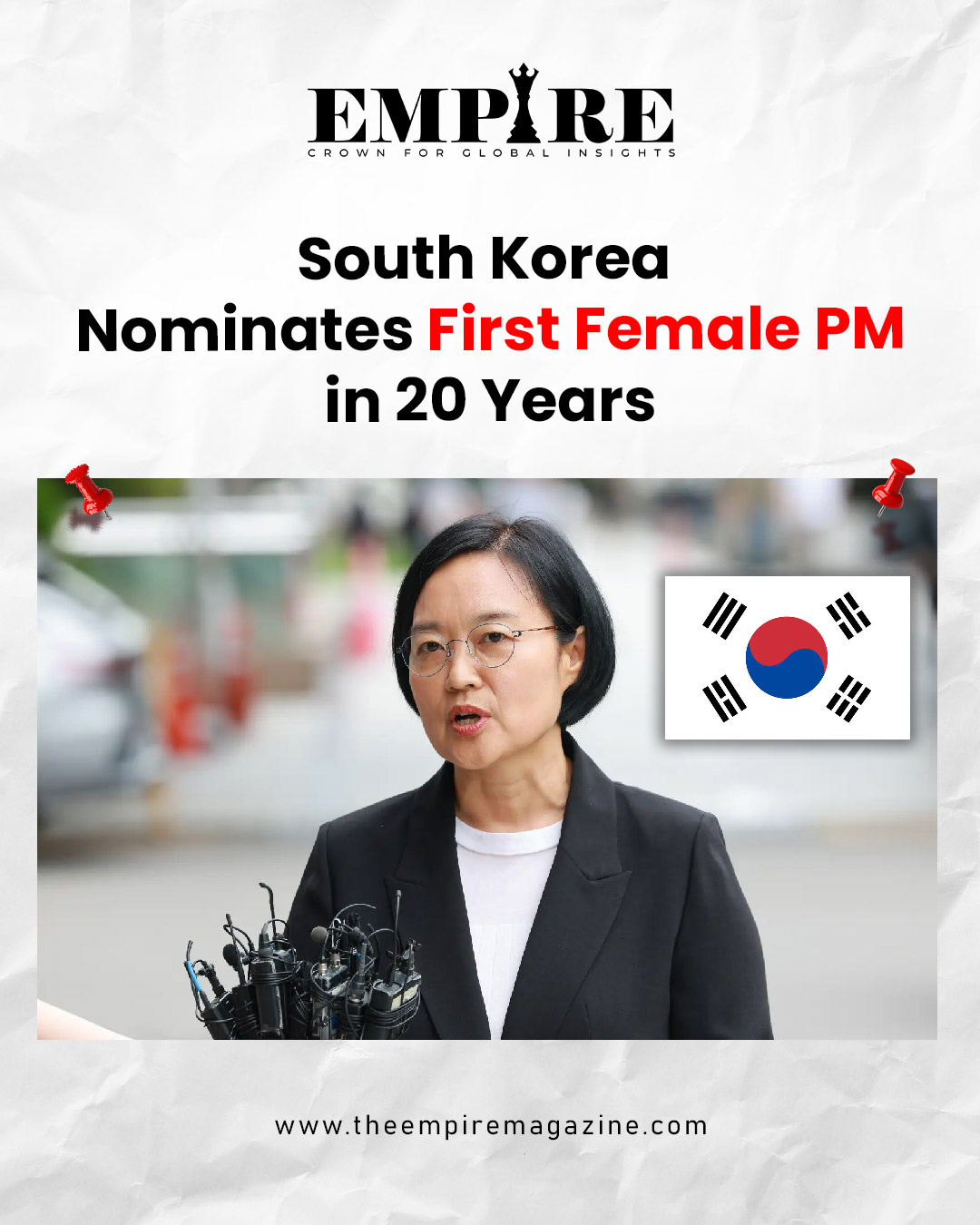
South Korea has entered a historic phase in its political journey with the nomination of Han Seong-sook as the country’s next Prime Minister, marking the first time in nearly 20 years that a woman has been chosen for this powerful executive position. If confirmed by the National Assembly, she will become only the second woman in South Korea’s history to hold the office, following Han Myeong-sook’s brief tenure in the mid-2000s. This nomination, announced by President Lee Jae Myung’s office, is being viewed as a landmark moment that reflects both political evolution and a shifting societal expectation around leadership representation in one of Asia’s most influential democracies.
Beyond symbolism, the decision also reflects South Korea’s broader ambition to align governance with technological transformation and global economic competitiveness. At a time when artificial intelligence, digital infrastructure, and startup ecosystems are reshaping global power structures, the appointment of a leader with deep industry experience signals a deliberate attempt to merge policy with innovation-driven thinking. The announcement has therefore sparked widespread attention not only within South Korea but across global political and business communities, as it represents a convergence of gender progress and strategic governance reform in a rapidly changing world.
Breaking a 20-Year Barrier in Leadership in South Korea
The nomination of a female Prime Minister after two decades highlights a significant gap in South Korea’s political representation at the highest levels. While the country has made gradual progress in increasing women’s participation in parliament, bureaucracy, and corporate leadership, top executive positions have remained largely male-dominated. The last and only woman to serve as Prime Minister, Han Myeong-sook, held office from 2006 to 2007, and since then, no female candidate had reached this level of national leadership, making this nomination historically significant.
This move is widely interpreted as part of a broader political recalibration aimed at modernizing governance structures and responding to increasing public demand for diversity in leadership. South Korea, despite being one of the world’s most advanced economies, has often faced criticism for gender inequality in senior decision-making roles. By elevating a woman to the Prime Ministerial nomination, the administration appears to be addressing both domestic expectations and international scrutiny regarding inclusive governance. However, the real test lies not in the nomination itself but in how effectively such representation translates into policy influence and structural change within government institutions.
Han Seong-sook: From Tech Leader to Political Figure in South Korea
Han Seong-sook’s journey to the nomination reflects a rare transition from corporate leadership to national politics. She is widely known for her tenure as the CEO of Naver, one of South Korea’s most influential technology companies, where she played a pivotal role in expanding the country’s digital ecosystem and strengthening its global tech competitiveness. Her leadership in the private sector earned her a reputation as a forward-thinking strategist with a strong understanding of innovation-driven growth and digital transformation.
Currently serving as the Minister for Small and Medium Enterprises and Startups, Han has been actively involved in strengthening South Korea’s entrepreneurial ecosystem. Her policies have focused on improving access to funding for startups, supporting small businesses, and integrating technology into traditional industries to boost productivity. This blend of corporate and public sector experience has positioned her as a technocrat capable of bridging the gap between innovation and governance. Her nomination reflects a growing global trend where governments increasingly turn to industry leaders to manage complex economic transitions driven by technology and globalization. Supporters argue that her expertise in digital transformation could be instrumental in guiding South Korea through the next phase of economic restructuring.
A New Direction for South Korea’s Economy and Governance
The significance of Han Seong-sook’s nomination extends well beyond gender representation, as it signals a potential shift in South Korea’s governance model toward innovation-led policymaking. The country is currently navigating a critical phase of economic transformation, where traditional manufacturing strength is being complemented and in some areas challenged by rapid advancements in artificial intelligence, robotics, and digital services. In this context, a leader with deep technological expertise is seen as strategically valuable for shaping future national priorities.
Her appointment is expected to influence key policy areas such as startup ecosystem expansion, digital infrastructure development, and AI-driven economic planning. South Korea is already positioning itself as a global leader in next-generation technologies, and leadership that understands both the private sector and regulatory frameworks is seen as essential for maintaining competitiveness. At the same time, there is growing emphasis on inclusive economic growth, particularly in supporting small and medium enterprises that form the backbone of the country’s economy. Han’s background in SME policy is therefore viewed as a critical advantage in balancing innovation with economic inclusivity, ensuring that technological progress does not widen existing structural inequalities.
Reactions, Challenges, and What Comes Next in South Korea
The political response to Han Seong-sook’s nomination has been mixed but largely constructive, with ruling party members praising her leadership credentials and opposition leaders calling for careful parliamentary scrutiny. While many view the nomination as a progressive step forward, it still requires approval from the National Assembly, where debates are expected to focus on her administrative experience, policy direction, and ability to manage national-level political complexities. Despite these discussions, analysts suggest that her confirmation is likely, given the current political alignment, although the process may still involve rigorous questioning and negotiation.
Public reaction has also been notable, with many citizens expressing optimism about the symbolic and practical implications of her appointment. However, there are also expectations that she will deliver tangible results beyond representation, particularly in areas such as job creation, economic stability, and technological competitiveness. The challenges ahead are substantial, as South Korea continues to navigate global economic uncertainty, demographic shifts, and regional geopolitical tensions. If confirmed, Han will assume office at a time when leadership demands both strategic vision and operational efficiency, making her tenure a closely watched period in the country’s political landscape.
A Defining Moment for Leadership in South Korea
Han Seong-sook’s nomination as South Korea’s Prime Minister represents more than a political appointment; it reflects a broader transformation in how leadership is being redefined in the 21st century. It brings together themes of gender inclusion, technological governance, and economic modernization at a time when nations worldwide are grappling with rapid structural change. Her background in technology and entrepreneurship positions her uniquely to address the challenges of a digital-first economy, while her nomination itself sends a strong message about evolving political norms in South Korea.
As the National Assembly prepares to deliberate on her confirmation, the country stands at a crossroads between tradition and transformation. Regardless of the final outcome, this moment has already reshaped national discourse around leadership, representation, and the future direction of governance. If confirmed, Han Seong-sook’s tenure could mark the beginning of a new era in which South Korea not only embraces diversity in leadership but also strengthens its position as a global innovator in technology and policy integration.
For more business and retail insights, read more on The Empire Magazine
Previous article: HCLTech’s AI Innovation Zone in Califronia
Magazine Feautures | Podcasts: Empire Global Talks
Follow The Empire Magazine on Facebook | Instagram | LinkedIn
The Empire Magazine | Crown for Global Insights