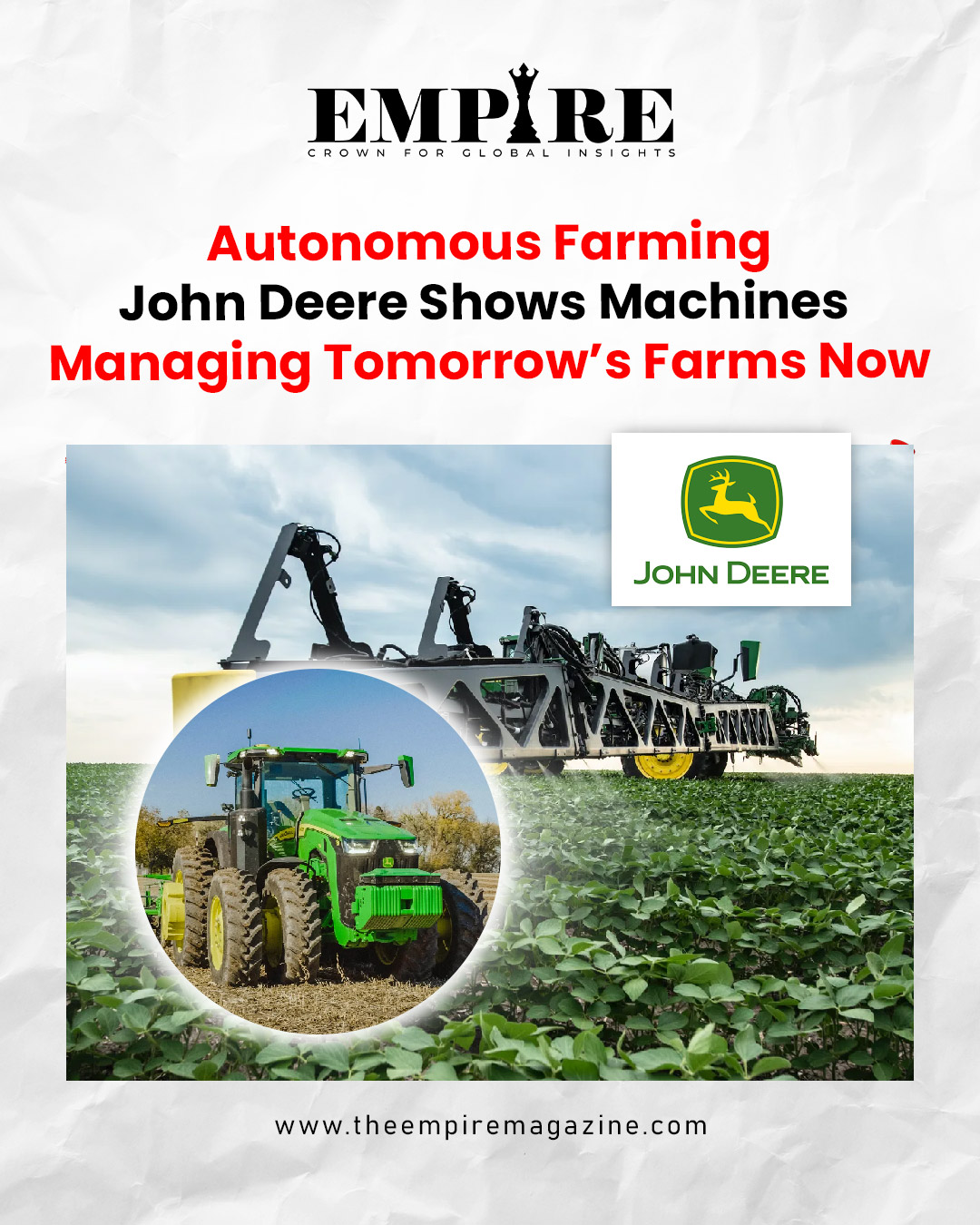
For decades, discussions around the future of farming have centred on bigger machinery, improved seeds and more efficient irrigation. Today, however, the conversation is shifting toward intelligence rather than size. Farms are increasingly becoming connected ecosystems where machines collect data, analyse field conditions and complete agricultural tasks with minimal human intervention.
That transition is becoming more visible through the latest advances from John Deere, one of the world’s largest agricultural equipment manufacturers. At recent technology demonstrations and product showcases, the company presented autonomous tractors, AI-powered sprayers and construction equipment capable of operating with limited human supervision. The announcement signals more than another machinery upgrade, it reflects how automation is steadily moving from research projects into commercial farming operations. Machines capable of perceiving their surroundings, making operational decisions and performing repetitive fieldwork are no longer concepts reserved for future farming. They are increasingly becoming part of today’s agricultural business.
The development comes at a time when farmers worldwide face growing pressure from labour shortages, rising operating costs, unpredictable weather patterns and the need to improve productivity while using fewer resources. Autonomous farming technologies are being positioned as one possible answer to these challenges.
Autonomous Farming Moves Beyond Experimental Technology
Agricultural automation has existed for years in the form of GPS guidance systems, automated steering and precision planting. What differentiates today’s autonomous machines is their ability to operate independently while continuously analysing real-time information collected from cameras, sensors and artificial intelligence systems. John Deere’s latest autonomous equipment expands this capability across multiple agricultural activities. Rather than simply following pre-programmed routes, these machines are designed to identify obstacles, monitor crop conditions and adapt operations according to changing field environments.
Modern autonomous tractors combine multiple technologies into one operating system. High-resolution cameras provide continuous visual awareness, while advanced computer vision algorithms interpret the surrounding environment. Machine learning models then determine whether the equipment should continue operating, stop or adjust its route.
For farmers, this means less time spent inside the tractor cab during long planting or tillage sessions. Instead, machinery can be monitored remotely through digital platforms while operators supervise several activities simultaneously. The result is not necessarily replacing farmers, but changing how agricultural work is managed.
AI Is Becoming the New Farm Operator
Artificial intelligence now plays a far greater role than simple navigation. New autonomous agricultural systems analyse millions of data points while operating across fields. Using computer vision, machines can distinguish between crops and weeds, identify obstacles and evaluate field conditions with remarkable accuracy. AI-powered sprayers, for example, can selectively apply herbicides only where weeds are detected rather than spraying entire fields uniformly.
This targeted approach reduces chemical usage while lowering operational expenses. It also supports broader sustainability goals as farms seek to minimise unnecessary pesticide applications. Beyond spraying, AI systems continue learning from every completed task. Operational data collected during planting, tillage and harvesting contributes to future decision-making, gradually improving machine performance over time. This shift reflects a broader trend across industries where artificial intelligence is becoming an operational assistant rather than simply an analytical tool.
Agriculture, traditionally viewed as labour-intensive, is increasingly joining sectors such as logistics, manufacturing and mining in adopting autonomous systems for repetitive, precision-based work.
Addressing Labour Shortages Through Automation
One of the strongest drivers behind autonomous farming is the growing shortage of skilled agricultural labour. Many farming regions continue experiencing ageing workforces alongside declining numbers of younger workers entering agriculture. Seasonal labour has also become increasingly difficult to secure in several countries, creating uncertainty during critical planting and harvesting periods.
Automation offers farmers additional flexibility. Instead of requiring operators to remain inside machinery throughout long working days, autonomous equipment allows supervision from nearby vehicles or remote management systems. One individual may eventually oversee multiple machines operating simultaneously across different parts of a farm.
This does not eliminate the need for skilled workers. Rather, the required skill set begins shifting toward equipment monitoring, software management, maintenance and data analysis. Agricultural employment itself is gradually evolving alongside technological advancement.
Precision Agriculture Becomes More Intelligent
Precision agriculture has been developing for years through GPS mapping, satellite imagery and yield monitoring. Autonomous farming extends those capabilities by allowing machines to respond instantly while operating. Rather than simply recording information for later analysis, autonomous equipment makes immediate decisions based on current field conditions.
If sensors identify uneven soil conditions, machinery can adjust operating parameters accordingly. If weather conditions begin changing, operational recommendations can be updated in real time. Advanced systems may also optimise planting depth, application rates or travel paths based on continuously collected environmental data. This real-time responsiveness improves resource efficiency while helping farmers maximise productivity from every hectare.
As digital agriculture platforms continue integrating weather forecasts, satellite imagery and machine-generated data, farms increasingly resemble connected technology networks rather than isolated production sites. The future of farming is therefore becoming less dependent on individual machines and more reliant on intelligent systems working together.
Why Autonomous Farming Makes Business Sense
For large agricultural operations, the appeal of autonomous machinery is increasingly financial rather than experimental. Farm equipment is expensive, and every hour of operation matters. Autonomous systems aim to improve equipment utilisation by allowing machines to work longer hours with fewer interruptions. In some cases, fieldwork can continue during nighttime conditions that would normally require additional labour planning.
More importantly, automation helps reduce inefficiencies that accumulate across thousands of acres. Precise application of seeds, fertilisers and crop protection products can lower input costs while improving consistency across fields.
John Deere has been investing heavily in connected agriculture platforms that combine machinery, software and field data into a single management system. This creates an ecosystem where planting, spraying, harvesting and equipment maintenance become increasingly coordinated through digital tools.
For agricultural businesses, the long-term value may come less from owning a self-driving tractor and more from gaining continuous visibility into every operational decision happening across the farm.
Sustainability Is Becoming a Competitive Advantage
Autonomous farming is also being promoted as a sustainability tool. Traditional agricultural practices often involve uniform application of chemicals across entire fields. AI-powered systems can identify exactly where treatment is needed, reducing unnecessary usage.
Targeted spraying, optimised fertiliser application and improved route planning can help reduce fuel consumption, chemical runoff and overall resource use. These improvements may become increasingly important as food companies, retailers and regulators place greater emphasis on sustainable supply chains.
Consumers are also paying closer attention to how food is produced. Farms that can demonstrate efficient resource management may gain advantages in certain markets, particularly where environmental reporting is becoming more common. While autonomous technology alone will not solve agriculture’s environmental challenges, it provides tools that can help farmers produce more with fewer inputs.
Challenges Still Stand in the Way of Large-Scale Adoption
Despite the momentum, fully autonomous farming is not yet becoming universal. The first challenge is cost. Advanced autonomous machinery represents a significant investment, making adoption easier for large commercial farms than for many smaller operations. Connectivity is another issue. Many rural areas still face limitations in broadband and mobile network coverage, which can affect cloud-based agricultural platforms.
Farm environments are also more unpredictable than factories or warehouses. Weather changes, uneven terrain, animals, debris and varying crop conditions create complex operating scenarios that autonomous systems must handle reliably. Farmers additionally need confidence that machines can operate safely around workers, livestock and other equipment. Building that trust will take time, field experience and clear safety standards.
As a result, the transition is likely to be gradual, with semi-autonomous and supervised-autonomous systems becoming common before fully independent farm operations become widespread.
The Race for Autonomous Agriculture Is Accelerating
John Deere is not alone in pursuing autonomous farming. Major agricultural equipment manufacturers, technology companies and agri-tech startups are all investing in robotics, AI-driven crop management and autonomous machinery. The competitive focus is increasingly shifting from simply building tractors to building intelligent agricultural platforms.
What makes John Deere notable is its scale. The company already has a large installed base of equipment operating across farms worldwide. That existing network gives it an advantage when introducing new software and autonomous capabilities.
Rather than asking farmers to adopt entirely new systems, the strategy increasingly involves adding intelligence to equipment many operators already use. This could accelerate adoption compared with technologies that require complete operational redesigns.
What Tomorrow’s Farms Could Look Like
The most realistic near-term vision is not a farm with no people. It is a farm where people supervise fleets of intelligent machines. Autonomous tractors may handle repetitive tillage work. AI-powered sprayers may target weeds individually. Harvesting equipment may optimise routes automatically. Drones and satellite systems may continuously monitor crop health and alert operators to emerging problems.
Farm managers could spend less time driving machinery and more time making strategic decisions based on real-time data. In this model, agriculture becomes increasingly similar to other technology-driven industries where human expertise focuses on oversight, planning and optimisation while machines handle routine execution.
The Future of Farming Is Becoming Increasingly Autonomous
John Deere’s latest autonomous farming demonstrations show that agricultural automation is moving beyond futuristic prototypes and into commercial reality. The technology is still evolving, and significant challenges remain around cost, connectivity and large-scale deployment. Yet the direction of travel is becoming difficult to ignore.
As farms face labour shortages, rising costs and pressure to improve sustainability, intelligent machines are becoming more attractive as operational partners rather than experimental gadgets.
The transformation will not happen overnight. But the evidence increasingly suggests that tomorrow’s farms will be managed by a combination of human judgment, artificial intelligence and autonomous machinery working together. And in many fields around the world, that future has already begun.
For more business and retail insights, read more on The Empire Magazine
Previous article: Cursor: Future of Coding Assistants
Magazine Feautures | Podcasts: Empire Global Talks
Follow The Empire Magazine on Facebook | Instagram | LinkedIn
The Empire Magazine | Crown for Global Insights