For years, stablecoins occupied a relatively narrow space within the cryptocurrency ecosystem. They served as digital assets that traders could move quickly between exchanges without converting funds back into traditional currencies. Outside crypto circles, they attracted limited attention from businesses.
That perception is changing.
Today, stablecoins are increasingly becoming part of a broader conversation about the future of payments. Financial technology companies, payment providers, banks, and even multinational corporations are beginning to explore how tokenized money can simplify transactions that have traditionally been slow, expensive, and fragmented.
The timing is significant. Businesses now operate across borders more than ever before, while customers expect payments to happen instantly regardless of geography. Traditional banking infrastructure, much of which was designed decades ago, often struggles to meet those expectations. Cross-border transfers can still take several days, involve multiple intermediaries, and generate substantial fees.
Stablecoins offer an alternative that combines the speed of blockchain networks with the relative price stability of traditional currencies. Instead of replacing existing financial systems overnight, they are gradually becoming another layer of payment infrastructure that businesses can use where it makes economic sense. For fintech companies, this represents more than a technological upgrade. It is an opportunity to redesign how money moves between businesses, suppliers, employees, and customers.
Stablecoins Are Moving Beyond Crypto Trading
A stablecoin is a digital token designed to maintain a stable value by being linked to an underlying asset, most commonly the U.S. dollar. Unlike cryptocurrencies known for dramatic price swings, stablecoins are intended to preserve purchasing power while retaining the advantages of blockchain technology.
Initially, their primary users were cryptocurrency traders seeking stability during volatile market conditions. Today, however, their utility is expanding into mainstream financial services.
Major payment companies, fintech startups, digital banks, and institutional investors increasingly see stablecoins as practical tools for transferring value rather than speculative assets. The shift reflects broader changes taking place across financial markets.
Businesses are becoming more comfortable with digital financial infrastructure. Cloud accounting, embedded finance, AI-driven treasury systems, and automated payment platforms have already modernized many financial operations. Stablecoins naturally fit within this digital transformation because they allow money itself to become programmable.
Instead of waiting for multiple banking systems to process transactions during business hours, companies can settle payments almost instantly through blockchain networks operating continuously. The result is not simply faster payments, it is greater flexibility in how businesses manage liquidity.
Why Businesses Are Looking at Tokenized Payments
The appeal of stablecoin payments extends well beyond technology. Finance departments are under increasing pressure to improve efficiency while reducing operational costs. Every international payment typically involves correspondent banks, currency conversion fees, settlement delays, and reconciliation processes that consume both time and resources.
Stablecoin transactions remove many of these intermediaries. When two businesses agree to transact using stablecoins, value can move directly across blockchain networks without requiring multiple financial institutions to process the payment. For companies operating global supply chains, the benefits can be meaningful.
Manufacturers paying overseas suppliers, digital platforms compensating international creators, and software companies serving customers worldwide all face similar challenges involving payment speed and transaction costs. Faster settlement also improves cash flow visibility. Rather than waiting several business days to confirm incoming payments, finance teams gain near real-time confirmation, allowing more accurate treasury planning and working capital management. As economic uncertainty continues to shape corporate decision-making, greater visibility into cash positions has become increasingly valuable.
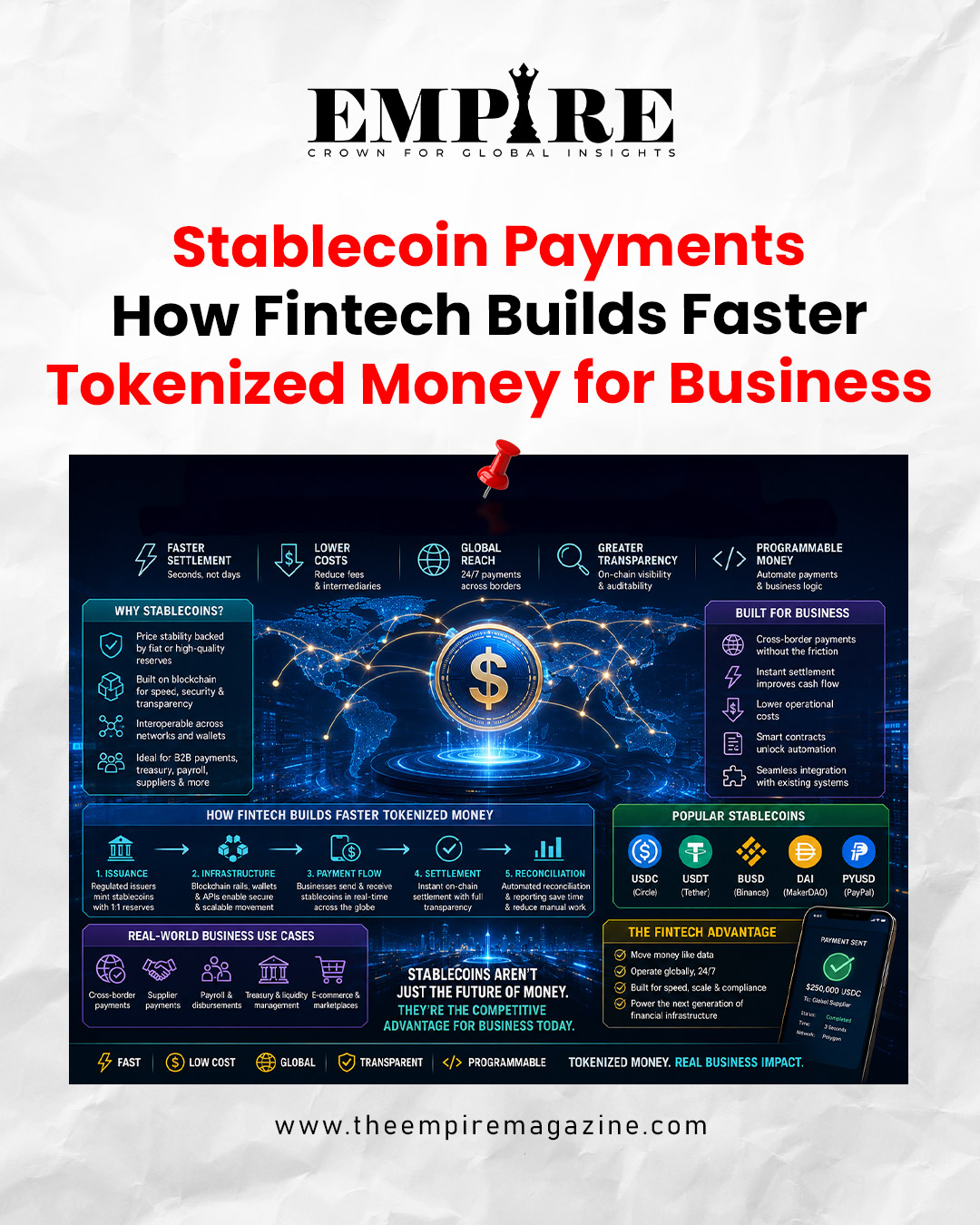
How Stablecoin Payments Actually Work
Despite the technical terminology surrounding blockchain, the payment experience itself is becoming increasingly straightforward.
A business holds approved stablecoins through a regulated digital wallet or payment platform. When making a payment, the sender transfers tokens directly to the recipient’s wallet using a supported blockchain network. Because blockchain transactions are verified through distributed networks rather than traditional banking systems, settlement often occurs within minutes. The recipient may choose to retain the stablecoins, convert them into local currency, or use them for subsequent business payments.
Increasingly, businesses are interacting with stablecoins without even realizing it. Many fintech platforms now integrate blockchain infrastructure behind familiar user interfaces. Customers continue using dashboards similar to online banking, while blockchain technology handles settlement in the background.
This abstraction is important. Historically, cryptocurrency adoption has been slowed by technical complexity. Modern fintech providers are attempting to hide that complexity entirely, allowing businesses to focus on payments rather than blockchain mechanics. The long-term objective is clear: companies should benefit from faster digital settlement without requiring blockchain expertise.
The Fintech Companies Driving Adoption
Much of the momentum behind stablecoin payments is coming from fintech firms rather than traditional financial institutions.
Unlike legacy banks, fintech companies typically operate with modern cloud-native infrastructure, making it easier to integrate blockchain payment capabilities into existing platforms. Several payment providers now allow merchants to accept stablecoin transactions while automatically converting funds into local currencies. Others focus on business-to-business settlements, payroll services, international contractor payments, or treasury management. Some startups are building entirely new financial infrastructure around programmable money.
Rather than treating payments as isolated transactions, they combine invoicing, compliance checks, identity verification, foreign exchange, accounting integration, and settlement into unified platforms. Artificial intelligence is increasingly becoming part of this ecosystem as well.
Machine learning systems help identify suspicious transactions, automate compliance screening, optimize payment routing, and improve liquidity forecasting. For finance teams, the combination of AI automation and blockchain settlement creates opportunities to streamline processes that have traditionally required significant manual oversight. The result is a more integrated approach to financial operations, where payment execution, reporting, and compliance increasingly occur within a single workflow.
Cross-Border Payments Become Faster and More Predictable
International payments remain one of the biggest inefficiencies in global commerce. While consumers have become accustomed to instant digital experiences, cross-border business payments often still depend on a chain of correspondent banks, each adding processing time, fees, and operational complexity.
A payment from one country to another may pass through several financial institutions before reaching its destination. Exchange rate spreads, intermediary charges, compliance checks, and banking holidays can all affect when funds finally arrive.
Stablecoins offer a different settlement model. Instead of routing payments through multiple banking networks, businesses can transfer tokenized dollars directly across blockchain infrastructure. Settlement can occur within minutes rather than days, regardless of the time zone or banking hours.
For exporters, importers, software providers, logistics companies, and global marketplaces, this speed has practical implications. Suppliers receive payments sooner, inventory cycles become easier to manage, and finance teams spend less time tracking pending transfers. The value is particularly noticeable for small and medium-sized enterprises. Large multinational corporations often have dedicated treasury teams capable of navigating international payment systems, but smaller businesses frequently lack those resources. Lower-cost digital settlement can help reduce barriers to participating in global trade.
That said, stablecoins are not eliminating traditional banking. Most businesses still need bank accounts for payroll, taxation, and local financial operations. Instead, stablecoins are emerging as an additional payment rail—one that complements existing infrastructure where faster settlement offers a measurable advantage.
Stablecoins Are Reshaping Corporate Treasury
Corporate treasury has traditionally focused on ensuring that a business has enough liquidity to meet its obligations while earning reasonable returns on idle cash. In practice, this often involves moving funds between multiple banks, currencies, and jurisdictions.
Stablecoins introduce a new level of flexibility. Treasury teams can move digital dollars between subsidiaries, settle invoices more quickly, and access funds almost immediately after a transaction is completed. For companies with operations across multiple countries, this can improve visibility into cash positions throughout the organization.
Another advantage lies in programmable money. Unlike conventional bank transfers, stablecoin payments can include automated conditions through smart contracts. For example, a supplier payment could be released automatically once shipment documentation is verified, or recurring vendor payments could execute according to predefined business rules.
Automation is becoming increasingly attractive as finance departments look to reduce manual processing while maintaining stronger internal controls. Although many treasury teams are still evaluating these capabilities, the concept aligns with a broader shift toward real-time finance, where financial decisions rely on continuously updated information rather than end-of-day reports.
Regulation Is Beginning to Provide Greater Clarity
Technology alone is rarely enough to transform financial infrastructure. Businesses also need legal certainty, regulatory oversight, and confidence that digital assets will operate within established financial frameworks.
Over the past two years, regulators in several major economies have moved toward creating clearer rules for stablecoins. Policymakers generally recognize that digital payment innovation can coexist with consumer protection and financial stability, provided issuers meet strict requirements.
Many proposed frameworks focus on reserve transparency, regular audits, operational resilience, anti-money laundering compliance, and redemption rights for users. These measures are intended to ensure that stablecoins maintain their promised value and remain trustworthy for commercial transactions. This regulatory progress has encouraged greater participation from institutional investors, payment providers, and established financial firms that previously adopted a cautious approach.
Banks are also becoming more active. Rather than viewing stablecoins solely as competitors, some financial institutions are exploring custody services, tokenized deposits, and blockchain-based settlement networks. The conversation has gradually shifted from whether stablecoins belong in mainstream finance to how they should be integrated responsibly.
Challenges Still Remain
Despite growing momentum, stablecoin payments are not without obstacles. One of the biggest challenges is interoperability.
Different stablecoins operate across multiple blockchain networks, and not every platform supports the same digital assets. Businesses adopting tokenized payments must ensure compatibility with partners, customers, and financial service providers. There is also the issue of compliance.
Cross-border payments remain subject to know-your-customer (KYC), anti-money laundering (AML), sanctions screening, and tax reporting obligations. While blockchain transactions can improve transparency, businesses must still meet the same regulatory standards that apply to conventional financial systems. Cybersecurity remains another priority.
Digital wallets, private keys, and blockchain infrastructure introduce operational risks that finance teams may not have encountered before. As a result, many enterprises rely on regulated custodians or enterprise-grade payment platforms rather than managing digital assets independently. Finally, adoption itself takes time.
Businesses rarely replace financial infrastructure overnight. Payment systems are deeply integrated with accounting software, enterprise resource planning platforms, banking relationships, and compliance processes. Stablecoins are therefore likely to be introduced gradually, beginning with specific use cases where the business benefits are easiest to demonstrate.
Can Stablecoins Become Mainstream Business Money?
The question facing businesses today is no longer whether blockchain technology has commercial applications. Instead, it is whether stablecoins can become a trusted component of everyday financial operations.
The answer increasingly appears to depend less on technology and more on usability.
Few businesses want to become cryptocurrency experts. What they want are payment systems that are faster, more transparent, and easier to manage than existing alternatives. If stablecoins remain hidden behind familiar financial software and regulated payment platforms, adoption becomes considerably more realistic.
This is precisely where fintech companies are concentrating their efforts. Rather than asking businesses to learn blockchain terminology, they are embedding tokenized settlement into products companies already use for invoicing, payroll, expense management, accounts payable, and international payments.
In many cases, the end user may never know that blockchain technology facilitated the transaction. That invisible infrastructure could prove to be the industry’s greatest strength.
History shows that the most successful financial technologies rarely succeed because users are fascinated by the underlying systems. They succeed because they make routine business activities noticeably simpler. Digital banking, online accounting software, contactless payments, and cloud-based payroll followed this pattern. Stablecoins may ultimately do the same.
A New Layer in Global Payments
Stablecoins are unlikely to replace traditional currencies or commercial banks in the foreseeable future. Businesses still require credit facilities, lending relationships, regulatory reporting, and local banking services that blockchain alone cannot provide.
Instead, tokenized money is emerging as an additional layer within the global financial system. It offers businesses another option for moving value quickly, particularly where international settlement, digital commerce, and automated financial workflows intersect.
As artificial intelligence continues to automate financial decision-making and blockchain infrastructure matures, payment systems themselves are becoming more intelligent. Real-time reconciliation, programmable transactions, continuous treasury visibility, and instant settlement are gradually moving from experimental concepts to commercial products.
This evolution reflects a broader transformation in enterprise finance. Businesses are no longer evaluating payments solely based on transaction costs; they are increasingly considering how payment infrastructure can improve operational efficiency, strengthen cash flow management, and support global expansion.
Stablecoin Payments and Commercial Relevance
Stablecoin payments are entering a new phase of commercial relevance. What began as a tool for cryptocurrency markets is steadily evolving into practical financial infrastructure for businesses seeking faster, more efficient ways to move money.
The momentum behind tokenized payments is being driven less by speculation and more by measurable business needs. Companies want lower transaction costs, quicker settlement, improved liquidity visibility, and payment systems that match the pace of modern digital commerce.
Fintech firms have positioned themselves at the centre of this shift by combining blockchain infrastructure with familiar business software, making stablecoin transactions increasingly accessible without requiring specialist technical knowledge.
While regulation, interoperability, and enterprise adoption will continue to shape the market, the direction of travel is becoming clearer. Stablecoins are moving beyond their origins as digital assets and are beginning to establish themselves as a practical component of the next generation of global payment infrastructure.
For businesses navigating an increasingly connected economy, tokenized money is no longer simply an emerging technology to watch. It is becoming part of a broader conversation about how finance itself is evolving, towards systems that are faster, more programmable, and better suited to the demands of modern commerce.
For more business and retail insights, read more on The Empire Magazine
Previous article: NVIDIA Rubin
Magazine Feautures | Podcasts: Empire Global Talks
Follow The Empire Magazine on Facebook | Instagram | LinkedIn
The Empire Magazine | Crown for Global Insights